

Theodore Wendel (1859-1932) was born to German parents in Ohio, USA. He began his artistic education at the McMicken School of Design. In 1876, he continued his studies at the Royal Academy in Munich, where he joined a circle of artists around Frank Duveneck. Wendel spent summers painting and traveling through Italy, while winters were devoted to Duveneck’s art school in Munich. He returned to the United States in 1882.
By 1886, Wendel was back in Europe, this time in Giverny, France, where he met Claude Monet. Deeply influenced by Monet and the Impressionist movement, Wendel abandoned the dark realism of his Munich years in favor of a lighter palette and more atmospheric style.
Wendel embraced Impressionist techniques in both oil and pastel. Inspired by French Impressionists who popularised pastels for landscapes in the 1870s, Wendel helped introduce the medium to American artists. Alongside contemporaries such as William Merritt Chase, Thomas Dewing, and Robert Blum, he contributed to the growing popularity of pastels in American art circles by the mid-1880s.
From 1888 until 1902 or 1903, Wendel worked in Gloucester, Massachusetts, where he adapted Impressionism to the New England landscape. He exhibited actively, taught lessons in his studio, and held teaching positions at Wellesley College and Boston’s Cowles Art School. Later, he settled in Ipswich, Massachusetts, making the saltmarshes, fields, and village his own personal Giverny.
Wendel’s achievements were recognised with the Jennie Sesnan gold medal from the Pennsylvania Academy of the Fine Arts in 1909 and a silver medal at the 1915 Panama-Pacific International Exposition in San Francisco. Unfortunately, an infection in his jaw in 1917 forced him to curtail his work, and he painted little until his death in 1932.
Images to download
-

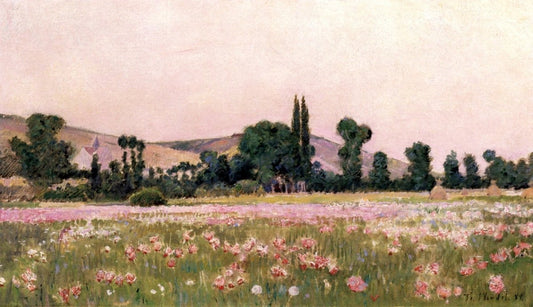
Wendel, Theodore (1857-1932) - Flowering Fields, Giverny 1889
Vendor:Digital Download - 1 imageRegular price £0.80Regular priceUnit price per -

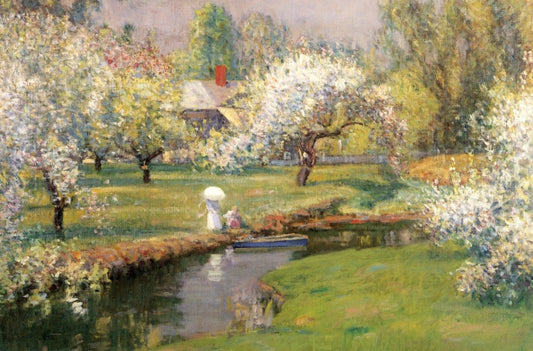
Wendel, Theodore (1857-1932) - Lady with a Parasol by a Stream 1889
Vendor:Digital Download - 1 imageRegular price £0.80Regular priceUnit price per


Latest Picture Trove Blog Posts
View all-

William Morris’s Strawberry Thief: The Story Behind a Classic Arts and Crafts Pattern
Few William Morris designs are as instantly recognisable as Strawberry Thief. With its richly patterned foliage, small red strawberries and watchful birds hidden among curling leaves, it has become one of the most loved designs of the Arts and Crafts movement.
William Morris’s Strawberry Thief: The Story Behind a Classic Arts and Crafts Pattern
Few William Morris designs are as instantly recognisable as Strawberry Thief. With its richly patterned foliage, small red strawberries and watchful birds hidden among curling leaves, it has become one of the most loved designs of the Arts and Crafts movement.
-

Glasgow and the Mackintosh Style
We recently took ourselves off to Scotland, and on our travels, we popped into the Mackintosh Tea Rooms in Glasgow for a bit of a nose around and a spot of lunch.
Glasgow and the Mackintosh Style
We recently took ourselves off to Scotland, and on our travels, we popped into the Mackintosh Tea Rooms in Glasgow for a bit of a nose around and a spot of lunch.
-

A Trip to Edinburgh & Glasgow, and Scottish Art
We have just returned from a well-deserved few days' break in Scotland, visiting both Edinburgh and Glasgow, taking in Scottish art and tea rooms!
A Trip to Edinburgh & Glasgow, and Scottish Art
We have just returned from a well-deserved few days' break in Scotland, visiting both Edinburgh and Glasgow, taking in Scottish art and tea rooms!


