

Abbott Handerson Thayer (1849-1921) was an American artist renowned for his evocative paintings and innovative contributions to both art and natural history. Born in Boston, Massachusetts, Thayer displayed an early interest in drawing and nature, which would later become central themes throughout his life’s work. Although his career spanned the turn of the twentieth century and was rooted in the United States, Thayer’s artistic influence and ideas found recognition internationally, including in Britain.
Thayer’s early artistic training was shaped by his studies at the Brooklyn Art School and later at the National Academy of Design in New York. He was also influenced by the French academic tradition after a period of study in Paris. Upon returning to America, Thayer established himself as a portraitist, but his deepest passions lay in the realm of symbolic and allegorical painting. His works often featured ethereal figures, predominantly women and angels, set against natural backdrops. These compositions, executed in a style combining realism with mystical overtones, are now considered exemplary of American Symbolism.
One of Thayer’s most significant contributions was his exploration of the concept of camouflage in nature, particularly in birds and animals. Fascinated by the protective colouration of wildlife, he theorised that animals’ markings served as a form of concealment, a revolutionary idea at the time. Thayer published his observations in “Concealing-Coloration in the Animal Kingdom” (1909), co-authored with his son Gerald. This book not only influenced naturalists but also had a profound impact on military camouflage during the First World War. Thayer’s proposals for camouflage techniques were taken seriously by the British military; he even visited Britain to promote his ideas, though not all of his theories were adopted.
Despite his scientific pursuits, Thayer continued to paint prolifically. His most celebrated works include the series of angel paintings, such as “Angel” (1887), which depict serene, winged figures that have become iconic. These paintings reflect Thayer’s preoccupation with themes of purity, protection, and the spiritual beauty of nature.
Thayer was a complex figure, at once a visionary artist and an eccentric naturalist. He suffered from bouts of mental illness throughout his life, which at times affected his output and relationships. Nevertheless, his legacy endures through his art and his pioneering work in camouflage, bridging the fields of aesthetics and science in a manner that was ahead of his time. Today, Abbott Handerson Thayer is remembered as a singular figure whose creative and intellectual curiosity left a lasting mark on both art and natural history.
Images to download
-

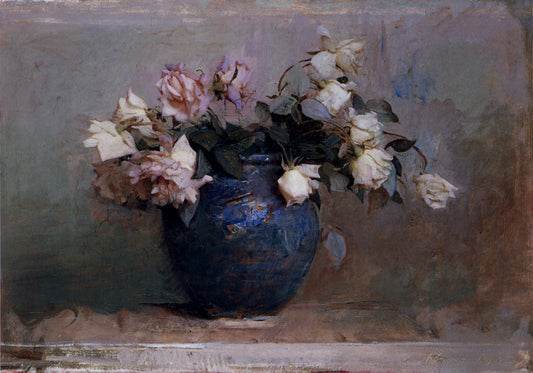
Thayer, Abbott Handerson (1849-1921) - Roses 1890
Vendor:Digital Download - 1 imageRegular price £0.80Regular priceUnit price per -

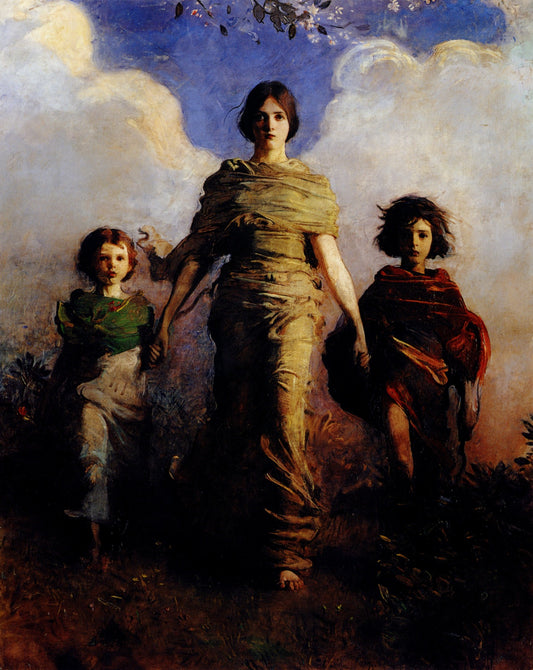
Thayer, Abbott Handerson (1849-1921) - A Virgin c.1892-93
Vendor:Digital Download - 1 imageRegular price £0.80Regular priceUnit price per


Latest Picture Trove Blog Posts
View all-

William Morris’s Strawberry Thief: The Story Behind a Classic Arts and Crafts Pattern
Few William Morris designs are as instantly recognisable as Strawberry Thief. With its richly patterned foliage, small red strawberries and watchful birds hidden among curling leaves, it has become one of the most loved designs of the Arts and Crafts movement.
William Morris’s Strawberry Thief: The Story Behind a Classic Arts and Crafts Pattern
Few William Morris designs are as instantly recognisable as Strawberry Thief. With its richly patterned foliage, small red strawberries and watchful birds hidden among curling leaves, it has become one of the most loved designs of the Arts and Crafts movement.
-

Glasgow and the Mackintosh Style
We recently took ourselves off to Scotland, and on our travels, we popped into the Mackintosh Tea Rooms in Glasgow for a bit of a nose around and a spot of lunch.
Glasgow and the Mackintosh Style
We recently took ourselves off to Scotland, and on our travels, we popped into the Mackintosh Tea Rooms in Glasgow for a bit of a nose around and a spot of lunch.
-

A Trip to Edinburgh & Glasgow, and Scottish Art
We have just returned from a well-deserved few days' break in Scotland, visiting both Edinburgh and Glasgow, taking in Scottish art and tea rooms!
A Trip to Edinburgh & Glasgow, and Scottish Art
We have just returned from a well-deserved few days' break in Scotland, visiting both Edinburgh and Glasgow, taking in Scottish art and tea rooms!


