

George "Sidney" Shepherd (1784-1862) was a British draughtsman and watercolourist. At one time, George Shepherd and George Sidney Shepherd were thought to be two different people; it is now believed that they are the same person.
Shepherd was a topographical, architectural and landscape painter. Until 1793, he lived in France (where his younger brother was born), returning to Britain on the outbreak of the Great French War. Shepherd was awarded a silver palette by the Society of Arts in 1803 and again in the following year.
He was a contributor to John Britton's The Architectural Antiquities of Great Britain, vol IV, in the early 19th century. He first married in 1812, Anna Sarah Lonnon of Bedfordshire. He Illustrated, with others, Architectura Ecclesiastica Londini (1819) by Charles Clarke. He worked on and off throughout his career with publisher Rudolph Ackermann, who published a series of street views, Ackermann's Repository of Arts, containing illustrations from both George and his brother, Thomas Hosmer Shepherd.
In 1831, Shepherd was one of the founder members of the resurrected New Society of Painters in Watercolours (now the Royal Institute of Painters in Water Colours). The society was first formed in 1807 as a result of the Royal Academy (of Arts) refusing to accept watercolours as an important contribution to art. The society attracted leading watercolour artists of that period, including David Cox, Peter De Wint, William Blake, Samuel Prout, Paul Sandby and Joseph Powell. It closed in 1812 due to financial problems. In 1850, there was a movement to expel Shepherd from the resurrected society for non-payment of dues, but on further investigation, he was deemed to be impoverished and was instead made an Honorary Member. 10 years later, he became bedridden and was granted a pension.
Images to download
-

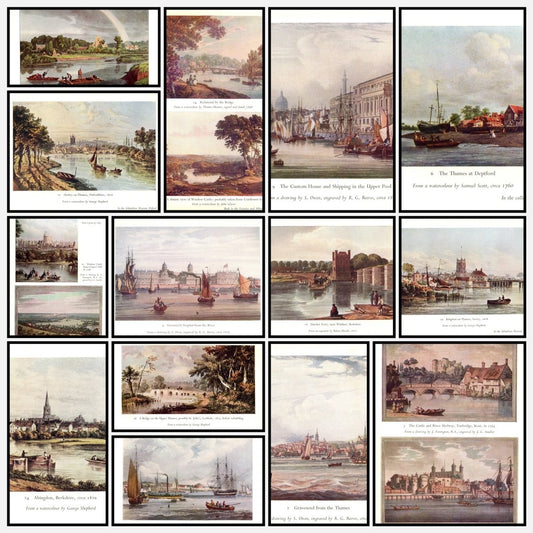
Thames, The 1951 - Various artists - 18 images
Vendor:Digital Download - 18 imagesRegular price £2.00Regular priceUnit price per

Latest Picture Trove Blog Posts
View all-

William Morris’s Strawberry Thief: The Story Behind a Classic Arts and Crafts Pattern
Few William Morris designs are as instantly recognisable as Strawberry Thief. With its richly patterned foliage, small red strawberries and watchful birds hidden among curling leaves, it has become one of the most loved designs of the Arts and Crafts movement.
William Morris’s Strawberry Thief: The Story Behind a Classic Arts and Crafts Pattern
Few William Morris designs are as instantly recognisable as Strawberry Thief. With its richly patterned foliage, small red strawberries and watchful birds hidden among curling leaves, it has become one of the most loved designs of the Arts and Crafts movement.
-

Glasgow and the Mackintosh Style
We recently took ourselves off to Scotland, and on our travels, we popped into the Mackintosh Tea Rooms in Glasgow for a bit of a nose around and a spot of lunch.
Glasgow and the Mackintosh Style
We recently took ourselves off to Scotland, and on our travels, we popped into the Mackintosh Tea Rooms in Glasgow for a bit of a nose around and a spot of lunch.
-

A Trip to Edinburgh & Glasgow, and Scottish Art
We have just returned from a well-deserved few days' break in Scotland, visiting both Edinburgh and Glasgow, taking in Scottish art and tea rooms!
A Trip to Edinburgh & Glasgow, and Scottish Art
We have just returned from a well-deserved few days' break in Scotland, visiting both Edinburgh and Glasgow, taking in Scottish art and tea rooms!


