

Horace Pippin (1888-1946) was an influential African American artist whose evocative paintings offer a powerful commentary on life in the United States during the early twentieth century. Born in West Chester, Pennsylvania, Pippin’s early life was marked by hardship and limited formal education. Despite these challenges, he developed a passion for drawing as a child, often using whatever materials he could find to express himself artistically.
Pippin’s adult life was transformed by his service in the First World War. He enlisted in the 369th Infantry Regiment, famously known as the “Harlem Hellfighters,” and served with distinction on the Western Front. During the war, he was severely wounded in his right arm, an injury that would impact him for the rest of his life. Nevertheless, Pippin’s determination to paint remained undiminished. He taught himself to use his left hand to support and guide his injured right arm, allowing him to continue creating art despite his disability.
Pippin began painting seriously in the late 1920s, initially producing works for his own satisfaction. His paintings, characterised by bold colours, strong lines, and a distinctive sense of composition, soon attracted the attention of the art world. He drew inspiration from his personal experiences, African American history, and scenes of everyday life. Notable works such as “Cabin in the Cotton” and “John Brown Going to His Hanging” showcase his commitment to depicting the complexities of American society, including themes of racial injustice and the legacy of slavery.
Pippin’s style is often described as folk art or naïve art, yet his work transcends such labels through its emotional depth and technical skill. He was not formally trained, which lent his paintings a unique perspective unbounded by academic convention. Critics and collectors alike were captivated by his ability to convey powerful stories with apparent simplicity. His first solo exhibition was held in 1937 at the West Chester Community Centre, and soon after, his reputation grew nationally, leading to exhibitions at major museums such as the Museum of Modern Art in New York.
Horace Pippin’s legacy endures as a testament to creativity, resilience, and the human spirit. He overcame adversity to create a body of work that continues to resonate with audiences, offering poignant insights into American life and history from the perspective of a remarkable and singular artist.
Images to download
-

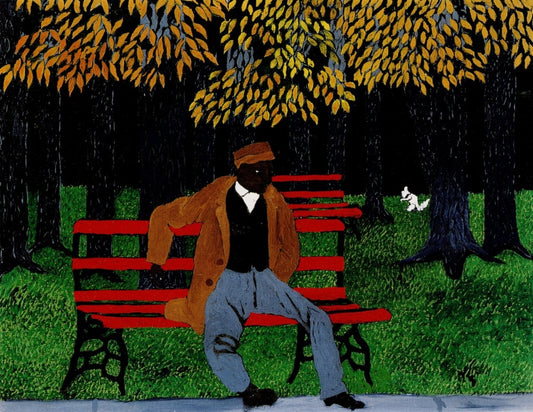
Pippin, Horace (1888-1946) - Man on a Bench (self-portrait) 1946
Vendor:Digital Download - 1 imageRegular price £0.80Regular priceUnit price per

Latest Picture Trove Blog Posts
View all-

William Morris’s Strawberry Thief: The Story Behind a Classic Arts and Crafts Pattern
Few William Morris designs are as instantly recognisable as Strawberry Thief. With its richly patterned foliage, small red strawberries and watchful birds hidden among curling leaves, it has become one of the most loved designs of the Arts and Crafts movement.
William Morris’s Strawberry Thief: The Story Behind a Classic Arts and Crafts Pattern
Few William Morris designs are as instantly recognisable as Strawberry Thief. With its richly patterned foliage, small red strawberries and watchful birds hidden among curling leaves, it has become one of the most loved designs of the Arts and Crafts movement.
-

Glasgow and the Mackintosh Style
We recently took ourselves off to Scotland, and on our travels, we popped into the Mackintosh Tea Rooms in Glasgow for a bit of a nose around and a spot of lunch.
Glasgow and the Mackintosh Style
We recently took ourselves off to Scotland, and on our travels, we popped into the Mackintosh Tea Rooms in Glasgow for a bit of a nose around and a spot of lunch.
-

A Trip to Edinburgh & Glasgow, and Scottish Art
We have just returned from a well-deserved few days' break in Scotland, visiting both Edinburgh and Glasgow, taking in Scottish art and tea rooms!
A Trip to Edinburgh & Glasgow, and Scottish Art
We have just returned from a well-deserved few days' break in Scotland, visiting both Edinburgh and Glasgow, taking in Scottish art and tea rooms!


