

Otto Mueller (1874-1930) was a German painter and printmaker of the Die Brücke expressionist movement.
Mueller was born in Liebau (now Lubawka, Kamienna Góra County), Kreis Landeshut, Silesia. Between 1890 and 1892 he was trained in lithography in Görlitz and Breslau. From 1894 to 1896 he studied at the Academy of Fine Arts in Dresden under Georg Freyer and continued his study in Munich during 1898. He left Munich's academy after Franz von Stuck classified him as untalented.
His early works are influenced by impressionism, Jugendstil and Symbolism. However, much of his early work is lost due to his own destruction of his early pieces. When he settled in Berlin in 1908, his style became more expressionist. In 1910, he joined 'Die Brücke', a Dresden-based group of Expressionist artists, and in 1911 worked and travelled with Ernst Ludwig Kirchner, Max Pechstein, and Erich Heckel. He continued his close association with Kirchner and Heckel after Brücke disbanded in 1913. At the same time Mueller also had contact with the artists group 'Der Blaue Reiter'. Mueller was known as vehemently anti-bourgeois and is said to have urinated on the floor of a middle-class household when he was invited for a dinner party.
During World War I he fought as a German soldier in France and Russia. After the war he became a professor at the Academy of Arts (Akademie der Bildenden Kunste) in Breslau where he taught until his death on 24 September 1930. Johnny Friedlaender and Isidor Ascheim were among his pupils there.
In 1937 the Nazis seized 357 of his works from German museums as "degenerate art". They also looted Mueller's artworks from Jewish collectors like the Littmanns. Other Muellers were lost or stolen during the war. Several artworks by Mueller turned up in the Gurlitt hoard.
Mueller was one of the most lyrical of German expressionist painters. The main topic of Mueller's works is the unity of humans and nature; his paintings emphasise a harmonious simplification of form, colour and contours. He is known especially for his characteristic paintings of nudes and Romani women; his nickname was "Gypsy Mueller" and his mother was perhaps Romani. Mueller greatly admired Egyptian art and likened his use of simple clean lines to the ancient style. The medium he preferred for his paintings was distemper on coarse canvas, which produced a mat surface. Altogether his printmaking amounted to 172 prints, nearly all of them lithographs, but including a few woodcuts and etchings.
Images to download
-


Mueller, Otto (1874-1930) - Bathers 1920
Vendor:Digital Download - 1 imageRegular price £0.80Regular priceUnit price per -


Mueller, Otto (1874-1930) - Gipsies with Sunflowers 1927
Vendor:Digital Download - 1 imageRegular price £0.80Regular priceUnit price per -


Mueller, Otto (1874-1930) - Lovers 1919
Vendor:Digital Download - 1 imageRegular price £0.80Regular priceUnit price per -

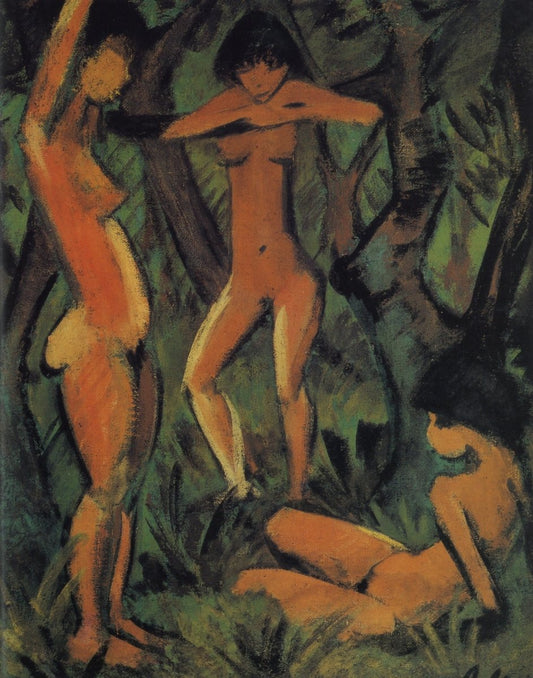
Mueller, Otto (1874-1930) - Three Nudes in the Forest 1911
Vendor:Digital Download - 1 imageRegular price £0.80Regular priceUnit price per -


Mueller, Otto (1874-1930) - Two Sisters 1920
Vendor:Digital Download - 1 imageRegular price £0.80Regular priceUnit price per -


Nudes in Art - 100 High Resolution Images
Vendor:Digital Download - 100 imagesRegular price £5.00Regular priceUnit price per


Latest Picture Trove Blog Posts
View all-

William Morris’s Strawberry Thief: The Story Behind a Classic Arts and Crafts Pattern
Few William Morris designs are as instantly recognisable as Strawberry Thief. With its richly patterned foliage, small red strawberries and watchful birds hidden among curling leaves, it has become one of the most loved designs of the Arts and Crafts movement.
William Morris’s Strawberry Thief: The Story Behind a Classic Arts and Crafts Pattern
Few William Morris designs are as instantly recognisable as Strawberry Thief. With its richly patterned foliage, small red strawberries and watchful birds hidden among curling leaves, it has become one of the most loved designs of the Arts and Crafts movement.
-

Glasgow and the Mackintosh Style
We recently took ourselves off to Scotland, and on our travels, we popped into the Mackintosh Tea Rooms in Glasgow for a bit of a nose around and a spot of lunch.
Glasgow and the Mackintosh Style
We recently took ourselves off to Scotland, and on our travels, we popped into the Mackintosh Tea Rooms in Glasgow for a bit of a nose around and a spot of lunch.
-

A Trip to Edinburgh & Glasgow, and Scottish Art
We have just returned from a well-deserved few days' break in Scotland, visiting both Edinburgh and Glasgow, taking in Scottish art and tea rooms!
A Trip to Edinburgh & Glasgow, and Scottish Art
We have just returned from a well-deserved few days' break in Scotland, visiting both Edinburgh and Glasgow, taking in Scottish art and tea rooms!


