
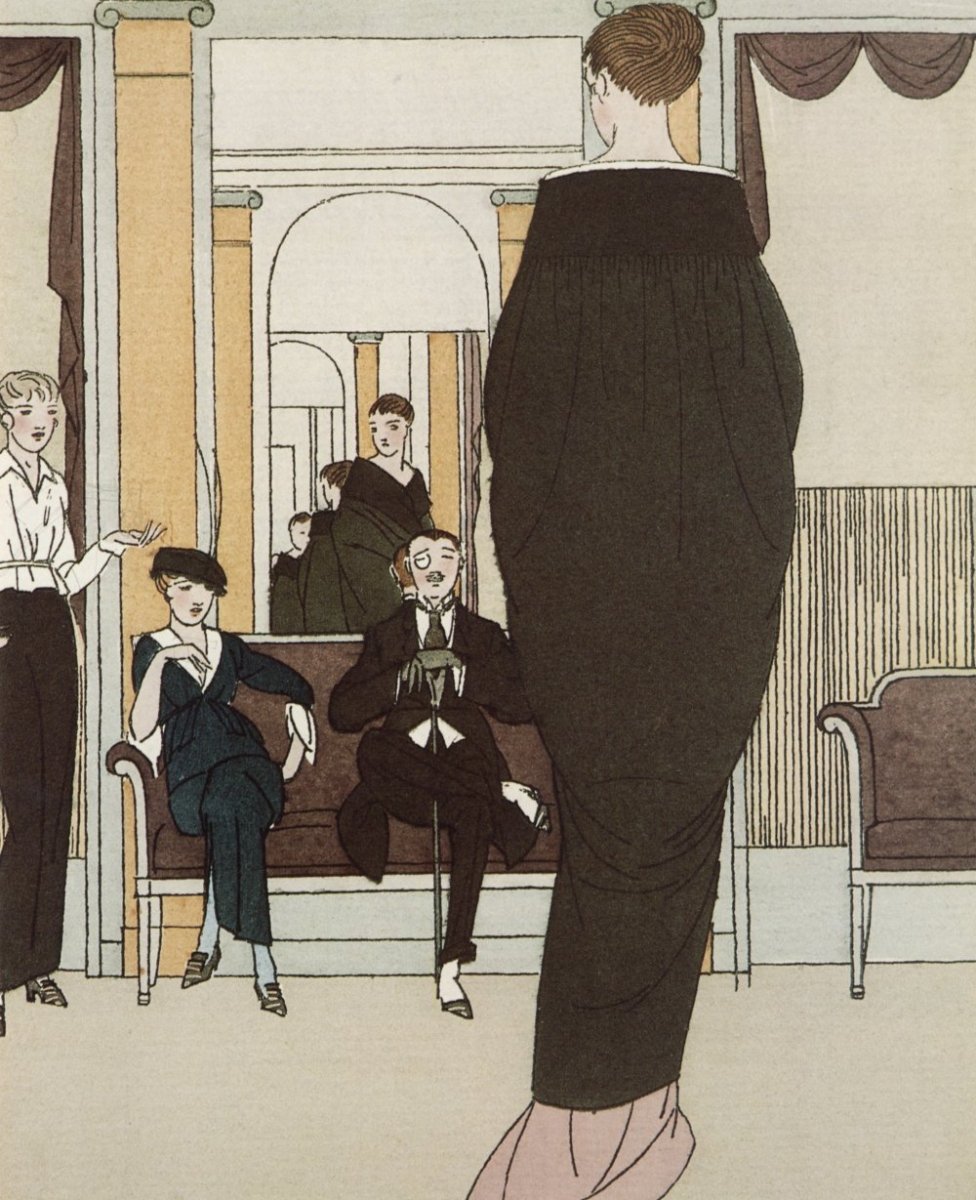
Bernard Boutet de Monvel (1881-1949) was a French painter, sculptor, engraver, fashion illustrator and interior decorator. Although first known for his etchings, he earned notability for his paintings, especially his geometric paintings from the 1900s and his Moroccan paintings made during World War I. In both Europe and the United States, where he often travelled, he also became known as a portrait painter for high society clients.
He was born in Paris's 4th district, the son of the painter and children's illustrator Louis-Maurice Boutet de Monvel. His brother Roger became a well-known writer. He was raised in both Paris and Nemours, and he set his sights on becoming a painter from the age of sixteen. Starting in 1897, he studied with Luc-Olivier Merson and Jean Dampt.
In 1898, he was introduced to etching by the American painter Louis McClellan Potter (1873-1912) and soon mastered the technique. Some of his earliest etchings were reminiscent of James McNeill Whistler's work.
Boutet de Monvel was simultaneously working in oil painting, especially portraits, which he began to exhibit at the Société Nationale des Beaux-Arts in 1903. He subsequently began sending works to the Salon d'Automne and the Salon des Indépendants. In 1907, he began to regularly send his works to exhibitions in the United States at the Carnegie Institute of Pittsburgh.
In 1909, Boutet de Monvel exhibited at Devambez Gallery a manifesto painting entitled Esquisse (Sketch, 1908), a portrait made using only a ruler and a pair of compasses. This geometric vision of a dandy drew critical censure and mockery of it as "rectilinear painting." Nonetheless, it laid the foundations for his signature style and helped to develop a path towards the later style known as Art Deco. Working with a refined geometric linearity, he reduced his palette to black and a few greys and earth tones handled as flat tints. He also tended to draw from a low perspective angle to accentuate the monumentality of his subjects.
For financial reasons, Boutet de Monvel also contributed illustrations, especially fashion drawings, to magazines such as Fémina, Jardin des modes nouvelles, and Gazette du Bon Ton. Among those he worked closely with were the fashion designer Paul Poiret, who was an early admirer of his talent, and the illustrator Georges Barbier, who were cofounders of the Journal des Dames et des Modes.
When war broke out in 1914, Boutet de Monvel was called up as a reservist. He was injured during the Battle of the Marne. After a brief recovery, he joined the 4th Bombardment Group as a bombardier.
After several plane accidents, Boutet de Monvel left Macedonia in June 1917 with the Légion d'Honneur award and five commendations. He was transferred to Fez, where the 551st squadron was based, in October 1917. At the request of General Lyautey, who was the Resident-General of French Morocco, he began to paint again for the first time since war had been declared. Continuing in his rectilinear style, he painted the city of Fez and its inhabitants at all hours of the day. He also painted in Rabat and Marrakesh. In the year and a half before he was demobilized in March 1919, he created a singular and powerful vision of Morocco, whose austerity kept it far from orientalist cliché.
When Boutet de Monvel returned to Paris, he took up his career as a painter again, especially as a portraitist of sportsmen and dandies. Books he illustrated included Général Bramble by André Maurois (1920) and La première traversée du Sahara (First crossing of the Sahara) by Georges Marie-Haardt and Louis Haudouin-Dubreuil (1924).
In 1929 he painted a series of New York cityscapes through which he endeavoured to capture the dehumanised modernity of a city under construction via a mixture of abstraction and photographic realism.
Back in Paris when the Second World War was declared, he opted not to leave France, and his main work during the war involved a series on secondhand booksellers along the quays of the Seine.
In 1947, the Knoedler Gallery mounted a retrospective of his work. Boutet de Monvel got back into the habit of travelling to the United States to paint portraits like that of Millicent Rogers (1949). During one of these trips between Paris and New York in 1949, he was killed when his plane crashed on Sao Miguel Island in the Azores.
Images to download
-

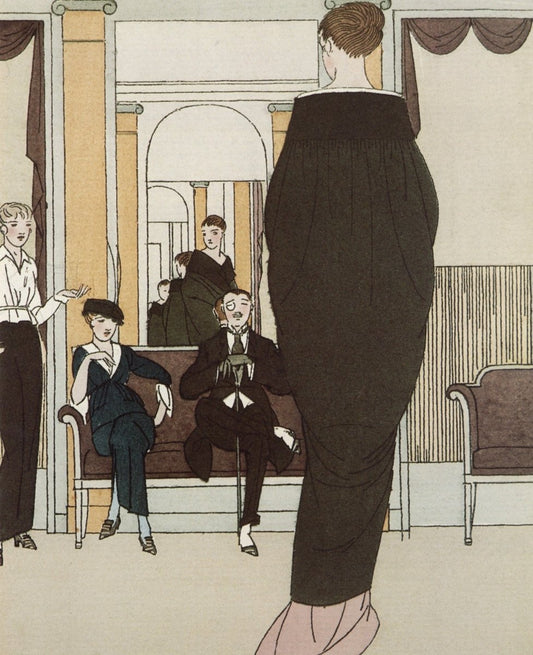
Monvel, Bernard Boutet de (1881-1949) - Le Choix Difficile 1914
Vendor:Digital Download - 1 imageRegular price £0.80Regular priceUnit price per

Latest Picture Trove Blog Posts
View all-

William Morris’s Strawberry Thief: The Story Behind a Classic Arts and Crafts Pattern
Few William Morris designs are as instantly recognisable as Strawberry Thief. With its richly patterned foliage, small red strawberries and watchful birds hidden among curling leaves, it has become one of the most loved designs of the Arts and Crafts movement.
William Morris’s Strawberry Thief: The Story Behind a Classic Arts and Crafts Pattern
Few William Morris designs are as instantly recognisable as Strawberry Thief. With its richly patterned foliage, small red strawberries and watchful birds hidden among curling leaves, it has become one of the most loved designs of the Arts and Crafts movement.
-

Glasgow and the Mackintosh Style
We recently took ourselves off to Scotland, and on our travels, we popped into the Mackintosh Tea Rooms in Glasgow for a bit of a nose around and a spot of lunch.
Glasgow and the Mackintosh Style
We recently took ourselves off to Scotland, and on our travels, we popped into the Mackintosh Tea Rooms in Glasgow for a bit of a nose around and a spot of lunch.
-

A Trip to Edinburgh & Glasgow, and Scottish Art
We have just returned from a well-deserved few days' break in Scotland, visiting both Edinburgh and Glasgow, taking in Scottish art and tea rooms!
A Trip to Edinburgh & Glasgow, and Scottish Art
We have just returned from a well-deserved few days' break in Scotland, visiting both Edinburgh and Glasgow, taking in Scottish art and tea rooms!


