

Adolph Friedrich Erdmann von Menzel (1815-1905) was a German Realist artist noted for drawings, etchings, and paintings. Along with Caspar David Friedrich, he is considered one of the two most prominent German painters of the 19th century, and was the most successful artist of his era in Germany. First known as Adolph Menzel, he was knighted in 1898 and changed his name to Adolph von Menzel.
His popularity in his native country, owing especially to his history paintings, was such that few of his major paintings left Germany, as many were quickly acquired by museums in Berlin. Menzel's graphic work (and especially his drawings) were more widely disseminated; these, along with informal paintings not initially intended for display, have largely accounted for his posthumous reputation.
Although he travelled in order to find subjects for his art, to visit exhibitions, and to meet with other artists, Menzel spent most of his life in Berlin, and was, despite numerous friendships, by his own admission detached from others. It is likely that he felt socially estranged for physical reasons alone - he had a large head, and stood about four foot six inches (137 cm).
Menzel was born to German parents in Breslau, Prussian Silesia (now Wrocław, Poland), on 8 December 1815. His father was a lithographer and intended to educate his son as a professor, but did not thwart his taste for art. After resigning his teaching post, Menzel senior set up a lithographic workshop in 1818. In 1830, the family moved to Berlin, and in 1832 Adolph was forced to take over the lithographic business on the death of his father. In 1833, he studied briefly at the Berlin Academy of Art, where he drew from plaster casts and ancient sculptures; thereafter Menzel was self-taught. Louis Friedrich Sachse of Berlin published his first work in 1833, an album of pen-and-ink drawings reproduced on stone, to illustrate Goethe's little poem, Kunstlers Erdenwallen. He executed lithographs in the same manner to illustrate Denkwürdigkeiten aus der brandenburgisch-preussischen Geschichte; The Five Senses and The Prayer, as well as diplomas for various corporations and societies.
From 1839 to 1842, he produced 400 drawings, largely introducing to Germany the technique of wood-engraving, to illustrate the Geschichte Friedrichs des Grossen (History of Frederick the Great) by Franz Kugler. He subsequently brought out Friedrichs der Grossen Armee in ihrer Uniformirung (The Uniforms of the Army under Frederick the Great), Soldaten Friedrichs der Grossen (The Soldiers of Frederick the Great); and finally, by order of King Frederick William IV, he illustrated the works of Frederick the Great, Illustrationen zu den Werken Friedrichs des Grossen (1843-1849). The artist had a deep sympathy for the Prussian king. In one of his letters to Johann Jakob Weber, he said that it was his intention to represent the monarch as a man who was both hated and admired, simply as he was, in other words, as a man of the people. Through these works, Menzel established his claim to be considered one of the first, if not actually the first, of the illustrators of his day in his own line.
Menzel's fame came from his illustrations of the 18th-century Prussian monarch, Frederick the Great. As well as dedication to adding historical accuracy and attention to detail. Menzel also made sure to do research on the items he was painting. From 1840 and onward Menzel became admirable for his small paintings and drawings. In which he depicted his unconventional ideas.
In the meantime, Menzel had also begun to study, unaided, the art of painting, and he soon produced a great number and variety of pictures. His paintings consistently demonstrated keen observation and honest workmanship in subjects dealing with the life and achievements of Frederick the Great, and scenes of everyday life, such as In the Tuileries, The Ball Supper, and At Confession. Among those considered most important of these works are Iron Rolling Mill (1872-1875) and The Market-place at Verona. When invited to paint The Coronation of William I at Koenigsberg, he produced an exact representation of the ceremony without regard to the traditions of official painting.
During Menzel's life, his paintings were appreciated by Otto von Bismarck and William I, and after his death they were appropriated for use as electoral posters by Adolf Hitler.
Images to download
-

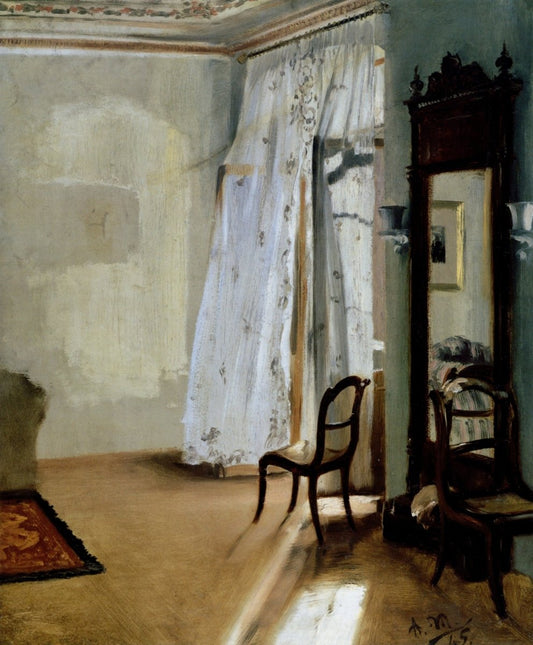
Menzel, Adolph von (1815-1905) - The Balcony Room 1845
Vendor:Digital Download - 1 imageRegular price £0.80Regular priceUnit price per -

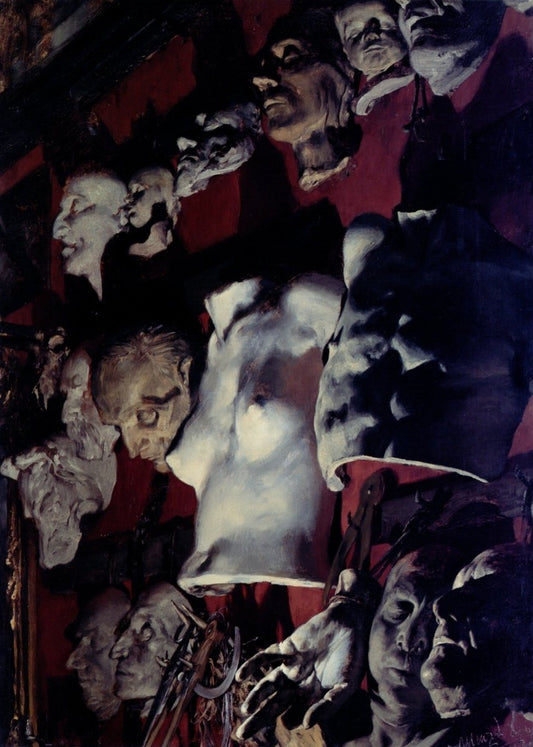
Menzel, Adolph von (1815-1905) - The Studio Wall 1872
Vendor:Digital Download - 1 imageRegular price £0.80Regular priceUnit price per -

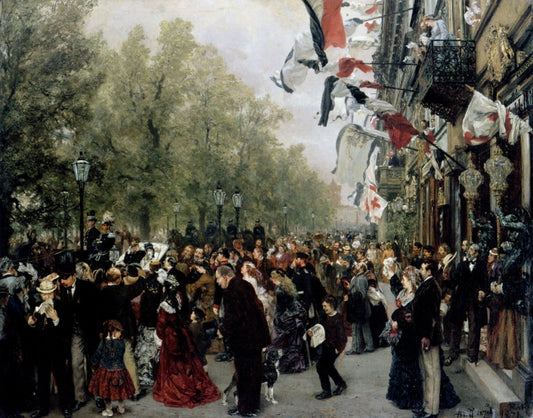
Menzel, Adolph von (1815-1905) - Departure of William I for the front 1870
Vendor:Digital Download - 1 imageRegular price £0.80Regular priceUnit price per


Latest Picture Trove Blog Posts
View all-

William Morris’s Strawberry Thief: The Story Behind a Classic Arts and Crafts Pattern
Few William Morris designs are as instantly recognisable as Strawberry Thief. With its richly patterned foliage, small red strawberries and watchful birds hidden among curling leaves, it has become one of the most loved designs of the Arts and Crafts movement.
William Morris’s Strawberry Thief: The Story Behind a Classic Arts and Crafts Pattern
Few William Morris designs are as instantly recognisable as Strawberry Thief. With its richly patterned foliage, small red strawberries and watchful birds hidden among curling leaves, it has become one of the most loved designs of the Arts and Crafts movement.
-

Glasgow and the Mackintosh Style
We recently took ourselves off to Scotland, and on our travels, we popped into the Mackintosh Tea Rooms in Glasgow for a bit of a nose around and a spot of lunch.
Glasgow and the Mackintosh Style
We recently took ourselves off to Scotland, and on our travels, we popped into the Mackintosh Tea Rooms in Glasgow for a bit of a nose around and a spot of lunch.
-

A Trip to Edinburgh & Glasgow, and Scottish Art
We have just returned from a well-deserved few days' break in Scotland, visiting both Edinburgh and Glasgow, taking in Scottish art and tea rooms!
A Trip to Edinburgh & Glasgow, and Scottish Art
We have just returned from a well-deserved few days' break in Scotland, visiting both Edinburgh and Glasgow, taking in Scottish art and tea rooms!


