

John Lindley FRS (1799-1865) was an English botanist, gardener and orchidologist.
Born in Catton, near Norwich, England, John Lindley was one of four children of George and Mary Lindley. George Lindley was a nurseryman and pomologist and ran a commercial nursery garden. Although he had great horticultural knowledge, the undertaking was not profitable and George lived in a state of indebtedness. As a boy, John would assist in the garden and also collected wild flowers he found growing in the Norfolk countryside. Lindley was educated at Norwich School. He would have liked to go to university or to buy a commission in the army but the family could not afford either. He became Belgian agent for a London seed merchant in 1815.
At this time Lindley became acquainted with the botanist William Jackson Hooker who allowed him to use his botanical library and who introduced him to Sir Joseph Banks who offered him employment as an assistant in his herbarium. His first publication, in 1819, a translation of the Analyse du fruit by Louis Claude Richard, was followed in 1820 by an original Monographia Rosarum, with descriptions of new species, and drawings executed by himself, then in 1821 by Monographia Digitalium and Observations on Pomaceae, which were both contributed to the Linnean Society.
Lindley went to work at Banks' house in London. He concentrated on the genera Rosa and Digitalis and published the monograph "A Botanical History of Roses" which distinguished seventy-six species, describes thirteen new ones and was illustrated by nineteen coloured plates painted by himself. He became acquainted with Joseph Sabine who grew a large assortment of roses and was the Secretary of the Horticultural Society of London. His employment came to an abrupt end with the death of Banks a few months later. One of Banks' friends, a wealthy merchant called William Cattley, paid Lindley to draw and describe new plants in his garden at Barnet. He also paid for the publication of "Digitalia Monographia". (Later Lindley honoured him by naming the orchid genus Cattleya after him.) In 1820, at the age of twenty-one, Lindley was elected a fellow of the Linnean Society of London.
From 1821 to 1826 he published a folio work with coloured illustrations that he had painted himself, "Collectanea botanica or Figures and botanic Illustrations of rare and curious exotic Plants". Many of these plants came from the family Orchidaceae with which he had a lifelong fascination.
Lindley was appointed assistant secretary to the Royal Horticultural Society and its new garden at Chiswick in 1822, where he supervised the collection of plants.
Assistant secretary to the Horticultural Society since 1822, in 1829 Lindley was appointed to the chair of botany at University College, London, which he retained until 1860. He also lectured on botany from 1831 at the Royal Institution, including delivering the 1833 Royal Institution Christmas Lecture, and from 1836 at the Chelsea Physic Garden, starting the society's flower show in the late 1830s.
Lindley described the plants collected on Thomas Livingstone Mitchell's expeditions of 1838 and wrote an Appendix to Edwards's Botanical Register of 1839, describing plants collected by James Drummond and Georgiana Molloy of the Swan River Colony in Western Australia. According to John Ryan, Lindley's 1840 'Sketch of the Vegetation of the Swan River Colony' provided 'the most succinct portrait to date of the flora of the Swan River Settlement', which had been established in 1829. The Sketch, which was published during November 1839 and January 1840 in Edwards' Botanical Register and separately on its completion, was illustrated by nine hand-coloured lithographs and four wood-cuts.
During his professorship, he wrote many scientific and popular works as well as making significant contributions to the Botanical Register, of which he was the editor for many years, and to The Gardeners' Chronicle, which he co-founded with Joseph Paxton, William Bradbury and Wentworth Dilke, and where he was in charge of the horticultural department from 1841. He was a fellow of the Royal, Linnean and Geological Societies. He received the Royal Society's royal medal in 1857, and in 1853 became a corresponding member of the Institut de France. In 1862, he was elected as a member of the American Philosophical Society.
About this time, the Horticultural Society of London asked Lindley to draw roses and in 1822 he became the Assistant Secretary of the Society's garden. Now with a steady income, in 1823 he married Sarah Freestone (1797-1869). They rented a house in rural Acton Green, a location convenient for the Society's garden at Turnham Green.
The Secretary of the Horticultural Society of London at that time was Joseph Sabine and he authorised expenditure on large projects beyond the Society's means. Lindley could only expostulate and was unsuccessful in moderating his actions. By 1830, the Society had mounting debts and a committee of enquiry was set up. Sabine resigned as Secretary and Lindley successfully defended his own position and carried the Society forward with the new Honorary Secretary, George Bentham.
An eminent botanist of the time, John Claudius Loudon, sought Lindley's collaboration on his "Encyclopedia of Plants". This covered nearly fifteen thousand species of flowering plants and ferns. It was a massive undertaking and Lindley was responsible for most of it.
After the death of Joseph Banks and the death also of their patron, King George III, the Royal Botanic Gardens at Kew went into a decline. The Government commissioned a report on their future to be prepared by Lindley, Joseph Paxton and John Wilson, head gardener to the Earl of Surrey. The report recommended that the Gardens be retained but the Government did not accept their findings and proposed to abolish it, distribute the plants and pull down the glasshouses. On 11 February 1840, Lindley told the Prime Minister that the matter was to be raised in Parliament. This caused an outcry. The public was indignant, the Government backed down and the Gardens were saved. William Jackson Hooker was appointed to be the new Director.
Lindley was very industrious and published a number of works including The Genera and Species of Orchidaceous Plants, the writing of which occupied him for ten years. He was acknowledged to be the top authority on the classification of orchids of his time. Bentham and Hooker, writing in 1883, accepted 114 genera he had named and described, and Pfitzer, in 1889, accepted 127. Over many years, Lindley had described a large number of orchid species, and many other plants, naming them and giving each a concise description of the plant's characteristics.
In 1863, he travelled to Vichy, a spa in the centre of France, but his health continued to decline. He died at his home at Acton Green, near London, aged 66. He was survived by his wife, two daughters including Sarah Lindley Crease and a son. The daughters were accomplished artists themselves and the son, Nathaniel, became a distinguished lawyer, the Master of the Rolls and a life peer.
Images to download
-

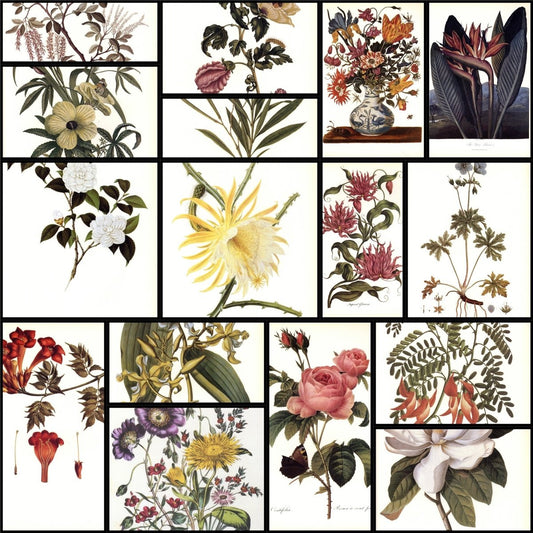
Botanical Prints - 40 High Resolution Images
Vendor:Digital Download - 40 imagesRegular price £4.00Regular priceUnit price per -

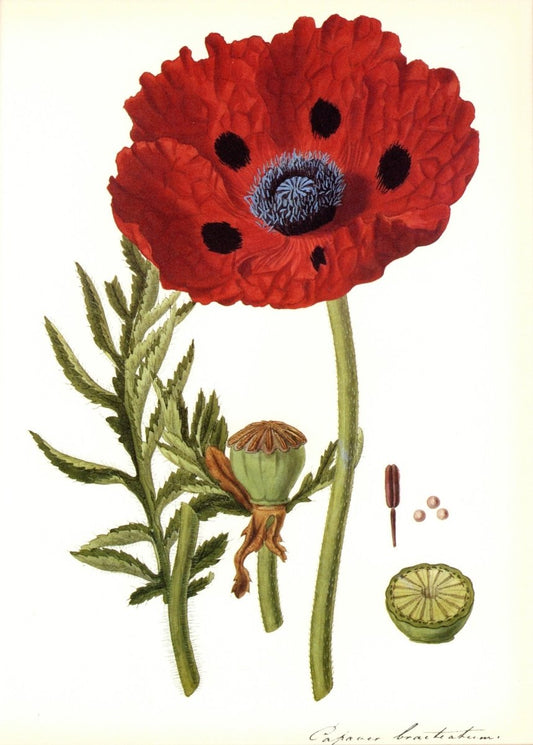
Lindley, John (1799-1865) - Great Scarlet Poppy 1821
Vendor:Digital Download - 1 imageRegular price £0.80Regular priceUnit price per


Latest Picture Trove Blog Posts
View all-

William Morris’s Strawberry Thief: The Story Behind a Classic Arts and Crafts Pattern
Few William Morris designs are as instantly recognisable as Strawberry Thief. With its richly patterned foliage, small red strawberries and watchful birds hidden among curling leaves, it has become one of the most loved designs of the Arts and Crafts movement.
William Morris’s Strawberry Thief: The Story Behind a Classic Arts and Crafts Pattern
Few William Morris designs are as instantly recognisable as Strawberry Thief. With its richly patterned foliage, small red strawberries and watchful birds hidden among curling leaves, it has become one of the most loved designs of the Arts and Crafts movement.
-

Glasgow and the Mackintosh Style
We recently took ourselves off to Scotland, and on our travels, we popped into the Mackintosh Tea Rooms in Glasgow for a bit of a nose around and a spot of lunch.
Glasgow and the Mackintosh Style
We recently took ourselves off to Scotland, and on our travels, we popped into the Mackintosh Tea Rooms in Glasgow for a bit of a nose around and a spot of lunch.
-

A Trip to Edinburgh & Glasgow, and Scottish Art
We have just returned from a well-deserved few days' break in Scotland, visiting both Edinburgh and Glasgow, taking in Scottish art and tea rooms!
A Trip to Edinburgh & Glasgow, and Scottish Art
We have just returned from a well-deserved few days' break in Scotland, visiting both Edinburgh and Glasgow, taking in Scottish art and tea rooms!


