

Gerard or Gerrit van Honthorst (1592-1656) was a Dutch Golden Age painter who became known for his depiction of artificially lit scenes, eventually receiving the nickname Gherardo delle Notti ("Gerard of the Nights"). Early in his career he visited Rome, where he had great success painting in a style influenced by Caravaggio. Following his return to the Netherlands he became a leading portrait painter.
Van Honthorst was born in Utrecht, the son of a decorative painter, and trained under his father, and then under Abraham Bloemaert.
Having completed his education, Honthorst went to Italy, where he was first recorded in 1616. He was one of the artists from Utrecht who went to Rome at around this time, all of whom were to be deeply influenced by the recent art they encountered there. They were named the Utrecht caravaggisti. The other three were Dirk van Baburen, Hendrick ter Bruggen and Jan van Bijlert. In Rome he lodged at the palace of Vincenzo Giustiniani, where he painted Christ Before the High Priest, now in London's National Gallery. Giustiniani had an important art collection, and Honthorst was especially influenced by the contemporary artists, including Caravaggio, Bartolomeo Manfredi and the Carracci. He was particularly known for his depiction of artificially lit scenes. Cardinal Scipione Borghese became another important patron, securing important commissions for him at San Silvestro Della Mariro, Montecompatri, and at Santa Maria della Vittoria, Rome. He also worked for Cosimo II de' Medici, Grand Duke of Tuscany.
Honthorst returned to Utrecht in 1620, and went on to build a considerable reputation both in the Dutch Republic and abroad. In 1623, the year of his marriage, he was president of the Guild of St. Luke in Utrecht. He soon became so fashionable that Sir Dudley Carleton, then English envoy at The Hague, recommended his works to Thomas Howard, 21st Earl of Arundel. In 1626 Honthorst hosted a dinner for Peter Paul Rubens, and painted him as the honest man sought for and found by Diogenes.
Queen Elizabeth of Bohemia, sister of Charles I of England and Electress Palatine, then in exile in the Netherlands, commissioned Honthorst as a painter and employed him as a drawing-master for her children. Through her he became known to Charles, who invited him to England in 1628. There he painted several portraits, and a vast allegory, now at Hampton Court Palace, of Charles and his queen Henrietta Maria as Diana and Apollo in the clouds receiving the Duke of Buckingham as Mercury and guardian of the King of Bohemia's children. He painted a more intimate group portrait of The Four Eldest Children of the King of Bohemia, (also at Hampton Court) in which the two eldest are depicted as Diana and Apollo.
After his return to Utrecht, Honthorst retained the patronage of the English monarch, painting for him, in 1631, a large picture of the king and queen of Bohemia and all their children. At around the same time, he painted some pictures illustrating the Odyssey for Lord Dorchester, and some showing incidents of Danish history for Christian IV of Denmark. He also painted a portrait of the King's daughter, Leonora Christina Ulfeldt while she was in The Hague.
His popularity in the Netherlands was such that he opened a second studio in The Hague, where he painted portraits of members of the court, and taught drawing. These large studios, where the work included making replicas of Honthorst's royal portraits, employed a large number of pupils and assistants; according to one pupil, Joachim von Sandrart, describing his experiences in the mid-1620s, Honthorst would have about 24 students at any one time, each paying 100 guilders a year for their education.
His brother Willem van Honthorst (1594-1666) was also a portrait painter. Many of Willem's paintings were previously misattributed to Gerrit due to the similarity of their signatures. Willem was a pupil of Abraham Bloemaert, and was also taught by his own elder brother. In 1646 he went to Berlin, where he became court painter to Louise-Henriette, wife of the Elector Frederick William of Brandenburg. He returned to Utrecht in 1664.
Images to download
-

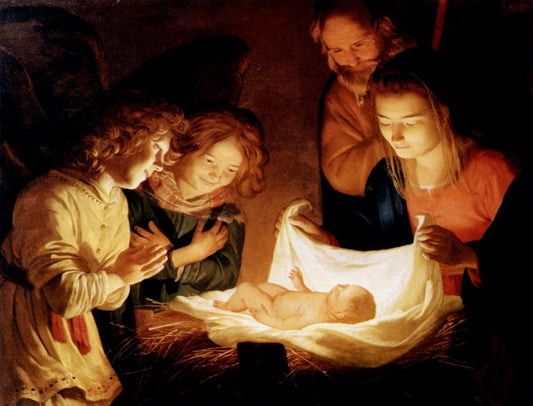
Honthorst, Gerrit van (1592-1656) - Nativity c.1620
Vendor:Digital Download - 1 imageRegular price £0.80Regular priceUnit price per -


Honthorst, Gerrit van (1592-1656) - The Procuress 1625
Vendor:Digital Download - 1 imageRegular price £0.80Regular priceUnit price per -


Honthorst, Gerrit van (1592-1656) - Charles I 1628
Vendor:Digital Download - 1 imageRegular price £0.80Regular priceUnit price per -


Honthorst, Gerrit van (1592-1656) - The Death of Seneca c.1625
Vendor:Digital Download - 2 imagesRegular price £0.80Regular priceUnit price per -


Honthorst, Gerrit van (1592-1656) - The Soldier & the Girl c.1621
Vendor:Digital Download - 1 imageRegular price £0.80Regular priceUnit price per -


Honthorst, Gerrit van (1592-1656) - The Concert 1624
Vendor:Digital Download - 1 imageRegular price £0.80Regular priceUnit price per -


Honthorst, Gerrit van (1592-1656) - Samson & Delilah c.1615
Vendor:Digital Download - 1 imageRegular price £0.80Regular priceUnit price per


Latest Picture Trove Blog Posts
View all-

William Morris’s Strawberry Thief: The Story Behind a Classic Arts and Crafts Pattern
Few William Morris designs are as instantly recognisable as Strawberry Thief. With its richly patterned foliage, small red strawberries and watchful birds hidden among curling leaves, it has become one of the most loved designs of the Arts and Crafts movement.
William Morris’s Strawberry Thief: The Story Behind a Classic Arts and Crafts Pattern
Few William Morris designs are as instantly recognisable as Strawberry Thief. With its richly patterned foliage, small red strawberries and watchful birds hidden among curling leaves, it has become one of the most loved designs of the Arts and Crafts movement.
-

Glasgow and the Mackintosh Style
We recently took ourselves off to Scotland, and on our travels, we popped into the Mackintosh Tea Rooms in Glasgow for a bit of a nose around and a spot of lunch.
Glasgow and the Mackintosh Style
We recently took ourselves off to Scotland, and on our travels, we popped into the Mackintosh Tea Rooms in Glasgow for a bit of a nose around and a spot of lunch.
-

A Trip to Edinburgh & Glasgow, and Scottish Art
We have just returned from a well-deserved few days' break in Scotland, visiting both Edinburgh and Glasgow, taking in Scottish art and tea rooms!
A Trip to Edinburgh & Glasgow, and Scottish Art
We have just returned from a well-deserved few days' break in Scotland, visiting both Edinburgh and Glasgow, taking in Scottish art and tea rooms!


