

Hector Guimard (1867-1942) was a prominent French architect and designer, most renowned for his significant contributions to the Art Nouveau movement at the turn of the twentieth century. Born in Lyon, Guimard became synonymous with the exuberant, organic style that defined Art Nouveau, and his work left an indelible mark on Paris’s architectural landscape.
Guimard trained at the École nationale supérieure des arts décoratifs and later at the École des Beaux-Arts in Paris. Early in his career, he drew inspiration from the theories of Eugène Viollet-le-Duc, advocating for the integration of structure and ornament. Guimard’s breakthrough came in 1898 with the design of the Castel Béranger, an apartment building located in the 16th arrondissement of Paris. This project, with its sinuous lines and elaborate ironwork, won him the city’s façade competition and established his reputation as a leading figure in Art Nouveau.
Perhaps Guimard’s most famous and enduring legacy is his design for the entrances to the Paris Métro. Commissioned in 1899, he created more than 140 entrances, each with distinctive cast iron forms, floral motifs, and glass canopies. These structures, with their flowing lines and naturalistic details, perfectly encapsulate the essence of Art Nouveau and have become iconic symbols of Paris. Despite initial controversy and criticism for their radical departure from traditional architectural styles, many of Guimard’s Métro entrances have survived and are cherished today.
Beyond public works, Guimard extended his artistic vision to a range of domestic projects, designing houses, apartment blocks, and even furniture and decorative objects. His approach was holistic, often overseeing every aspect of a commission, from the structural design to the smallest interior detail. This total work of art, or “Gesamtkunstwerk,” exemplified the Art Nouveau ideal of unifying art and life.
By the outbreak of the First World War, tastes had shifted, and the ornate style of Art Nouveau fell out of favour, replaced by the more restrained lines of Art Deco and modernism. Guimard’s later years were marked by relative obscurity, and he spent his final years in New York, having fled France at the onset of the Second World War for his Jewish wife’s safety.
Despite this decline, Hector Guimard’s work has enjoyed a revival since the mid-twentieth century. His fluid, imaginative forms and commitment to artistic unity continue to inspire architects and designers, securing his place as one of the most influential figures in the history of French architecture and design.
Images to download
-

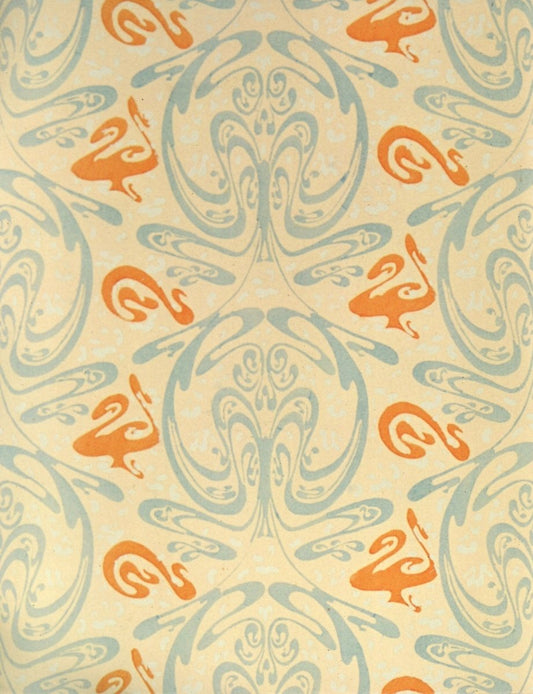
Guimard, Hector (1867-1942) - Art Nouveau Wallpaper for Castel Beranger 1895-98
Vendor:Digital Download - 1 imageRegular price £0.80Regular priceUnit price per

Latest Picture Trove Blog Posts
View all-

William Morris’s Strawberry Thief: The Story Behind a Classic Arts and Crafts Pattern
Few William Morris designs are as instantly recognisable as Strawberry Thief. With its richly patterned foliage, small red strawberries and watchful birds hidden among curling leaves, it has become one of the most loved designs of the Arts and Crafts movement.
William Morris’s Strawberry Thief: The Story Behind a Classic Arts and Crafts Pattern
Few William Morris designs are as instantly recognisable as Strawberry Thief. With its richly patterned foliage, small red strawberries and watchful birds hidden among curling leaves, it has become one of the most loved designs of the Arts and Crafts movement.
-

Glasgow and the Mackintosh Style
We recently took ourselves off to Scotland, and on our travels, we popped into the Mackintosh Tea Rooms in Glasgow for a bit of a nose around and a spot of lunch.
Glasgow and the Mackintosh Style
We recently took ourselves off to Scotland, and on our travels, we popped into the Mackintosh Tea Rooms in Glasgow for a bit of a nose around and a spot of lunch.
-

A Trip to Edinburgh & Glasgow, and Scottish Art
We have just returned from a well-deserved few days' break in Scotland, visiting both Edinburgh and Glasgow, taking in Scottish art and tea rooms!
A Trip to Edinburgh & Glasgow, and Scottish Art
We have just returned from a well-deserved few days' break in Scotland, visiting both Edinburgh and Glasgow, taking in Scottish art and tea rooms!


