

Henri Le Fauconnier (1881-1946) was a pivotal figure in the early twentieth-century avant-garde, playing a significant role in the development of Cubism in France. Born in Hesdin, France, in 1881, Le Fauconnier originally trained in law, but his passion for art soon led him to Paris, where he immersed himself in the vibrant artistic circles of Montparnasse and Montmartre. His early work was influenced by Post-Impressionists such as Paul Cézanne, whose structural approach to painting would become a foundational element in Le Fauconnier’s own oeuvre.
By 1907, Le Fauconnier began to experiment with geometric forms and fractured perspectives, aligning himself with the nascent Cubist movement. Alongside contemporaries such as Albert Gleizes, Jean Metzinger, and Fernand Léger, he contributed to the theoretical and practical evolution of Cubism. His paintings from this period, including the celebrated “Abundance” (1910-11), are characterised by bold, block-like forms and a subdued, earthy palette, reflecting his interest in constructing pictorial space through the interplay of volume and plane.
Le Fauconnier’s artistic career reached a significant milestone in 1911, when he exhibited at the Salon des Indépendants in Paris. This exhibition is often cited as a defining moment for Cubism, as it brought together the works of several leading artists in the movement, marking Cubism’s arrival on the wider art scene. Le Fauconnier’s contributions were particularly notable for their dramatic scale and compositional complexity, which set his work apart from that of his peers.
Beyond his own practice, Le Fauconnier was an influential teacher and theorist. He taught at the Académie de La Palette, an avant-garde art school in Paris, where he mentored numerous young artists eager to explore modernist ideas. His written texts and lectures helped articulate Cubist concepts, making them accessible to a broader audience and solidifying his position as a leading voice in the movement.
During the First World War, Le Fauconnier relocated to the Netherlands, where he continued to paint and exhibit. His later works show a move towards a more expressive, figurative style, reflecting changing artistic currents in post-war Europe. Henri Le Fauconnier died in 1946, leaving behind a legacy as a pioneering Cubist whose innovative approach to form and space helped shape modern art. His contributions continue to be recognised in major museum collections and art historical scholarship.
Images to download
-

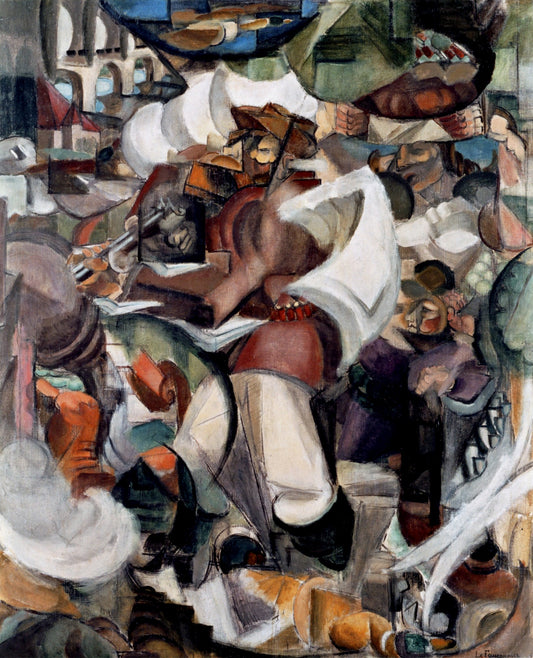
Fauconnier, Henri Le (1881-1946) - The Huntsman 1911-12
Vendor:Digital Download - 1 imageRegular price £0.80Regular priceUnit price per -


Fauconnier, Henri Le (1881-1946) - Village among the Rocks c.1910
Vendor:Digital Download - 1 imageRegular price £0.80Regular priceUnit price per -


Fauconnier, Henri Le (1881-1946) - The Signal 1915
Vendor:Digital Download - 1 imageRegular price £0.80Regular priceUnit price per -

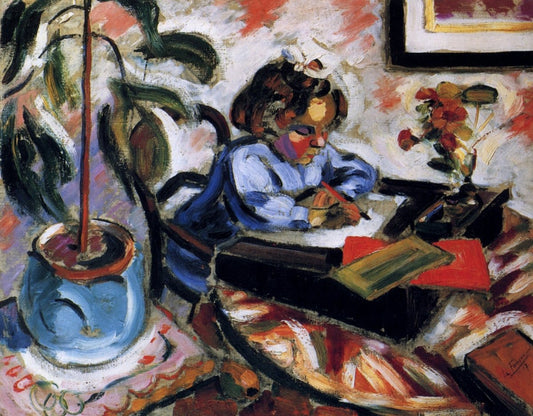
Fauconnier, Henri Le (1881-1946) - Little Schoolgirl 1907
Vendor:Digital Download - 1 imageRegular price £0.80Regular priceUnit price per -


Fauconnier, Henri Le (1881-1946) - Lake in the Mountains 1911
Vendor:Digital Download - 1 imageRegular price £0.80Regular priceUnit price per


Latest Picture Trove Blog Posts
View all-

William Morris’s Strawberry Thief: The Story Behind a Classic Arts and Crafts Pattern
Few William Morris designs are as instantly recognisable as Strawberry Thief. With its richly patterned foliage, small red strawberries and watchful birds hidden among curling leaves, it has become one of the most loved designs of the Arts and Crafts movement.
William Morris’s Strawberry Thief: The Story Behind a Classic Arts and Crafts Pattern
Few William Morris designs are as instantly recognisable as Strawberry Thief. With its richly patterned foliage, small red strawberries and watchful birds hidden among curling leaves, it has become one of the most loved designs of the Arts and Crafts movement.
-

Glasgow and the Mackintosh Style
We recently took ourselves off to Scotland, and on our travels, we popped into the Mackintosh Tea Rooms in Glasgow for a bit of a nose around and a spot of lunch.
Glasgow and the Mackintosh Style
We recently took ourselves off to Scotland, and on our travels, we popped into the Mackintosh Tea Rooms in Glasgow for a bit of a nose around and a spot of lunch.
-

A Trip to Edinburgh & Glasgow, and Scottish Art
We have just returned from a well-deserved few days' break in Scotland, visiting both Edinburgh and Glasgow, taking in Scottish art and tea rooms!
A Trip to Edinburgh & Glasgow, and Scottish Art
We have just returned from a well-deserved few days' break in Scotland, visiting both Edinburgh and Glasgow, taking in Scottish art and tea rooms!


