

Alfred Elmore RA (1815-1881) was a British history and genre painter.
Alfred Elmore was born in Clonakilty, Ireland, the son of John Richard Elmore, a surgeon who retired from the British Army to Clonakilty. His family moved to London, where Elmore studied at the Royal Academy of Arts. His early works were in the troubadour style of Richard Parkes Bonington, but he soon graduated to religious work, notably The Martyrdom of Thomas à Becket, commissioned by Daniel O'Connell for Westland Row Church in Dublin. Between 1840 and 1844, Elmore travelled across Europe, visiting Munich, Venice, Bologna, and Florence.
Elmore seems to have been associated with The Clique, a group of young artists who saw themselves as followers of Hogarth and David Wilkie. According to his friend William Powell Frith, he was a member of the group, but since it was most active while he was in continental Europe, his involvement was probably short-lived.
Most of Elmore's later works were historical narrative paintings. Religious Controversy and The Novice were implicitly anti-Catholic in character. Other paintings set episodes from Shakespeare or the history of the French Revolution. They often contained subtle explorations of the process of creation, most importantly his two paintings about technological innovation, The Invention of the Stocking Loom (1847, Nottingham Castle Museum) and The Invention of the Combing Machine (1862, Cartwright Hall, Bradford). Both portray the process of industrialisation by depicting picturesque pre-industrial handicrafts. The inventor is supposed to be pondering these manual skills while he forms in his mind a mechanism to replace them.
Elmore's best-known work is On the Brink 1865, a moral genre painting depicting a young woman who has lost her money gambling, and is 'on the brink' of responding to the blandishments of a seducer, who is depicted as a satan-like figure, luridly bathed in red light, and whispering corrupting thoughts in her ear.
By the late 1860s, Elmore was moving away from such Hogarthian subjects towards a more classical style influenced by Edward Poynter and Lawrence Alma-Tadema. He also painted Arabic figures, in line with the vogue for Orientalism in art.
Elmore suffered from neuralgia throughout much of his life, and in his later years he became lame following a bad fall from his horse. He died of cancer in January 1881 and was buried in Kensal Green Cemetery in London.
Images to download
-

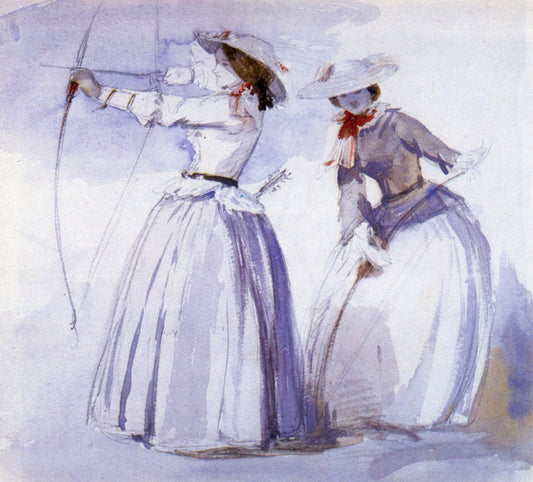
Elmore, Alfred (1815-1881) - Fair Toxophilites c.1850
Vendor:Digital Download - 1 imageRegular price £0.80Regular priceUnit price per

Latest Picture Trove Blog Posts
View all-

William Morris’s Strawberry Thief: The Story Behind a Classic Arts and Crafts Pattern
Few William Morris designs are as instantly recognisable as Strawberry Thief. With its richly patterned foliage, small red strawberries and watchful birds hidden among curling leaves, it has become one of the most loved designs of the Arts and Crafts movement.
William Morris’s Strawberry Thief: The Story Behind a Classic Arts and Crafts Pattern
Few William Morris designs are as instantly recognisable as Strawberry Thief. With its richly patterned foliage, small red strawberries and watchful birds hidden among curling leaves, it has become one of the most loved designs of the Arts and Crafts movement.
-

Glasgow and the Mackintosh Style
We recently took ourselves off to Scotland, and on our travels, we popped into the Mackintosh Tea Rooms in Glasgow for a bit of a nose around and a spot of lunch.
Glasgow and the Mackintosh Style
We recently took ourselves off to Scotland, and on our travels, we popped into the Mackintosh Tea Rooms in Glasgow for a bit of a nose around and a spot of lunch.
-

A Trip to Edinburgh & Glasgow, and Scottish Art
We have just returned from a well-deserved few days' break in Scotland, visiting both Edinburgh and Glasgow, taking in Scottish art and tea rooms!
A Trip to Edinburgh & Glasgow, and Scottish Art
We have just returned from a well-deserved few days' break in Scotland, visiting both Edinburgh and Glasgow, taking in Scottish art and tea rooms!


