

Jonathan Eastman Johnson (1824-1906) was an American painter whose career spanned much of the nineteenth century. Although he is often associated with the United States, Johnson’s artistic sensibilities and subject matter placed him among the most significant and versatile artists of his era, and his work was well-regarded both in America and abroad. He is best known for his genre scenes (paintings that depict everyday life) and his sensitive and realistic portraits.
Born in Lovell, Maine, Johnson displayed artistic talent from an early age. He began his formal training as a lithographer before moving to Boston, where he worked as a portraitist. Eager to expand his skills, Johnson travelled to Europe in 1849, an experience that proved transformative. In Germany, he studied at the Düsseldorf Academy, a centre of academic painting that emphasised meticulous technique and narrative clarity. He later spent time in The Hague, where he absorbed the influence of Dutch Golden Age painters such as Rembrandt and Vermeer. Their mastery of light, composition, and intimate subject matter left a lasting impression on Johnson’s style.
Returning to the United States in the mid-1850s, Johnson set up studios in Washington, D.C., and later in New York City. His works from this period include both portraits of prominent Americans, such as Abraham Lincoln and Nathaniel Hawthorne, and genre scenes that captured the nuances of daily life. One of his most celebrated paintings, “The Old Stagecoach” (1871), exemplifies his ability to combine technical skill with a profound sense of narrative and emotion. The painting, which depicts a group of children playing around a dilapidated coach, is suffused with nostalgia and warmth, qualities that endeared Johnson’s work to a wide audience.
Johnson also addressed more serious themes, notably in his depictions of African Americans before and after Emancipation. Paintings such as “Negro Life at the South” (1859) offered nuanced portrayals of Black Americans at a time when such representations were rare in fine art. These works, while sometimes criticised for their sentimentalism, reflected Johnson’s keen observational skills and his engagement with pressing social issues.
By the time of his death in 1906, Eastman Johnson had established himself as a leading figure in American art. His legacy endures in the collections of major museums, where his works continue to be admired for their humanity, technical excellence, and evocative portrayal of nineteenth-century life.
Images to download
-


Johnson, J. Eastman (1824-1906) - The Girl I Left Behind Me 1870-75
Vendor:Digital Download - 1 imageRegular price £0.80Regular priceUnit price per -

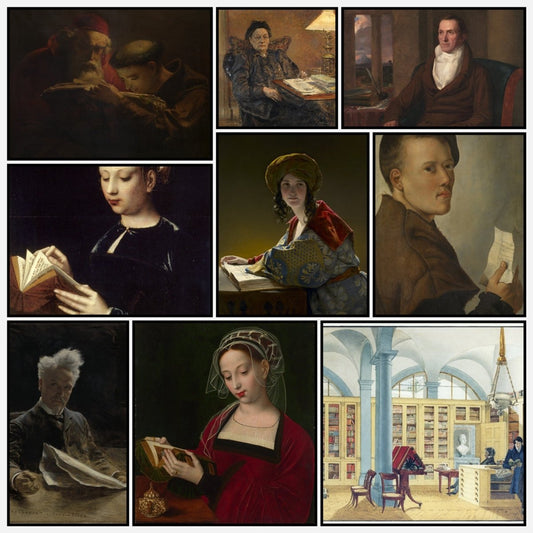
People that Read - 100 High Resolution Images
Vendor:Digital Download - 100 imagesRegular price £4.00Regular priceUnit price per


Latest Picture Trove Blog Posts
View all-

William Morris’s Strawberry Thief: The Story Behind a Classic Arts and Crafts Pattern
Few William Morris designs are as instantly recognisable as Strawberry Thief. With its richly patterned foliage, small red strawberries and watchful birds hidden among curling leaves, it has become one of the most loved designs of the Arts and Crafts movement.
William Morris’s Strawberry Thief: The Story Behind a Classic Arts and Crafts Pattern
Few William Morris designs are as instantly recognisable as Strawberry Thief. With its richly patterned foliage, small red strawberries and watchful birds hidden among curling leaves, it has become one of the most loved designs of the Arts and Crafts movement.
-

Glasgow and the Mackintosh Style
We recently took ourselves off to Scotland, and on our travels, we popped into the Mackintosh Tea Rooms in Glasgow for a bit of a nose around and a spot of lunch.
Glasgow and the Mackintosh Style
We recently took ourselves off to Scotland, and on our travels, we popped into the Mackintosh Tea Rooms in Glasgow for a bit of a nose around and a spot of lunch.
-

A Trip to Edinburgh & Glasgow, and Scottish Art
We have just returned from a well-deserved few days' break in Scotland, visiting both Edinburgh and Glasgow, taking in Scottish art and tea rooms!
A Trip to Edinburgh & Glasgow, and Scottish Art
We have just returned from a well-deserved few days' break in Scotland, visiting both Edinburgh and Glasgow, taking in Scottish art and tea rooms!


