

Arthur Wesley Dow (1857-1922) was an American painter, printmaker, photographer and arts educator.
Dow was born in Ipswich, Massachusetts, on 6th April 1857. Dow received his first art training in 1880 from Anna K. Freeland of Worcester, Massachusetts. The following year, Dow continued his studies in Boston with James M. Stone, a former student of Frank Duveneck and Gustave Bouguereau. In 1884, he went to Paris for his early art education, studying at the Académie Julian, under the supervision of the academic artists Gustave Boulanger and Jules Joseph Lefebvre.
In 1893, Dow was appointed assistant curator of the Japanese collection at the Museum of Fine Arts, Boston, under Ernest Fenellosa. Fenellosa introduced Dow to ukiyo‑e, the woodblock prints of Japan, which greatly influenced his later works.
He accepted commissions for posters and other commercial work. In 1895, he designed the poster to advertise the Journal of Modern Art, and in 1896, he designed the poster for an exhibition of Japanese prints.
Over the course of his career, Dow taught art at several major American art training institutions, beginning at Pratt Institute from 1896 to 1903. He also taught at the New York Art Students League from 1898 to 1903. In 1900, Dow founded and served as the director of the Ipswich Summer School of Art in Ipswich, Massachusetts. From 1904 to 1922, he was a professor of fine arts at Columbia University Teachers College.
Dow taught many of America's leading artists and craftspeople, including: Georgia O'Keeffe, Shirley Williamson, Charles Sheeler, Charles J. Martin, two of the Overbeck Sisters, Delle Miller, Charles Burchfield, Isabelle Percy West and Walter King Stone. One of his pupils, the educator and printmaker Pedro Joseph de Lemos, adapted and widely disseminated Dow's theories in dozens of theoretical and instructional publications (1918-1950) for art schools. Early in his career, the young Frank Lloyd Wright was influenced by Dow. Dow also influenced the Byrdcliffe Colony.
His ideas were quite revolutionary for the period; Dow taught that rather than copying nature, individuals should create art through elements of the composition, such as line, mass, and colour. He wanted leaders of the public to see that art is a living force for all in everyday life, not as a sort of traditional ornament for the few. Dow suggested that the American lack of interest in art would improve if art were presented as a means of self-expression. He wanted people to be able to include personal experience in creating art.
His ideas on art were published in his 1899 book Composition: A Series of Exercises in Art Structure for the Use of Students and Teachers.
Dow died on 13th December 1922 in his home in New York City. He was interred in the Old North Burying Ground in Ipswich, Massachusetts. He was survived by his wife, Eleanor Pearson, whom he married in 1893.
Images to download
-

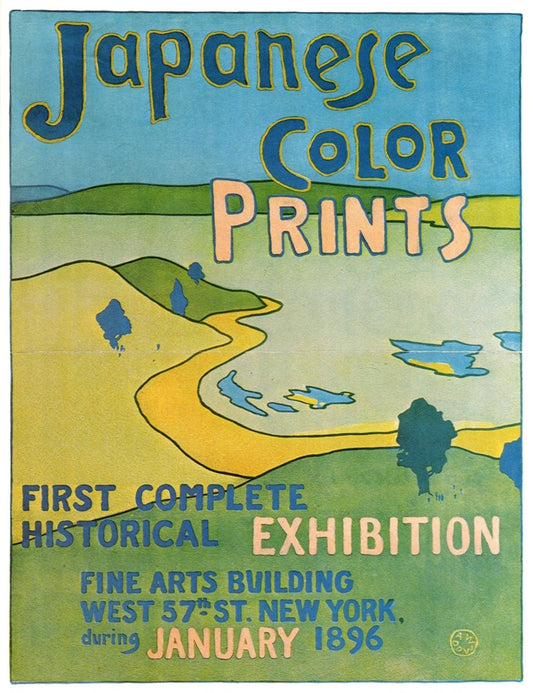
Dow, Arthur W. (1857-1922) - Japanese Print Exhibition 1896
Vendor:Digital Download - 1 imageRegular price £0.80Regular priceUnit price per -

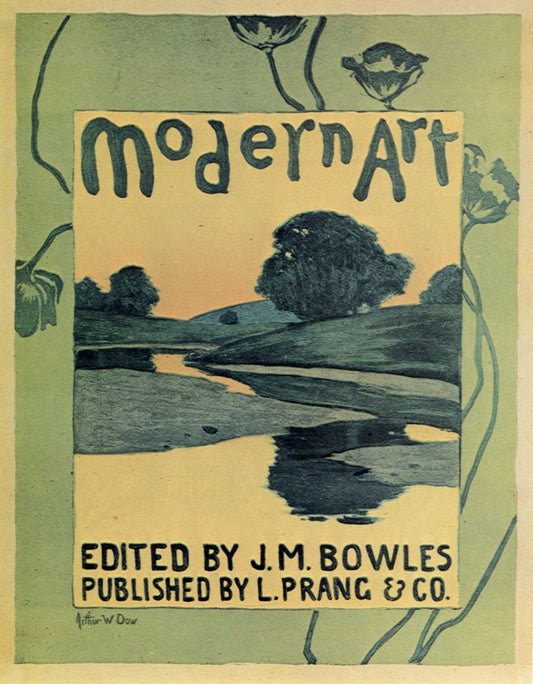
Dow, Arthur W. (1857-1922) - Modern Art 1895
Vendor:Digital Download - 1 imageRegular price £0.80Regular priceUnit price per -


Les Maîtres de l’Affiche - 256 High Resolution Images
Vendor:Digital Download - 256 imagesRegular price £6.00Regular priceUnit price per


Latest Picture Trove Blog Posts
View all-

William Morris’s Strawberry Thief: The Story Behind a Classic Arts and Crafts Pattern
Few William Morris designs are as instantly recognisable as Strawberry Thief. With its richly patterned foliage, small red strawberries and watchful birds hidden among curling leaves, it has become one of the most loved designs of the Arts and Crafts movement.
William Morris’s Strawberry Thief: The Story Behind a Classic Arts and Crafts Pattern
Few William Morris designs are as instantly recognisable as Strawberry Thief. With its richly patterned foliage, small red strawberries and watchful birds hidden among curling leaves, it has become one of the most loved designs of the Arts and Crafts movement.
-

Glasgow and the Mackintosh Style
We recently took ourselves off to Scotland, and on our travels, we popped into the Mackintosh Tea Rooms in Glasgow for a bit of a nose around and a spot of lunch.
Glasgow and the Mackintosh Style
We recently took ourselves off to Scotland, and on our travels, we popped into the Mackintosh Tea Rooms in Glasgow for a bit of a nose around and a spot of lunch.
-

A Trip to Edinburgh & Glasgow, and Scottish Art
We have just returned from a well-deserved few days' break in Scotland, visiting both Edinburgh and Glasgow, taking in Scottish art and tea rooms!
A Trip to Edinburgh & Glasgow, and Scottish Art
We have just returned from a well-deserved few days' break in Scotland, visiting both Edinburgh and Glasgow, taking in Scottish art and tea rooms!


