

Colin Campbell Cooper (1856-1936) was a prominent American Impressionist painter renowned for his urban landscapes and architectural scenes. Born in Philadelphia, Pennsylvania, Cooper displayed an early interest in art and pursued formal training at the Pennsylvania Academy of the Fine Arts. He later continued his studies in Europe, attending the Académie Julian in Paris, where he was influenced by the burgeoning Impressionist movement and the works of leading European artists.
Cooper’s artistic career was marked by his fascination with architecture, particularly the skyscrapers that began to dominate the skylines of major cities in the late 19th and early 20th centuries. He became especially well known for his paintings depicting the rapidly changing urban environments of New York City, Chicago, and Philadelphia. His works often captured the interplay of light and shadow on stone and steel, as well as the bustling activity of city streets. These paintings are considered significant contributions to the documentation and celebration of early modern architecture in America.
In addition to urban scenes, Cooper painted landscapes, genre scenes, and portraits, frequently travelling in the United States and abroad to find new subjects. He spent time in Europe, visiting England, France, and the Netherlands, where he painted landmarks such as the cathedrals of Chartres and Rouen. His travels also took him to India, Japan, and North Africa, further enriching his artistic output with diverse influences and subject matter.
Cooper was an active member of the American art community, exhibiting widely and earning numerous awards throughout his career. He was associated with the National Academy of Design, the Salmagundi Club, and the American Water Color Society, among other organisations. His works were shown in major exhibitions, including the World’s Columbian Exposition in Chicago in 1893, and he received accolades such as medals at the St. Louis Exposition (1904) and the Panama-Pacific International Exposition (1915).
Later in life, Cooper moved to California, settling in Santa Barbara in 1921. There, he continued to paint and became involved in the local arts scene, serving as president of the Santa Barbara Art Association. His later works often featured the landscapes and missions of California, rendered in the luminous style characteristic of California Impressionism.
Colin Campbell Cooper’s legacy lies in his sensitive portrayal of both natural and built environments, and his works can be found in prominent public and private collections, including the Metropolitan Museum of Art and the Smithsonian American Art Museum.
Images to download
-

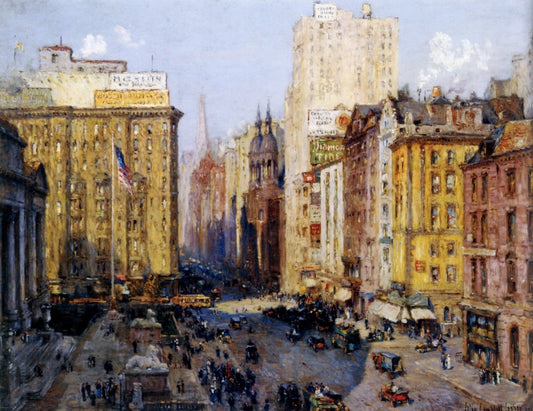
Cooper, Colin Campbell (1856-1936) - Fifth Avenue New York 1913
Vendor:Digital Download - 1 imageRegular price £0.80Regular priceUnit price per

Latest Picture Trove Blog Posts
View all-

William Morris’s Strawberry Thief: The Story Behind a Classic Arts and Crafts Pattern
Few William Morris designs are as instantly recognisable as Strawberry Thief. With its richly patterned foliage, small red strawberries and watchful birds hidden among curling leaves, it has become one of the most loved designs of the Arts and Crafts movement.
William Morris’s Strawberry Thief: The Story Behind a Classic Arts and Crafts Pattern
Few William Morris designs are as instantly recognisable as Strawberry Thief. With its richly patterned foliage, small red strawberries and watchful birds hidden among curling leaves, it has become one of the most loved designs of the Arts and Crafts movement.
-

Glasgow and the Mackintosh Style
We recently took ourselves off to Scotland, and on our travels, we popped into the Mackintosh Tea Rooms in Glasgow for a bit of a nose around and a spot of lunch.
Glasgow and the Mackintosh Style
We recently took ourselves off to Scotland, and on our travels, we popped into the Mackintosh Tea Rooms in Glasgow for a bit of a nose around and a spot of lunch.
-

A Trip to Edinburgh & Glasgow, and Scottish Art
We have just returned from a well-deserved few days' break in Scotland, visiting both Edinburgh and Glasgow, taking in Scottish art and tea rooms!
A Trip to Edinburgh & Glasgow, and Scottish Art
We have just returned from a well-deserved few days' break in Scotland, visiting both Edinburgh and Glasgow, taking in Scottish art and tea rooms!


