

William Collins (1788-1847) was a renowned British landscape and genre painter whose works captured the rural charm and everyday life of early nineteenth-century England. Born in London, Collins was the son of a well-known writer and publisher, William Collins Sr., which afforded him early exposure to the artistic and literary circles of the capital. Demonstrating a precocious talent for drawing, he was admitted to the Royal Academy Schools at the age of seventeen, where he honed his skills under the tutelage of prominent artists such as George Morland and Sir Thomas Lawrence.
Collins’ early career was marked by his affection for the English countryside and its inhabitants. He became celebrated for his evocative depictions of rural landscapes, coastal scenes, and the simple lives of fishermen, farmers, and children. His paintings often exuded a sense of tranquillity and nostalgia, reflecting both the beauty and the hardships of rural existence. Works such as "Rustic Hospitality" and "Children Fishing" exemplify his ability to infuse ordinary scenes with warmth and sentimentality, earning him a loyal following among art collectors and critics alike.
Throughout his career, Collins exhibited regularly at the Royal Academy, where his paintings were met with considerable acclaim. In 1820, he was elected an Associate of the Royal Academy, and by 1827, he achieved the distinction of becoming a full Academician. His growing reputation allowed him to travel extensively, including notable visits to France, the Netherlands, and Italy. The Italian sojourn, in particular, had a significant impact on his palette and subject matter, as seen in works such as "The Shrine at Capuchin Convent, Amalfi," where Mediterranean light and colour enlivened his compositions.
Despite his success, Collins’ later years were tinged with personal difficulty, including recurring ill-health. Nevertheless, he remained industrious, continuing to produce paintings that resonated with the Victorian public’s yearning for idyllic rural life. His technique was characterised by careful observation, a delicate touch, and a keen sensitivity to light and atmosphere.
William Collins died in 1847, leaving behind a legacy as one of Britain’s foremost genre painters of his era. His son, Wilkie Collins, would later achieve fame as a novelist. Today, William Collins’ works are held in major collections, including the Tate Britain, where they continue to be admired for their gentle lyricism and affectionate portrayal of nineteenth-century rural England.
Images to download
-

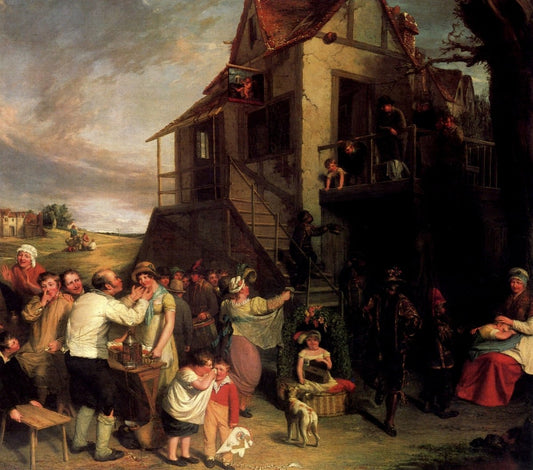
Collins, William (1788-1847) - May Day
Vendor:Digital Download - 1 imageRegular price £0.80Regular priceUnit price per

Latest Picture Trove Blog Posts
View all-

William Morris’s Strawberry Thief: The Story Behind a Classic Arts and Crafts Pattern
Few William Morris designs are as instantly recognisable as Strawberry Thief. With its richly patterned foliage, small red strawberries and watchful birds hidden among curling leaves, it has become one of the most loved designs of the Arts and Crafts movement.
William Morris’s Strawberry Thief: The Story Behind a Classic Arts and Crafts Pattern
Few William Morris designs are as instantly recognisable as Strawberry Thief. With its richly patterned foliage, small red strawberries and watchful birds hidden among curling leaves, it has become one of the most loved designs of the Arts and Crafts movement.
-

Glasgow and the Mackintosh Style
We recently took ourselves off to Scotland, and on our travels, we popped into the Mackintosh Tea Rooms in Glasgow for a bit of a nose around and a spot of lunch.
Glasgow and the Mackintosh Style
We recently took ourselves off to Scotland, and on our travels, we popped into the Mackintosh Tea Rooms in Glasgow for a bit of a nose around and a spot of lunch.
-

A Trip to Edinburgh & Glasgow, and Scottish Art
We have just returned from a well-deserved few days' break in Scotland, visiting both Edinburgh and Glasgow, taking in Scottish art and tea rooms!
A Trip to Edinburgh & Glasgow, and Scottish Art
We have just returned from a well-deserved few days' break in Scotland, visiting both Edinburgh and Glasgow, taking in Scottish art and tea rooms!


