

John Brewster (1766-1854) was an American artist renowned for his poignant and distinctive portraiture, most notably within the folk art tradition of the early United States. Though American by birth, Brewster’s work has drawn admiration worldwide and stands as a testament to the enduring power of individual expression during a time of rapid cultural transformation.
Born in Hampton, Connecticut, Brewster was the son of Dr. John Brewster, a respected physician, and Mary Eells. He was born deaf, a circumstance that profoundly shaped his life and artistic career. Despite the limitations imposed by his disability, a significant obstacle in the 18th and early 19th centuries, Brewster developed a remarkable ability to observe and capture the subtleties of human expression. His acute visual sensitivity became the hallmark of his portraiture.
Brewster received some instruction in painting, possibly from Joseph Steward, a prominent regional artist. His earliest known works date from the 1790s and reflect the style and conventions of the era: sitters depicted in three-quarter view, set against plain or subtly decorated backgrounds, and rendered with a gentle luminosity. He travelled extensively throughout New England, working as an itinerant portraitist. He painted families, children, and notable figures, producing over two hundred works during his lifetime.
Brewster’s portraits are celebrated for their psychological depth and sincerity. Unlike many of his contemporaries, who favoured grandiloquent poses and elaborate props, Brewster’s sitters often appear serene, introspective, and dignified. His use of soft lighting and muted colour palettes imbues his portraits with a sense of calm and timelessness. Particularly striking are his images of children, who are rendered with a directness and innocence that remains deeply affecting.
Not confined to any one social class, Brewster painted both affluent and modest families, capturing the diversity of early American society. His unique artistic voice was likely influenced by his deafness, which may have heightened his sensitivity to visual cues and gestures. Brewster’s ability to communicate through his art, despite his inability to hear or speak conventionally, underscores the universality of artistic expression.
In 1817, Brewster became one of the first students to attend the newly established American School for the Deaf in Hartford, Connecticut. This experience broadened his social circles and may have contributed to the increased confidence and sophistication evident in his later works.
Today, John Brewster’s portraits are held in major collections, including the American Folk Art Museum and the Fenimore Art Museum. His work is valued not only for its technical merit but also for its emotional resonance and insight into the early American experience. Brewster remains a celebrated figure in the history of portraiture, his legacy enduring as a symbol of resilience and creative achievement.
Images to download
-

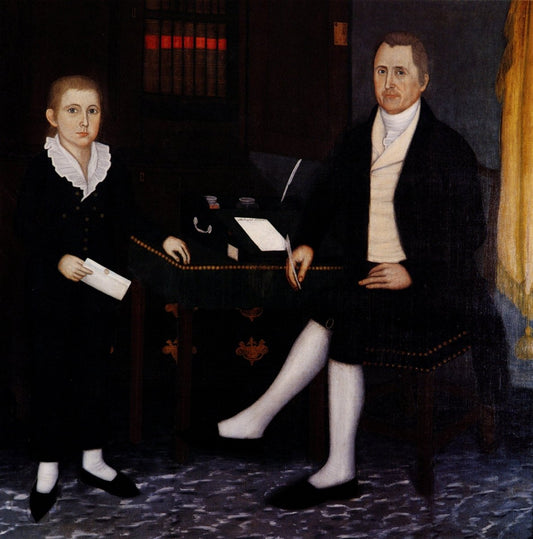
Brewster, John (1766-1854) - James Prince and son William Henry 1801
Vendor:Digital Download - 1 imageRegular price £0.80Regular priceUnit price per

Latest Picture Trove Blog Posts
View all-

William Morris’s Strawberry Thief: The Story Behind a Classic Arts and Crafts Pattern
Few William Morris designs are as instantly recognisable as Strawberry Thief. With its richly patterned foliage, small red strawberries and watchful birds hidden among curling leaves, it has become one of the most loved designs of the Arts and Crafts movement.
William Morris’s Strawberry Thief: The Story Behind a Classic Arts and Crafts Pattern
Few William Morris designs are as instantly recognisable as Strawberry Thief. With its richly patterned foliage, small red strawberries and watchful birds hidden among curling leaves, it has become one of the most loved designs of the Arts and Crafts movement.
-

Glasgow and the Mackintosh Style
We recently took ourselves off to Scotland, and on our travels, we popped into the Mackintosh Tea Rooms in Glasgow for a bit of a nose around and a spot of lunch.
Glasgow and the Mackintosh Style
We recently took ourselves off to Scotland, and on our travels, we popped into the Mackintosh Tea Rooms in Glasgow for a bit of a nose around and a spot of lunch.
-

A Trip to Edinburgh & Glasgow, and Scottish Art
We have just returned from a well-deserved few days' break in Scotland, visiting both Edinburgh and Glasgow, taking in Scottish art and tea rooms!
A Trip to Edinburgh & Glasgow, and Scottish Art
We have just returned from a well-deserved few days' break in Scotland, visiting both Edinburgh and Glasgow, taking in Scottish art and tea rooms!


