

Pedro Berruguete (c.1450-1504) is widely regarded as one of the most significant painters in late 15th-century Spain, bridging the creative worlds of Gothic tradition and the advent of the Renaissance. Born in the small town of Paredes de Nava, in the province of Palencia, Berruguete’s career unfolded during a period of profound artistic transformation, both within the Iberian Peninsula and across Europe.
Little is known about the details of his early training. However, his work reveals a solid grounding in the Spanish Gothic tradition, visible in his clear, linear compositions and the devout, sometimes austere, expression of his religious figures. What truly sets Berruguete apart is the apparent influence of Italian Renaissance art, prompting speculation that he may have travelled to Italy, possibly even working in Urbino, as some art historians suggest. While there is no documentary evidence of such a journey, the stylistic traits in his paintings, such as increased naturalism, the use of perspective, and carefully modelled figures, suggest familiarity with Italian innovations.
Berruguete’s oeuvre is dominated by religious themes, reflective of the pious climate of late medieval Spain and the demands of his principal patrons: the Church and the nobility. He is best known for his altarpieces (retablos), which combine intricate narrative scenes with individualised saints and donors. Among his most celebrated works is the altarpiece for the convent of Santo Tomás in Ávila, commissioned by Tomás de Torquemada, the first Grand Inquisitor of Spain. This ambitious project displays Berruguete’s ability to orchestrate complex iconographies, blending the solemnity of Gothic art with the fresh realism of the Renaissance.
His style is marked by a delicate interplay of colour, meticulous attention to detail, and a growing sense of spatial awareness. Berruguete often included architectural elements in his backgrounds, lending depth and a sense of place to his scenes. His figures, while sometimes retaining a Gothic stiffness, increasingly display psychological depth and individuality, a hallmark of Renaissance portraiture.
Pedro Berruguete’s legacy is twofold: he stands as a pivotal figure in the transition from medieval to modern painting in Spain, and he is also the father of Alonso Berruguete, who would become one of the leading sculptors and painters of the Spanish Renaissance. Through his innovative synthesis of Gothic and Renaissance elements, Pedro Berruguete left a lasting imprint on Spanish art history.
Images to download
-

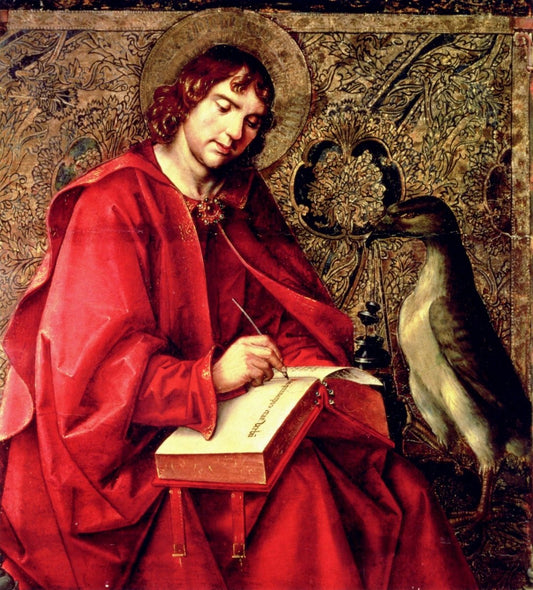
Berruguete, Pedro (c.1450-1504) - St John the Evangelist c.1491-99
Vendor:Digital Download - 1 imageRegular price £0.80Regular priceUnit price per

Latest Picture Trove Blog Posts
View all-

William Morris’s Strawberry Thief: The Story Behind a Classic Arts and Crafts Pattern
Few William Morris designs are as instantly recognisable as Strawberry Thief. With its richly patterned foliage, small red strawberries and watchful birds hidden among curling leaves, it has become one of the most loved designs of the Arts and Crafts movement.
William Morris’s Strawberry Thief: The Story Behind a Classic Arts and Crafts Pattern
Few William Morris designs are as instantly recognisable as Strawberry Thief. With its richly patterned foliage, small red strawberries and watchful birds hidden among curling leaves, it has become one of the most loved designs of the Arts and Crafts movement.
-

Glasgow and the Mackintosh Style
We recently took ourselves off to Scotland, and on our travels, we popped into the Mackintosh Tea Rooms in Glasgow for a bit of a nose around and a spot of lunch.
Glasgow and the Mackintosh Style
We recently took ourselves off to Scotland, and on our travels, we popped into the Mackintosh Tea Rooms in Glasgow for a bit of a nose around and a spot of lunch.
-

A Trip to Edinburgh & Glasgow, and Scottish Art
We have just returned from a well-deserved few days' break in Scotland, visiting both Edinburgh and Glasgow, taking in Scottish art and tea rooms!
A Trip to Edinburgh & Glasgow, and Scottish Art
We have just returned from a well-deserved few days' break in Scotland, visiting both Edinburgh and Glasgow, taking in Scottish art and tea rooms!


