

Antonin Artaud (1896-1948) was a French artist, dramatist, poet, essayist, actor, and theatre director whose radical ideas profoundly influenced twentieth-century art and theatre. Born in Marseille to a family of Greek and Turkish descent, Artaud suffered from neuralgia and mental illness from an early age, which would shape much of his creative output and his tumultuous life.
Artaud is best remembered for his concept of the “Theatre of Cruelty,” a revolutionary approach to theatre that he first articulated in his seminal works, including the 1938 publication “The Theatre and Its Double.” In Artaud’s vision, theatre was not merely a vehicle for storytelling, but a sensory experience that should shock and awaken the audience, stripping away the artifice of conventional theatre. He believed that language was often inadequate for true expression, advocating instead for gesture, sound, and visual symbolism to communicate the deepest aspects of human experience. His idea of “cruelty” was not about physical violence, but rather a relentless pursuit of truth, an assault on the complacency of both performers and spectators.
Artaud’s theatrical theories were shaped by his own experiences as an actor and his involvement with influential avant-garde groups, such as the Surrealists. He acted in several films, including Carl Dreyer’s “The Passion of Joan of Arc” (1928), and collaborated with directors like Charles Dullin and Georges Pitoëff. However, his uncompromising vision often led to professional conflicts, and many of his planned theatrical projects were never realised.
His personal life was marked by suffering, instability, and frequent hospitalisation. Artaud spent much of his later years in psychiatric institutions, where he underwent experimental treatments including electroconvulsive therapy. Despite these hardships, he continued to write prolifically, producing poems, essays, letters, and drawings. His later works, such as “Van Gogh: The Man Suicided by Society” (1947), reflect his belief in the transformative and redemptive power of art, as well as his ongoing struggles with mental illness and alienation.
Though Artaud’s ideas were largely dismissed or misunderstood during his lifetime, his legacy has grown considerably. He is now regarded as a visionary precursor to movements such as the Theatre of the Absurd and experimental performance art. Artaud’s relentless exploration of the boundaries of artistic expression continues to inspire writers, directors, and artists who seek to challenge convention and probe the depths of human consciousness.
Images to download
-

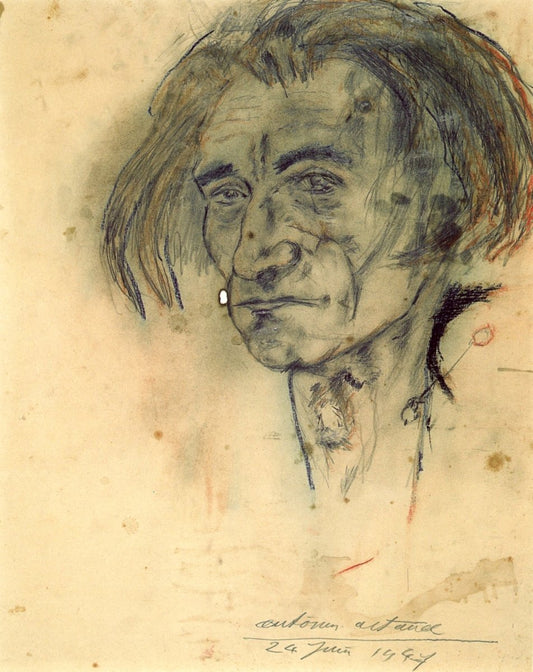
Artaud, Antonin (1896-1948) - Self-portrait 1947
Vendor:Digital Download - 1 imageRegular price £0.80Regular priceUnit price per

Latest Picture Trove Blog Posts
View all-

William Morris’s Strawberry Thief: The Story Behind a Classic Arts and Crafts Pattern
Few William Morris designs are as instantly recognisable as Strawberry Thief. With its richly patterned foliage, small red strawberries and watchful birds hidden among curling leaves, it has become one of the most loved designs of the Arts and Crafts movement.
William Morris’s Strawberry Thief: The Story Behind a Classic Arts and Crafts Pattern
Few William Morris designs are as instantly recognisable as Strawberry Thief. With its richly patterned foliage, small red strawberries and watchful birds hidden among curling leaves, it has become one of the most loved designs of the Arts and Crafts movement.
-

Glasgow and the Mackintosh Style
We recently took ourselves off to Scotland, and on our travels, we popped into the Mackintosh Tea Rooms in Glasgow for a bit of a nose around and a spot of lunch.
Glasgow and the Mackintosh Style
We recently took ourselves off to Scotland, and on our travels, we popped into the Mackintosh Tea Rooms in Glasgow for a bit of a nose around and a spot of lunch.
-

A Trip to Edinburgh & Glasgow, and Scottish Art
We have just returned from a well-deserved few days' break in Scotland, visiting both Edinburgh and Glasgow, taking in Scottish art and tea rooms!
A Trip to Edinburgh & Glasgow, and Scottish Art
We have just returned from a well-deserved few days' break in Scotland, visiting both Edinburgh and Glasgow, taking in Scottish art and tea rooms!


