-
Digital Download - 1 image -
Dimensions 3664 x 5144 pixels
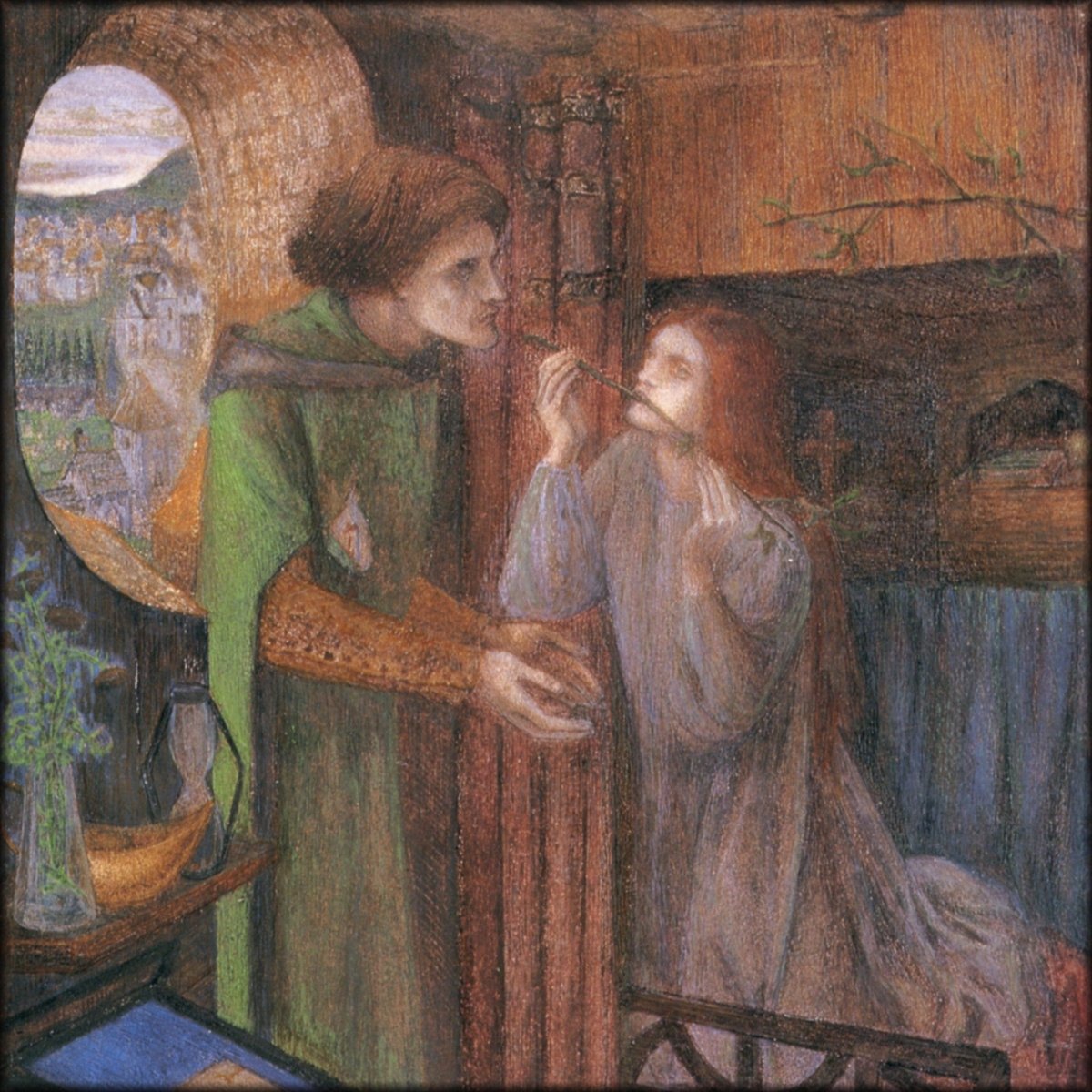
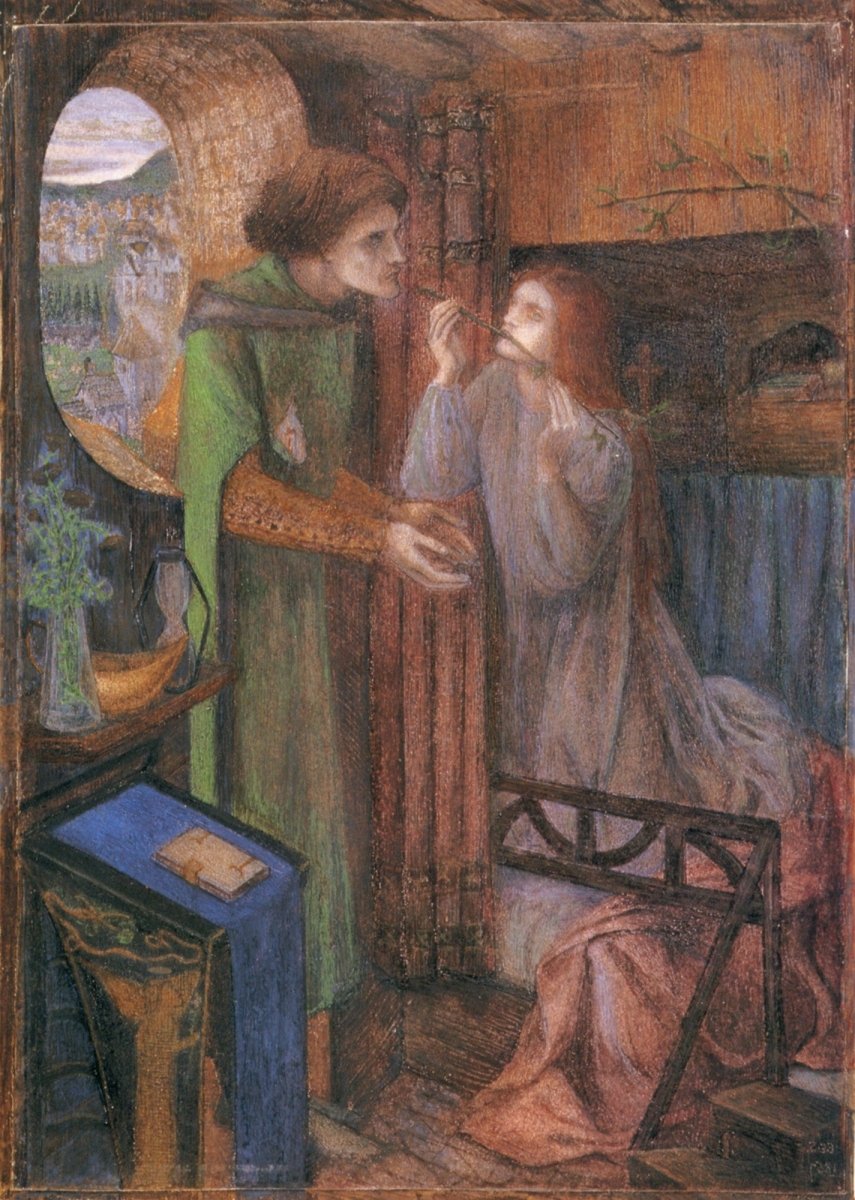
Siddal, Lizzie (1829-1862) - Clerk Saunders 1857
Digital Download - 1 image
Couldn't load pickup availability
- All images are out of copyright
- Commercial use allowed
- Immediate download after purchase
Clerk Sanders is an 1857 drawing by Pre-Raphaelite artist and muse, Lizzie Siddal. The tragic story of Clerk Saunders and his sweetheart Mary Margaret was an ancient native folk ballad, collected by Sir Walter Scott and published as the Minstrelsy of the Scottish Border (1802-3).
This download consists of 1 image, in jpeg format, that is 600dpi and 3664 pixels wide by 5144 pixels tall.
The picture is out of copyright and in the public domain, so you are free to use it in whatever way you'd like, including commercial use.
Elizabeth Eleanor Siddall (1829-1862), better known as Lizzie Siddal, was an English artist, art model and poet. Siddal was perhaps the most significant of the female models who posed for the Pre-Raphaelite Brotherhood. Their ideas of female beauty were fundamentally influenced and personified by her.
Lizzie was introduced into the Pre-Raphaelite circle when, in 1849 and whilst working at a millinery in Cranbourne Alley, London, she made the acquaintance of Walter Deverell. Accounts differ on the circumstances of their meeting. Deverell subsequently employed Siddal as a model.
Deverell and William Holman Hunt both painted Siddal, and she was the model for John Everett Millais's famous painting Ophelia (1852). She became romantically involved with Dante Gabriel Rossetti, and became his muse and exclusive model. He portrayed her in almost all his early artwork depicting women.
For John Everett Millais's Ophelia, Siddal floated in a bathtub full of water to portray the drowning Ophelia. Millais painted daily through the winter, putting oil lamps under the tub to warm the water. On one occasion, the lamps went out and the water became icy cold. Millais, absorbed by his painting, did not notice and Siddal did not complain. After this, she became ill with a severe cold or pneumonia. Her father held Millais responsible and, under the threat of legal action, Millais paid her doctor's bills.
In 1851 or 1852, Lizzie and Rossetti were engaged, and also at that time she began to study with Rossetti. She began staying at his Chatham Place residence, sometimes with him and sometimes by herself. They subsequently became anti-social and absorbed in each other's affections. They coined affectionate nicknames for one another, such as "Guggums" or "Gug" and "Dove", the latter one of Rossetti's names for Siddal. He also shortened the spelling of her surname to Siddal, dropping the second l.
Siddal became an artist in her own right and was the only woman to exhibit at an 1857 Pre-Raphaelite exhibition.
As Siddal came from a working-class family, Rossetti feared introducing her to his family. Siddal was the victim of harsh criticism from his sisters. The knowledge that his family would not approve contributed to Rossetti delaying the marriage. Siddal appears to have believed, with some justification, that Rossetti was always seeking to replace her with a younger muse, which contributed to her later depressive periods and illness. Although Ruskin urged Rossetti to marry in 1855, their relationship deteriorated: the reasons probably included Siddal's ill-health, her laudanum addiction, Rossetti's philandering, Rossetti's lack of funds, the aforementioned disapproval of the Rossetti family, and Rossetti's probable aversion to marriage in general.
In Spring 1860, Siddal's family contacted Ruskin with the news that Siddal was gravely ill. Ruskin in turn informed Rossetti. Siddal was at the seaside resort of Hastings. In a change of heart, Rossetti hurried to her side that April with a marriage licence. Siddal and Rossetti married on Wednesday, 23 May 1860 at St. Clement's Church in Hastings. There were no family or friends present, only a couple of witnesses whom they had asked. When Siddal's health improved, they honeymooned in Paris and Boulogne in the latter half of 1860, then returned to the Chatham Place residence that they expanded into an adjoining house.
It was thought that she suffered from tuberculosis, but some historians believe an intestinal disorder was more likely. Elbert Hubbard wrote that "She suffered much from neuralgia, and the laudanum taken to relieve the pain had grown into a necessity." Others suggest that she may have been anorexic or that her poor health was due to laudanum addiction or a combination of ailments.
Siddal travelled to Paris and Nice for several years for her health. At the time of her wedding, she was so frail and ill that she had to be carried to the church, despite it being a five-minute walk from where she was staying. She became severely depressed and her long illness gave her access to laudanum to which she became addicted. By 1861, Siddal became pregnant, which ended with the birth of a stillborn daughter. The stillbirth left Siddal with post-partum depression. By early 1862, she had become pregnant for a second time.
Siddal overdosed on laudanum on 10 February 1862. She, Rossetti, and his friend Algernon Charles Swinburne had dined together in a nearby hotel. After having taken Siddal home, Rossetti attended his weekly lecture at the Working Men's College. Upon returning home from teaching, Rossetti found Siddal unconscious in bed and could not revive her. The first doctor Rossetti called claimed that he was unable to save her, upon which Rossetti sent for another three doctors. A stomach pump was used, but to no avail. She died at 7:20 am on 11 February 1862 at their home at 14 Chatham Place. Her obituary noted that she "had expressed no wish to die, but quite the reverse. Indeed she contemplated going out of town in a day or two, and had ordered a new mantle which she intended to wear on the occasion." The coroner ruled her death as accidental; however, there are suggestions that Rossetti found a suicide note, with the words "Please look after Harry" (her invalid brother, who may have had a slight intellectual disability), supposedly "pinned on the breast of her night-shirt." Consumed with grief and guilt Rossetti allegedly went to see Ford Madox Brown who is supposed to have instructed him to burn the note. Since suicide was illegal and considered immoral, it would have brought scandal on the family and barred Siddal from a Christian burial.
In August 1869, Rossetti had her coffin disinterred to retrieve a handwritten book of Rossetti's poems, which he had laid beside her head before burial. Rossetti then published the contents in Poems (1870).
His poem "Without Her" was a reflection on life once love has departed.
What of her glass without her? The blank grey
There where the pool is blind of the moon's face.
Her dress without her? The tossed empty space
Of cloud-rack whence the moon has passed away.
Her paths without her? Day's appointed sway
Usurped by desolate night. Her pillowed place
Without her? Tears, ah me! For love's good grace,
And cold forgetfulness of night or day.
What of the heart without her? Nay, poor heart,
Of thee what word remains ere speech be still?
A wayfarer by barren ways and chill,
Steep ways and weary, without her thou art,
Where the long cloud, the long wood's counterpart,
Sheds doubled up darkness up the labouring hill.

Public Domain Copyright Rules
The pictures in our collections are out of copyright in the United States, the UK, Canada, most of Europe, Australia and all countries that follow the lifetime plus 70 years rule. Read our blog post about public domain copyright rules for more information.