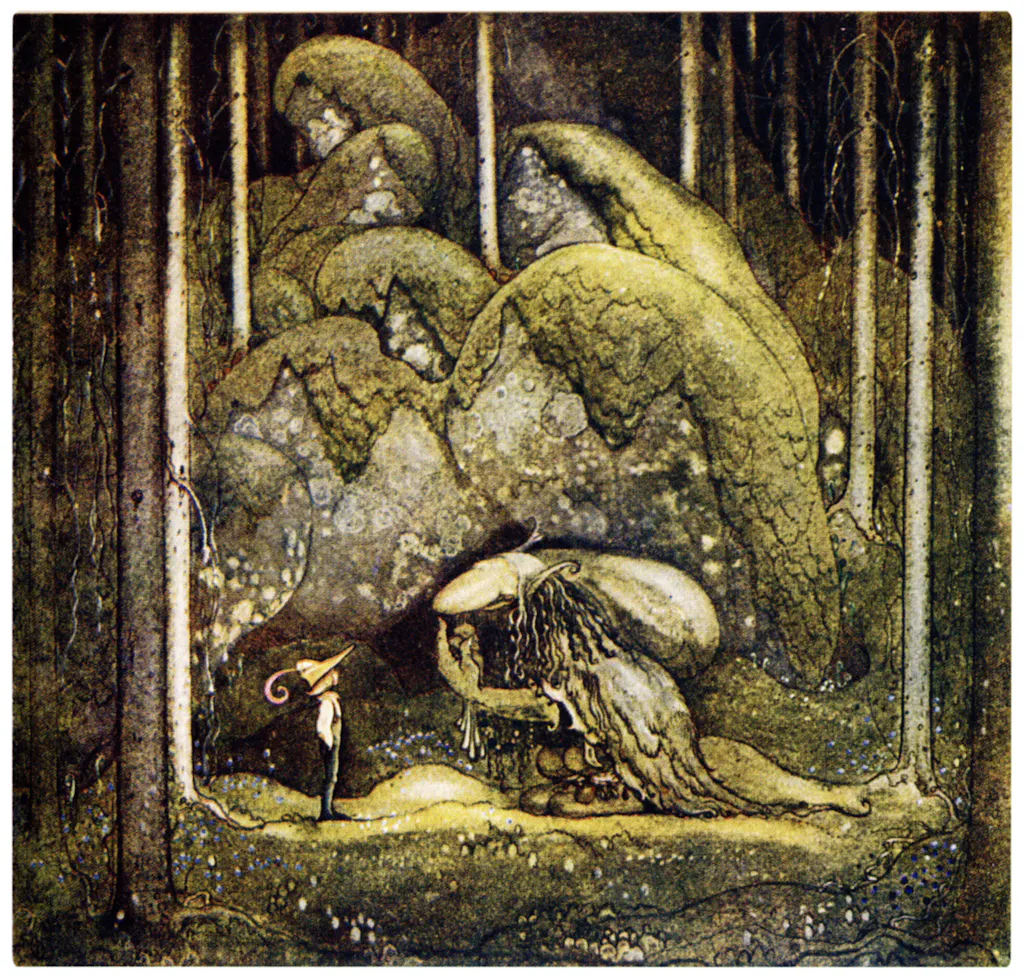
Discover the whimsical characters and rich landscapes of John Bauer, a celebrated Swedish painter and illustrator, renowned for his enchanting fairy-tale imagery that resonates with nature's magic.
John Bauer, a celebrated Swedish painter and illustrator, is renowned for his enchanting fairy-tale imagery that resonates with nature's magic. His captivating works, infused with whimsical characters and rich landscapes, invite viewers into a dreamlike world of fantastical stories.
This download features 82 hi-res images, in jpeg format, by the Swedish artist, John Bauer.
The images are all 600dpi and range in size from 2870 pixels wide/tall to 5571 pixels wide/tall.
Click on the link above to see a full list of the images included.
John Albert Bauer (1882-1918) was a Swedish painter and illustrator. His work is concerned with landscape and mythology, but he also composed portraits. He is best known for his illustrations of early editions of Bland tomtar och troll (Among Gnomes and Trolls), an anthology of Swedish folklore and fairy tales.
Bauer was born and raised in Jönköping on 4 June 1882. He was given to sketching and drawing from an early age, without encouragement from his family. However, when he turned sixteen and wanted to go to Stockholm to study art, they were enthusiastic for him and backed him financially. In 1898, he was one of the 40 applicants to study at the Royal Swedish Academy of Arts, and although he was deemed well qualified for a place at the academy, he was too young to be accepted. He spent the next two years at the Kaleb Ahltins school for painters. During this time he was, like many teenagers, torn between hope and despair, something that is reflected in his artwork.
By 1900, Baeur was old enough to attend the Academy of Arts. Baeur was one of the three students admitted that year; the two other successful applicants were his friends Ivar Kamke and Pontus Lanner. He studied traditional illustrations and made drawings of plants, medieval costumes and croquis, all of which served him in his later work.
While at the academy, he received his first commissions to illustrate magazines (including the Söndags-Nisse and Snöflingan) and books (e.g. De gyllene böckerna, Ljungars saga and Länge, länge sedan). In 1904 he travelled to Lappland to create paintings for a book on the culture of the county and its "exotic wilderness". At the end of 1905, he left the academy and put "Artist" on his business card.
Following the discovery of iron ore deposits in the north of Sweden, Lappland became a frontier for industrial development, instead of an exotic wilderness of the Sami culture and midnight sun. Opportunistically, Carl Adam Victor Lundholm published his Lappland, det stora svenska framtidslandet (Lappland, the great Swedish land of the future). He engaged noted Swedish artists, such as Karl Tirén, Alfred Thörne, Per Daniel Holm and Hjalmar Lindberg, to create the illustrations. Since Bauer was an inexperienced illustrator by comparison, Lundholm tested his abilities by sending him to create some drawings of Sami people at Skansen.
Although reluctant to audition for the commission, on 15 July 1904 Bauer left for Lappland and stayed there for a month. Coming from the dense, dark forests of Småland he was overwhelmed by the open vistas and colourful landscapes. His encounters with the Sami people and their culture became important for his later works. He took many photos, sketched and made notes of the tools, costumes and objects he saw, but he had difficulty becoming close to the Sami, due to their shyness. He recorded his experiences in his diary and in letters to his family and friends.
The book on Lappland was published in 1908, with eleven watercolours by Bauer. They were painted in Stockholm, almost 18 months after his visit, using the photos and sketches he had collected during his journey. Many of the photos resulted in other drawings and paintings. Most of these were romanticised versions of the photos, but he succeeded in capturing the nuances and ambiance of the goahtis, and the richness of the Sami garments and crafts.
Bauer met fellow student Ester Ellqvist at the Royal Swedish Academy of Arts. Ellqvist studied at the separate department for women, since women were not allowed to attend the same classes as men. So, while Ellqvist was talented and ambitious, she did not have an equal opportunity as her male colleagues to develop her artistry, and society's expectation was that her role in life would be that of housewife, not artist.
Bauer started courting her in 1903, but since they were apart most of the time, this was done by mail. Their relationship developed as they shared their dreams, aspirations, doubts and insecurities in their correspondence. For Bauer, Ellqvist became his inspiration, muse, and "fairy princess"; it was as such he painted her for the first time in Sagoprinsessan (The Fairy Princess). He made sketches for the painting in 1904, and finalised them in an oil painting in 1905. Ellqvist is portrayed as a strong, enlightened and unobtainable Valkyrie. The painting was shown at Bauer's first exhibition at the Valand Academy in Gothenburg in 1905 (where he was one of eleven debutants) and in Norrköping in 1906, where it was sold to a private collector. It is now in the Jönköpings läns museum. Bauer tried to mould Ellqvist into his vision of a creature of the woods and as the perfect artist's wife; he wanted her to make a home for them in a romantic cottage in the woods, while he wandered about the forest seeking inspiration.
On 18 December 1906, Bauer and Ellqvist were married. Little is known of their first years together since they now lived in the same house, making letters unnecessary. Bauer had jobs illustrating covers for magazines, like Hvar 8 Dag, and began work on Bland tomtar och troll (Among Gnomes and Trolls). In 1908, John and Ester travelled to Italy together; on their return they found a house, the "Villa Björkudden", situated on the shores of Lake Bunn just outside Gränna. They bought the house in 1914, and the following year their son Bengt (called "Putte") was born. The birth of Putte marked a harmonious and joyful time for the couple. Bauer made his final illustrations for Among Gnomes and Trolls, his grand farewell to the series, which freed him to explore playwriting and make frescos. He showed his paintings at exhibitions and experimented with modernism, but all this came at a cost. Bauer was often away, leaving Ellqvist alone at home, and he no longer had the steady income that the illustrations had provided. By 1917, their marriage was in trouble, and in 1918, Bauer put his thoughts about a divorce in a letter to his wife.
Over time, Bauer used Ellqvist as a model less frequently. With the birth of their son, Bauer started to paint pictures with children as part of the composition. The painting Rottrollen (The Root Trolls), completed in 1917, is of Putte sleeping among troll-shaped roots in a forest.
Bauer and his wife made a long journey to Italy at Josef's expense in 1909. They chose to travel through Germany and on to Italy based on his readings of medieval towns during a 1902 visit to Germany with his father. The couple visited Verona, Florence, Siena and spent two months in Volterra. They continued through Naples and Capri, spending the winter in Rome.
Their journey was abandoned after a murder in their building in Rome. Bauer was interrogated by Italian police due to a misunderstanding. He was never a suspect but the situation became public, leaving a bitter memory of their visit to Rome.
Bauer, Ester and their three-year-old son, Bengt, were on their way to their new home in Stockholm, where Bauer hoped for spiritual renewal and a new life for himself and his family. A recent, well-publicised train accident at Getå caused Bauer to book their return to Stockholm by boat, the steamer Per Brahe.
On the night of 19 November 1918, when the steamer left Gränna it was loaded with iron stoves, plowshares, sewing machines and barrels of produce. All the cargo did not fit into the hold and a significant portion was stored unsecured on deck, making the ship top-heavy. The weather was bad and by the time the steamer was at sea, a full storm was raging; the wind caused the cargo on deck to shift, some of it falling overboard, further destabilising the ship. The ship capsized and went down, stern first, just 500 metres (1,600 feet) from the next port, Hästholmen, killing all 24 people on board, including the Bauers. Most of the passengers had been trapped in their cabins.