-
Digital Download - 1 image -
Dimensions 5434 x 3720 pixels
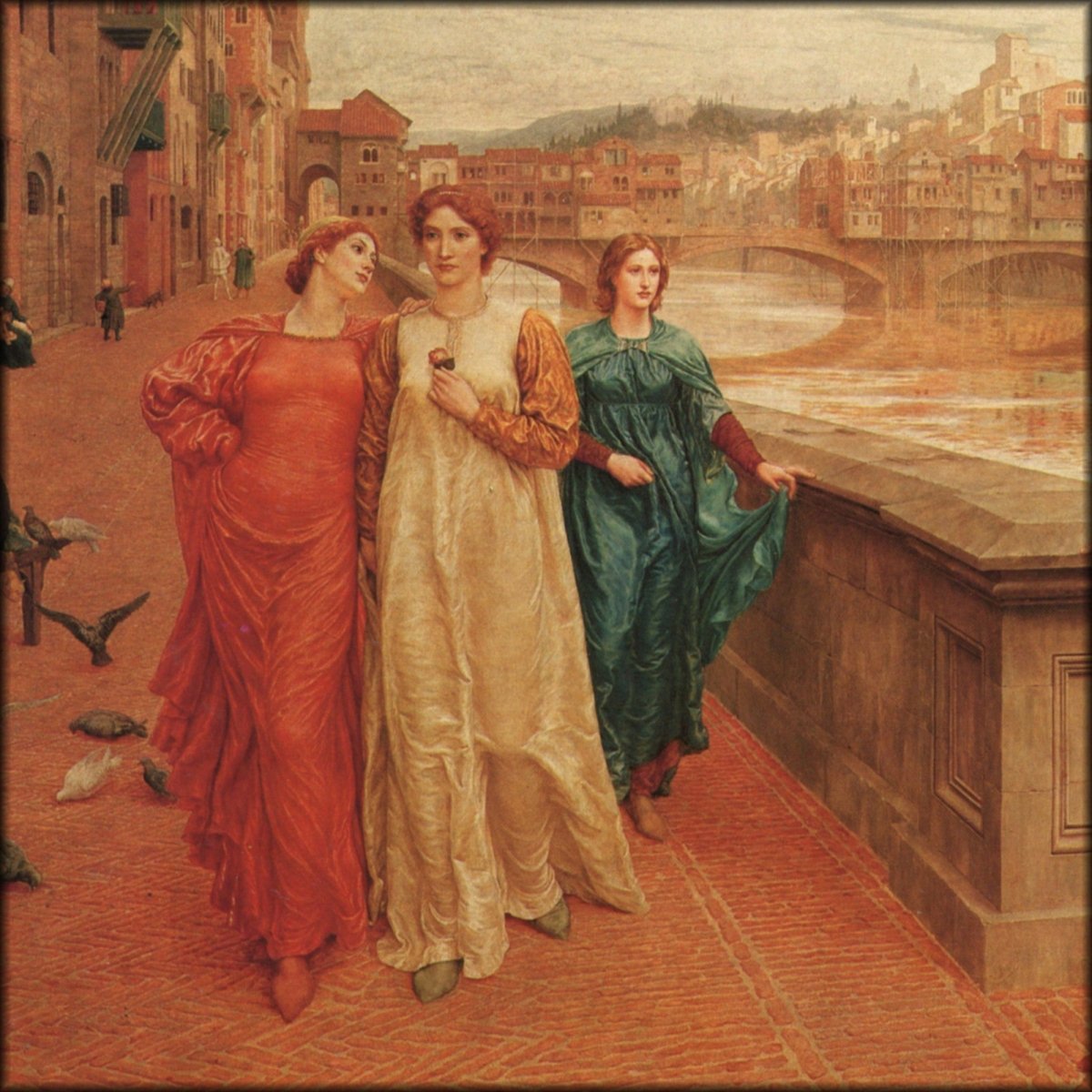
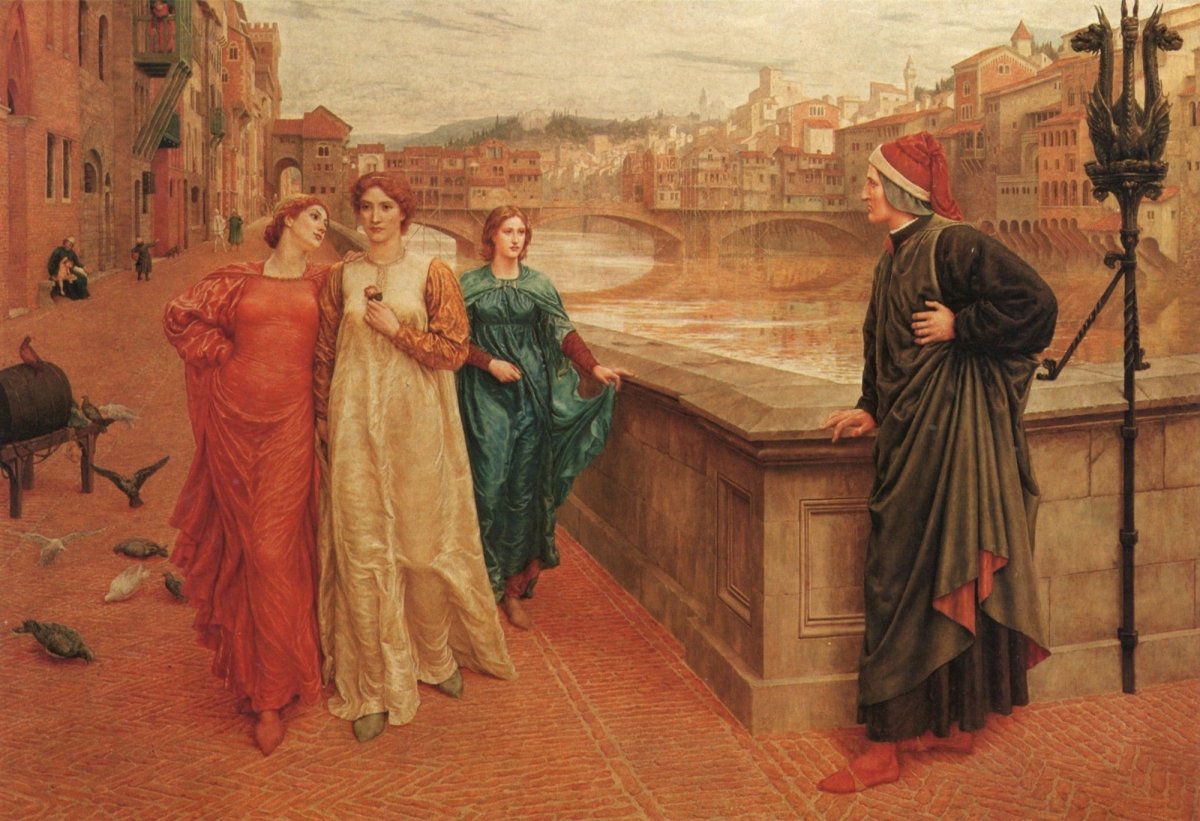
Holiday, Henry (1839-1927) - Dante and Beatrice 1883
Digital Download - 1 image
Couldn't load pickup availability
- All images are out of copyright
- Commercial use allowed
- Immediate download after purchase
'Dante and Beatrice' was the most important painting by Henry Holiday. The theme of the painting is inspired by the autobiography Vita Nuova of the medieval poet Dante (1265-1321). Dante concealed his love for Beatrice by pretending to be attracted to other women. The scene depicted in the painting is that of Beatrice refusing to greet Dante because of the gossip that had reached her.
This download consists of 1 image, in jpeg format, that is 600dpi and 5434 pixels wide by 3720 pixels tall.
The picture is out of copyright and in the public domain, so you are free to use it in whatever way you'd like, including commercial use.
Henry Holiday (1839-1927) was an English Victorian painter of historical genre and landscapes, also a stained-glass designer, illustrator, and sculptor. He was influenced by the Pre-Raphaelite Brotherhood, many of whom he knew.
Holiday was born in London. He showed an early aptitude for art and was given lessons by William Cave Thomas. He attended Leigh's art academy (where a fellow student was Frederick Walker) and in 1855, at the age of 15, was admitted to the Royal Academy Schools. Through his friendship with Albert Moore and Simeon Solomon he was introduced to the artists Dante Gabriel Rossetti, Edward Burne-Jones and William Morris of the Pre-Raphaelite Brotherhood. This movement was to be pivotal in his future artistic and political life.
Holiday worked in both oils and watercolours. In 1858, his first picture, a landscape painting, was exhibited at the Royal Academy and immediately sold; from that year his work was frequently shown at the Academy and elsewhere.
Holiday spent much time at the studios of Sir Edward Burne-Jones, where groups of artists would meet to discuss, exchange and pool ideas. The influence of Burne-Jones can be seen in Holiday's work.
In 1861, Holiday accepted the position of stained glass window designer for Powell's Glass Works, after Burne-Jones had left to work for Morris & Co. During his time there he fulfilled over 300 commissions, mostly for customers in the United States. He left in 1891 to set up his own glass works in Hampstead, producing stained glass, mosaics, enamels and sacerdotal objects.
Holiday's stained glass work can be found all over Britain. Some of his best is at the chapel of Worcester College, Oxford (c.1865); Westminster Abbey (the Isambard Kingdom Brunel memorial window, 1868); St Luke's Church, Kentish Town; St Mary Magdalene, Paddington (1869); and Chartered Accountants' Hall, Moorgate. In 2018, four of his stained-glass windows were reinstalled in Chartered Accountants' Hall after being lost for almost 50 years following their removal for an extension in 1970.
Examples in the United States of Holiday's work may be seen in the sacristy of St. John's Chapel, Groton School (Groton, Massachusetts - panels by Holiday repurposed from the School's original chapel), and in Grace Church in New York City.
In October 1864, Holiday married Catherine Raven (1839-1924) and they moved to Bayswater, London. His wife was a talented embroiderer who worked for Morris & Co. They had one daughter, Winifred (1866-1949).
In July 1875, Holiday was commissioned by Lewis Carroll to illustrate The Hunting of the Snark. He remained a friend of the author throughout his life.
From 1899, Holiday worked with Jessie Mothersole as studio assistant and she remained closely associated with the family until Holiday's death. In 1906 Holiday gave Mothersole a drawing of his daughter Winifred, which later was acquired by the British Museum.
In 1907, Holiday went to Egypt, painting a series of watercolours and illustrations on ancient Egyptian themes. These were exhibited at Walker's Gallery, London, in March 1908 jointly with Mothersole who had been working on Egyptian archaeological drawings and watercolours since 1903/4. In 1907–08, he commissioned the building of a holiday home, Betty Fold, in his favourite part of the Lake District.
Holiday had been a socialist throughout his life and, together with his wife Kate and daughter Winifred, supported the Suffragette movement. The family were close acquaintances of Myra Sadd Brown and Emmeline Pankhurst and her daughter, and had organised local suffragette meetings in the Lake District.
Holiday died on 15 April 1927 in London, two years after his wife, Catherine. His nephew, Gilbert Holiday (1879-1937), son of Sir Frederick Holiday, was also an artist who also has paintings in British collections.

Public Domain Copyright Rules
The pictures in our collections are out of copyright in the United States, the UK, Canada, most of Europe, Australia and all countries that follow the lifetime plus 70 years rule. Read our blog post about public domain copyright rules for more information.