-
Digital Download - 1 image -
Dimensions 5446 x 3612 pixels
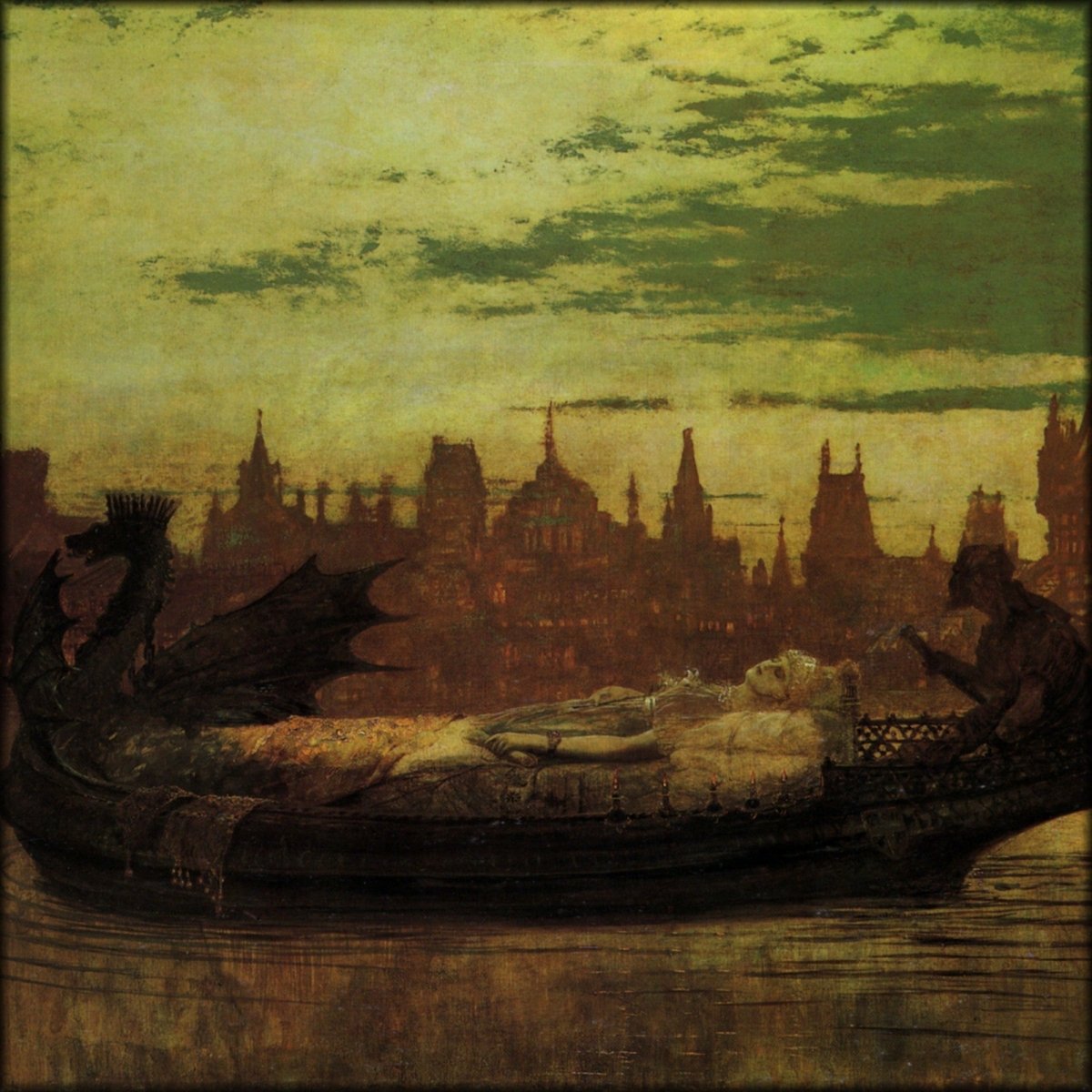
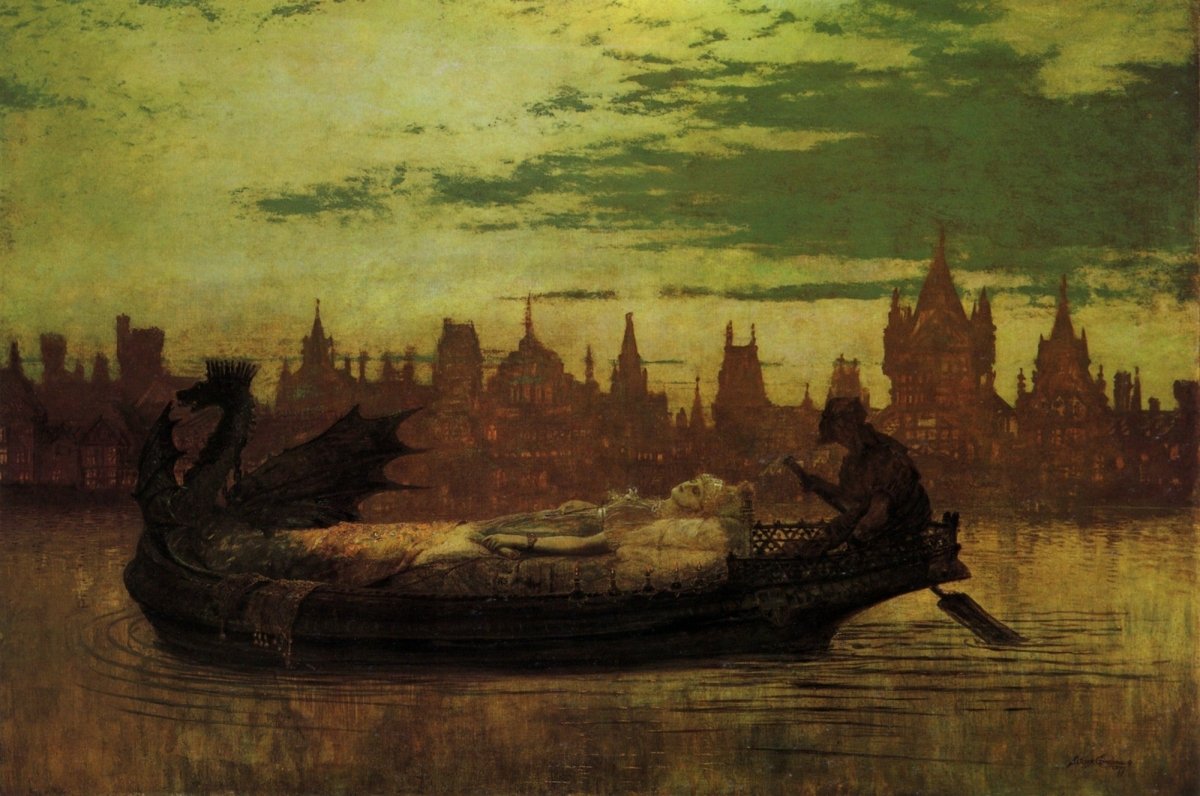
Grimshaw, John Atkinson (1836-1893) - Elaine 1877
Digital Download - 1 image
Couldn't load pickup availability
- All images are out of copyright
- Commercial use allowed
- Immediate download after purchase
'Elaine' is a painting by John Atkinson Grimshaw depicting the fictional character Elaine, the 'lily maid of the Astolat', from Tennyson's poem, 'Idylls of the King'.
This download consists of 1 image, in jpeg format, that is 600dpi and 5446 pixels wide by 3612 pixels tall.
The picture is out of copyright and in the public domain, so you are free to use it in whatever way you'd like, including commercial use.
John Atkinson Grimshaw (1836-1893) was an English Victorian-era artist best known for his nocturnal scenes of urban landscapes.
Grimshaw's love for realism stemmed from a passion for photography, which would eventually lend itself to the creative process. Though entirely self-taught, he is known to have openly used a camera obscura or lenses to project scenes onto canvas, which made up for his shortcomings as a draughtsman and his imperfect knowledge of perspective. This technique, which Caravaggio and Vermeer were suspected to have also used in secret, was condemned by a number of his contemporaries who believed it demonstrated less skill than painting by eye, with some claiming that his paintings appeared to "show no marks of handling or brushwork", while others "were doubtful whether they could be accepted as paintings at all". However, many recognised his mastery of colour, lighting and shadow, as well as his unique ability to provoke strong emotional responses in the viewer. James McNeill Whistler, whom Grimshaw worked with in his Chelsea studios, stated, "I considered myself the inventor of nocturnes until I saw Grimmy's moonlit pictures."
He was born on 6 September 1836 in a back-to-back house in Park Street, Leeds to Mary and David Grimshaw. In 1856 he married his cousin Frances Hubbard (1835-1917). In 1861, at the age of 24, to the dismay of his parents, he left his job as a clerk for the Great Northern Railway to become a painter. He first exhibited in 1862, mostly paintings of birds, fruit, and blossom, under the patronage of the Leeds Philosophical and Literary Society. He and his wife moved in 1866 to a semi-detached villa, which is now numbered 56 Cliff Road in Headingley and has a Leeds Civic Trust blue plaque, and in 1870 to Knostrop Old Hall. He became successful in the 1870s and rented a second home, Castle-by-the-Sea in Scarborough. Scarborough became a favourite subject.
Grimshaw's primary influence was the Pre-Raphaelites. True to the Pre-Raphaelite style, he created landscapes of accurate colour and lighting, vivid detail and realism, often typifying seasons or a type of weather. Moonlit views of city and suburban streets and the docks in London, Hull, Liverpool, and Glasgow also figured largely in his art. His careful painting and his skill in lighting effects meant that he captured both the appearance and the mood of a scene in minute detail. His "paintings of dampened gas-lit streets and misty waterfronts conveyed an eerie warmth as well as alienation in the urban scene."
Dulce Domum (1885), on whose reverse Grimshaw wrote, "mostly painted under great difficulties", captures the music portrayed in the piano-player, entices the eye to meander through the richly decorated room, and to consider the still and silent young lady who is listening. Grimshaw painted more interior scenes, especially in the 1870s, when he worked under the influence of James Tissot and the Aesthetic Movement.
On Hampstead Hill is considered one of Grimshaw's finest works, exemplifying his skill with a variety of light sources, in capturing the mood of the passing of twilight into night. In his later career his urban scenes under twilight or yellow streetlighting were popular with his middle-class patrons.
His later work included imagined scenes from the Greek and Roman empires, and he painted literary subjects from Longfellow and Tennyson, pictures including Elaine and The Lady of Shalott.

Public Domain Copyright Rules
The pictures in our collections are out of copyright in the United States, the UK, Canada, most of Europe, Australia and all countries that follow the lifetime plus 70 years rule. Read our blog post about public domain copyright rules for more information.