

Frederick Walker ARA RWS (1840-1875) was a British social realist painter and illustrator. Sir John Everett Millais described him as "the greatest artist of the century".
Walker was born at 90 Great Titchfield Street, in London, as one of eight children: the elder of twins and fifth son of William Henry, jeweller, and Ann (née Powell) Walker. His grandfather, William Walker, had been an artist who exhibited regularly at the Royal Academy and British Institution from 1782 to 1802. Fredrick's mother was an embroiderer and became the family's main breadwinner when his father died in 1847.
Walker received his education at a local school and later at the North London Collegiate School in Camden. He showed a talent for art from an early age, teaching himself to copy prints using pen and ink. He also practised drawing in the British Museum. Between 1855 and 1857, he worked in an architect's office on Gower Street, but he later gave this up to become a student at the British Museum and at James Mathews Leigh's art school.
In March 1858 he was admitted as a student to the Royal Academy, and later that year became also a part-time apprentice wood-engraver to Josiah Wood Whymper in Lambeth, soon abandoning his Academy classes. During the two years of his apprenticeship, he met fellow artists J.W. North and George Pinwell, and he continued to paint in his spare time, in oils and watercolours.
In 1859 Walker joined the Artists' Society in Langham Chambers, and from 1860 to 1865 achieved great success as a black-and-white illustrator for popular journals of the day such as Cornhill Magazine, Once a Week, Good Words, Everybody's Journal, and Leisure Hour. Much of his work in this period was engraved by Joseph Swain. He was introduced to the satirist and author William Thackeray, the Cornhill's editor, for whom he provided drawings, such as "Comfort in grief", for "The Adventures of Philip", initially published as a serial, then as a book in 1862. He also illustrated Thackeray's unfinished novel "Denis Duval", magazine stories by Thackeray's daughter Ann Ritchie (many of the drawings later reproduced in watercolour), and provided drawings such as "Summer days" for the Dalziel brothers, which appeared in two poetry books: "A Round of Days" and "Wayside Posies".
Walker produced his first important watercolour, "Strange faces" in 1862, and in the following year "Philip in Church", which won a medal at the Paris Exhibition of 1867. Walker exhibited at the Royal Watercolour Society from 1864 until the end of his life, becoming an associate member in February 1864 and a full member in 1866, entitling him to add the post-nominal initials RWS to his name. In 1871, he was elected an Associate Royal Academician (ARA) and was elected an honorary member of the Belgian Watercolour Society in the same year.
In 1863, Walker exhibited his first oil painting, The Lost Path at the Royal Academy of Arts. Thereafter, he showed Wayfarers (1866), Bathers (1867), Vagrants (1868), The Old Gate (1869), The Plough (1870), At the Bar (1871), The Harbour of Refuge (1872) and The Right of Way (1875).
Walker never married, spending his life in London with family members: his brother John (died 1868), his sister Fanny (died 1876) and his mother (died 1874). They resided in Bayswater from 1863. He twice visited Paris in 1863 and 1867, and Venice in 1868 and 1870, in the latter case with a friend, William Quiller Orchardson. In 1873 he travelled to Algiers in a failed attempt to recuperate from a bout of tuberculosis that worsened until his death in June 1875 at St Fillans in Perthshire, Scotland. He was buried at Cookham.
Images to download
-

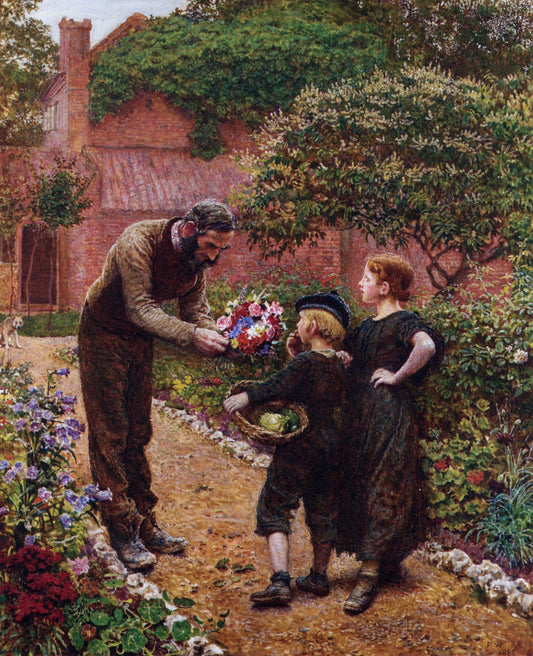
Walker, Frederick (1840-1875) - The Bouquet 1865
Vendor:Digital Download - 1 imageRegular price £0.80Regular priceUnit price per -


Walker, Frederick (1840-1875) - The Old Gate
Vendor:Digital Download - 1 imageRegular price £0.80Regular priceUnit price per -


Walker, Frederick (1840-1875) - Spring
Vendor:Digital Download - 1 imageRegular price £0.80Regular priceUnit price per -


Walker, Frederick (1840-1875) - Coachman and Cabbages 1870
Vendor:Digital Download - 1 imageRegular price £0.80Regular priceUnit price per -


Walker, Frederick (1840-1875) - Autumn 1865
Vendor:Digital Download - 1 imageRegular price £0.80Regular priceUnit price per


Latest Picture Trove Blog Posts
View all-

William Morris’s Strawberry Thief: The Story Behind a Classic Arts and Crafts Pattern
Few William Morris designs are as instantly recognisable as Strawberry Thief. With its richly patterned foliage, small red strawberries and watchful birds hidden among curling leaves, it has become one of the most loved designs of the Arts and Crafts movement.
William Morris’s Strawberry Thief: The Story Behind a Classic Arts and Crafts Pattern
Few William Morris designs are as instantly recognisable as Strawberry Thief. With its richly patterned foliage, small red strawberries and watchful birds hidden among curling leaves, it has become one of the most loved designs of the Arts and Crafts movement.
-

Glasgow and the Mackintosh Style
We recently took ourselves off to Scotland, and on our travels, we popped into the Mackintosh Tea Rooms in Glasgow for a bit of a nose around and a spot of lunch.
Glasgow and the Mackintosh Style
We recently took ourselves off to Scotland, and on our travels, we popped into the Mackintosh Tea Rooms in Glasgow for a bit of a nose around and a spot of lunch.
-

A Trip to Edinburgh & Glasgow, and Scottish Art
We have just returned from a well-deserved few days' break in Scotland, visiting both Edinburgh and Glasgow, taking in Scottish art and tea rooms!
A Trip to Edinburgh & Glasgow, and Scottish Art
We have just returned from a well-deserved few days' break in Scotland, visiting both Edinburgh and Glasgow, taking in Scottish art and tea rooms!


