

John Trumbull (1756-1843) stands as one of the most significant figures in early American art, renowned for his vivid depictions of the American Revolutionary War and his contributions to the visual identity of the fledgling United States. Born in Lebanon, Connecticut, Trumbull was the son of Jonathan Trumbull, the Governor of Connecticut and a staunch supporter of the colonial cause, an environment that deeply influenced John’s perspective and career.
Trumbull attended Harvard College, graduating in 1773, but the outbreak of the American Revolution soon drew him away from academic pursuits. He joined the Continental Army, serving as an aide-de-camp to General George Washington and later as deputy adjutant general under General Horatio Gates. His military experience, combined with his keen observational skills, provided him with a unique insight into the events and personalities that would later populate his canvases.
After the war, Trumbull travelled to London to study painting under Benjamin West, the leading Anglo-American painter of the period. West’s mentorship was invaluable, helping Trumbull refine his technique and introducing him to the ‘history painting’ tradition—a genre that aimed to encapsulate pivotal moments and heroic deeds. Trumbull embraced this approach, choosing the American Revolution as his primary subject matter.
He is perhaps best known for his series of large-scale paintings depicting seminal events from the Revolution. Among these, "The Declaration of Independence," completed in 1817, is undoubtedly the most iconic. This work, which hangs in the rotunda of the United States Capitol, captures the presentation of the draft Declaration to Congress—a moment both patriotic and profound. Trumbull’s meticulous attention to detail and insistence on accurate likenesses of the key figures lend his paintings an authenticity that resonates to this day.
Trumbull’s oeuvre extends beyond battle scenes and historic gatherings; he also produced many portraits of the era’s notable individuals, including Washington, Jefferson, and Hamilton. His ability to convey both the character and gravitas of his sitters contributed to his reputation as a leading portraitist of his generation.
In later life, Trumbull served as president of the American Academy of the Fine Arts and compiled his autobiography, further cementing his legacy. His works remain central to the American artistic canon, serving as both artistic achievements and invaluable records of the nation’s birth. Through his paintings, John Trumbull ensured that the struggles and ideals of the American Revolution would be remembered by generations to come.
Images to download
-


Trumbull, John (1756-1843) - The Capture of the Hessians at Trenton 26 December 1776
Vendor:Digital Download - 1 imageRegular price £0.80Regular priceUnit price per -

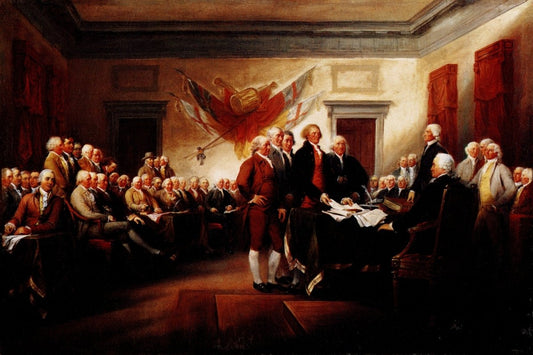
Trumbull, John (1756-1843) - The Declaration of Independence 1786-97
Vendor:Digital Download - 1 imageRegular price £0.80Regular priceUnit price per


Latest Picture Trove Blog Posts
View all-

William Morris’s Strawberry Thief: The Story Behind a Classic Arts and Crafts Pattern
Few William Morris designs are as instantly recognisable as Strawberry Thief. With its richly patterned foliage, small red strawberries and watchful birds hidden among curling leaves, it has become one of the most loved designs of the Arts and Crafts movement.
William Morris’s Strawberry Thief: The Story Behind a Classic Arts and Crafts Pattern
Few William Morris designs are as instantly recognisable as Strawberry Thief. With its richly patterned foliage, small red strawberries and watchful birds hidden among curling leaves, it has become one of the most loved designs of the Arts and Crafts movement.
-

Glasgow and the Mackintosh Style
We recently took ourselves off to Scotland, and on our travels, we popped into the Mackintosh Tea Rooms in Glasgow for a bit of a nose around and a spot of lunch.
Glasgow and the Mackintosh Style
We recently took ourselves off to Scotland, and on our travels, we popped into the Mackintosh Tea Rooms in Glasgow for a bit of a nose around and a spot of lunch.
-

A Trip to Edinburgh & Glasgow, and Scottish Art
We have just returned from a well-deserved few days' break in Scotland, visiting both Edinburgh and Glasgow, taking in Scottish art and tea rooms!
A Trip to Edinburgh & Glasgow, and Scottish Art
We have just returned from a well-deserved few days' break in Scotland, visiting both Edinburgh and Glasgow, taking in Scottish art and tea rooms!


