

Nicolas de Staël (1914-1955) stands as one of the most distinctive figures in twentieth-century European art, renowned for his evocative abstraction and the lyrical power of his landscapes and still lifes. Born in St. Petersburg in 1914, de Staël’s early years were shaped by upheaval and displacement, as his family fled the Russian Revolution, eventually settling in France. This early experience of exile and adaptation would inform his emotional depth and sense of solitude, recurrent themes in his artistic output.
De Staël’s formal art education began in Brussels, where he attended the Académie Royale des Beaux-Arts. His early work was influenced by post-impressionism and the old masters, yet he soon gravitated towards abstraction, drawn by a desire to capture the essence of his subjects rather than their literal forms. This pursuit was not merely intellectual; it was deeply visceral, as de Staël sought to express the world’s intensity through bold brushwork and a vibrant, often unexpected palette.
By the 1940s, de Staël had become associated with the School of Paris, a broad group of émigré and French artists exploring the boundaries between figuration and abstraction. His works from this period are marked by thick impasto, geometric structuring, and a remarkable sense of light. Paintings such as “Composition” (c.1950) exemplify his ability to evoke landscapes or still lifes with blocks of colour and textured surfaces, inviting viewers to engage emotionally rather than analytically.
Despite his abstract tendencies, de Staël never abandoned reference to the visible world. Unlike many of his contemporaries who pursued pure abstraction, he continually returned to recognisable subjects: landscapes, seascapes, and still lifes. His late works, particularly those painted in the south of France, radiate a luminous intensity, reflecting both the Mediterranean light and his own inner turbulence.
Tragically, de Staël’s life was cut short when he died by suicide in 1955 at the age of forty-one. Yet his legacy endures through a body of work that bridges the gap between abstraction and representation, marked by an emotional resonance unmatched by many of his peers. Today, Nicolas de Staël is celebrated not only for his technical innovations but also for the profound sense of humanity and poetry that infuses his art, ensuring his enduring appeal in the canon of modern painting.
Images to download
-

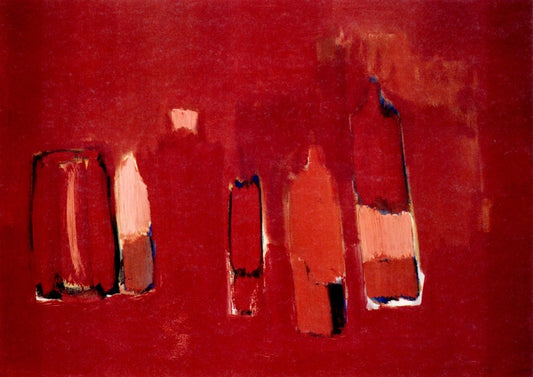
Staël, Nicolas de (1914-1955) - Red Bottles 1955
Vendor:Digital Download - 1 imageRegular price £0.80Regular priceUnit price per -

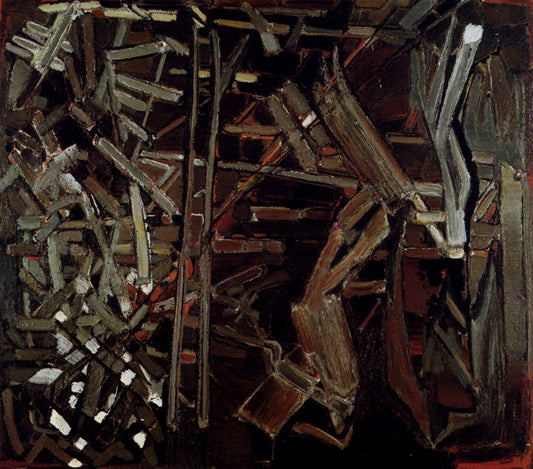
Staël, Nicolas de (1914-1955) - Life is Hard 1946
Vendor:Digital Download - 1 imageRegular price £0.80Regular priceUnit price per -

 Value Bundle
New for 2026 - 476 Image Value Bundle
Vendor:Digital Download - 476 imagesRegular price £35.00Regular priceUnit price per£50.40Sale price £35.00Value Bundle


Latest Picture Trove Blog Posts
View all-

William Morris’s Strawberry Thief: The Story Behind a Classic Arts and Crafts Pattern
Few William Morris designs are as instantly recognisable as Strawberry Thief. With its richly patterned foliage, small red strawberries and watchful birds hidden among curling leaves, it has become one of the most loved designs of the Arts and Crafts movement.
William Morris’s Strawberry Thief: The Story Behind a Classic Arts and Crafts Pattern
Few William Morris designs are as instantly recognisable as Strawberry Thief. With its richly patterned foliage, small red strawberries and watchful birds hidden among curling leaves, it has become one of the most loved designs of the Arts and Crafts movement.
-

Glasgow and the Mackintosh Style
We recently took ourselves off to Scotland, and on our travels, we popped into the Mackintosh Tea Rooms in Glasgow for a bit of a nose around and a spot of lunch.
Glasgow and the Mackintosh Style
We recently took ourselves off to Scotland, and on our travels, we popped into the Mackintosh Tea Rooms in Glasgow for a bit of a nose around and a spot of lunch.
-

A Trip to Edinburgh & Glasgow, and Scottish Art
We have just returned from a well-deserved few days' break in Scotland, visiting both Edinburgh and Glasgow, taking in Scottish art and tea rooms!
A Trip to Edinburgh & Glasgow, and Scottish Art
We have just returned from a well-deserved few days' break in Scotland, visiting both Edinburgh and Glasgow, taking in Scottish art and tea rooms!


