

Walter Richard Sickert (1860-1942) was a German-born British painter and printmaker who was a member of the Camden Town Group of Post-Impressionist artists in early 20th-century London. He was an important influence on distinctively British styles of avant-garde art in the mid and late 20th century.
Sickert was a cosmopolitan and an eccentric who often favoured ordinary people and urban scenes as his subjects. His work includes portraits of well-known personalities and images derived from press photographs. He is considered a prominent figure in the transition from Impressionism to Modernism.
Decades after his death, several authors and researchers theorised that Sickert might have been the London-based serial killer Jack the Ripper, but the claim has largely been dismissed.
Sickert was born in Munich, Kingdom of Bavaria, on 31 May 1860, the eldest son of Oswald Sickert, a Danish artist, and his English wife, Eleanor Louisa Henry, who was the illegitimate daughter of the astronomer Richard Sheepshanks. In 1868, following the German annexation of Schleswig-Holstein, the family settled in England, where Oswald's work had been recommended by Freiherrin Rebecca von Kreusser to Ralph Nicholson Wornum, who was Keeper of the National Gallery at the time. The family eventually settled in London and obtained British nationality.
The young Sickert was sent to University College School from 1870 to 1871, before transferring to King's College School, where he studied until the age of 18. Though he was the son and grandson of painters, he first sought a career as an actor; he appeared in small parts in Sir Henry Irving's company before taking up the study of art in 1881. After less than a year's attendance at the Slade School, Sickert left to become a pupil of and etching assistant to James Abbott McNeill Whistler. Sickert's earliest paintings were small tonal studies painted alla prima from nature after Whistler's example.
In 1883 he travelled to Paris and met Edgar Degas, whose use of pictorial space and emphasis on drawing would have a powerful effect on Sickert's work. He developed a personal version of Impressionism, favouring sombre colouration. Following Degas' advice, Sickert painted in the studio, working from drawings and memory as an escape from "the tyranny of nature". In 1888 Sickert joined the New English Art Club, a group of French-influenced realist artists. Sickert's first major works, dating from the late 1880s, were portrayals of scenes in London music halls.
In the late 1880s he spent much of his time in France, especially in Dieppe, which he first visited in mid-1885, and where his mistress, and possibly his illegitimate son, lived. During this period, Sickert began writing art criticism for various publications, including Herbert Vivian and Ruaraidh Erskine's The Whirlwind. Between 1894 and 1904, Sickert made a series of visits to Venice, initially focusing on the city's topography; it was during his last painting trip in 1903-4 that, forced indoors by inclement weather, he developed a distinctive approach to the multiple-figure tableau that he further explored on his return to Britain.
Sickert's fascination with urban culture accounted for his acquisition of studios in working-class sections of London, first in Cumberland Market in the 1890s, then in Camden Town in 1905. The latter location provided an event that would secure Sickert's prominence in the realist movement in Britain.
On 11 September 1907, Emily Dimmock, a prostitute cheating on her partner, was murdered in her home at Agar Grove (then St Paul's Road), Camden. After sexual intercourse, the man had slit her throat open while she was asleep, then left in the morning. The Camden Town murder became an ongoing source of prurient sensationalism in the press. For several years, Sickert had already been painting lugubrious female nudes on beds, and continued to do so, deliberately challenging the conventional approach to life painting. "The modern flood of representations of vacuous images dignified by the name of 'the nude' represents an artistic and intellectual bankruptcy", giving four of them, which included a male figure, the title The Camden Town Murder, and causing a controversy which ensured attention for his work. These paintings do not show violence, however, but a sad thoughtfulness, explained by the fact that three of them were originally exhibited with completely different titles, one more appropriately being What Shall We Do for the Rent?, and the first in the series, Summer Afternoon.
While the painterly handling of the works inspired comparison to Impressionism, and the emotional tone suggested a narrative more akin to genre painting, specifically Degas's Interior, the documentary realism of the Camden Town paintings was without precedent in British art. These and other works were painted in heavy impasto and narrow tonal range. Sickert's best-known work, Ennui (c1914), reveals his interest in Victorian narrative genres.
Just before the First World War he championed the avant-garde artists Lucien Pissarro, Jacob Epstein, Augustus John and Wyndham Lewis. At the same time Sickert founded, with other artists, the Camden Town Group of British painters, named from the district of London in which he lived. This group had been meeting informally since 1905, but was officially established in 1911. It was influenced by Post-Impressionism and Expressionism, but concentrated on scenes of often drab suburban life; Sickert himself said he preferred the kitchen to the drawing room as a scene for paintings.
From 1908 to 1912, and again from 1915 to 1918, he was an influential teacher at Westminster School of Art, where David Bomberg, Wendela Boreel, Mary Godwin and John Doman Turner were among his students. He founded a private art school, Rowlandson House, in the Hampstead Road in 1910. It lasted until 1914; for most of that period its co-principal and chief financial supporter was the painter Sylvia Gosse, a former student of Sickert. He also briefly set up an art school in Manchester where his students included Harry Rutherford.
After the death of his second wife in 1920, Sickert relocated to Dieppe, where he painted scenes of casinos and café life until his return to London in 1922. In 1924, he was elected an Associate of the Royal Academy (ARA).
In 1926 he suffered an illness, thought to have been a minor stroke. In 1927, he abandoned his first name in favour of his middle name, and thereafter chose to be known as Richard Sickert. His style and subject matter also changed: Sickert stopped drawing, and instead painted from snapshots usually taken by his third wife, Thérèse Lessore, or from news photographs. The photographs were squared up for enlargement and transferred to canvas, with their pencil grids plainly visible in the finished paintings.
Seen by many of his contemporaries as evidence of the artist's decline, Sickert's late works are also his most forward-looking, and prefigure the practices of Chuck Close and Gerhard Richter. Other paintings from Sickert's late period were adapted from illustrations by Victorian artists such as Georgie Bowers and John Gilbert. Sickert, separating these illustrations from their original context and painting them in poster-like colours so that the narrative and spatial intelligibility partly dissolved, called the resulting works his "English Echoes".
Sickert painted an informal portrait of Winston Churchill in about 1927. Churchill's wife Clementine introduced him to Sickert, who had been a friend of her family. The two men got along so well that Churchill, whose hobby was painting, wrote to his wife that "He is really giving me a new lease of life as a painter."
Sickert tutored and mentored students of the East London Group, and exhibited alongside them at The Lefevre Gallery in November 1929.
One of Sickert's closest friends and supporters was newspaper baron Lord Beaverbrook, who accumulated the largest single collection of Sickert paintings in the world. This collection, with a private correspondence between Sickert and Beaverbook, is in the Beaverbrook Art Gallery in Fredericton, New Brunswick, Canada. In addition to having painted Beaverbrook, Sickert painted portraits of notables including Gwen Ffrangcon-Davies, Hugh Walpole, Valentine Browne, 6th Earl of Kenmare, and less formal depictions of Aubrey Beardsley, King George V, and Peggy Ashcroft.
Sickert died in Bath, Somerset in 1942, at the age of 81. He had spent much time in the city in his later years, and many of his paintings depict Bath's varied street scenes. He is buried in the churchyard of the Church of St Nicholas, Bathampton.
Images to download
-


Walter Sickert 127 High Resolution Images
Vendor:Digital Download - 127 imagesRegular price £4.00Regular priceUnit price per -

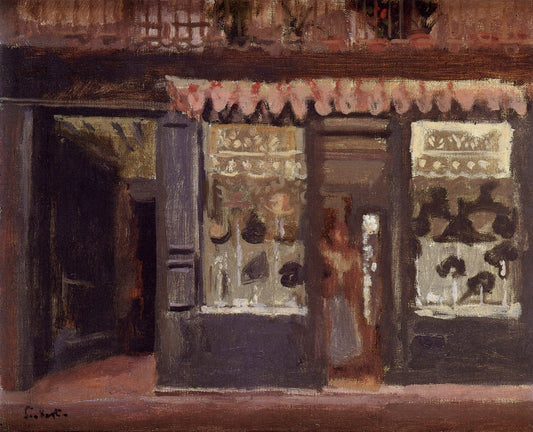
Sickert, Walter (1860-1942) - The Hat Shop
Vendor:Digital Download - 1 imageRegular price £0.80Regular priceUnit price per -


Sickert, Walter (1860-1942) - The Studio, Painting of a Nude c.1911-12
Vendor:Digital Download - 1 imageRegular price £0.80Regular priceUnit price per -


Sickert, Walter (1860-1942) - The Mantelpiece c.1911-12
Vendor:Digital Download - 1 imageRegular price £0.80Regular priceUnit price per -


Sickert, Walter (1860-1942) - Sir Winston Churchill 1927
Vendor:Digital Download - 1 imageRegular price £0.80Regular priceUnit price per -


Sickert, Walter (1860-1942) - Queen's Road Station, Bayswater c1916
Vendor:Digital Download - 1 imageRegular price £0.80Regular priceUnit price per -


Sickert, Walter (1860-1942) - Piazzetta di San Marco with La Giuseppina c.1906
Vendor:Digital Download - 1 imageRegular price £0.80Regular priceUnit price per -


Sickert, Walter (1860-1942) - Noctes Ambrosianae 1906
Vendor:Digital Download - 1 imageRegular price £0.80Regular priceUnit price per -


Sickert, Walter (1860-1942) - Mornington Crescent Nude c.1907
Vendor:Digital Download - 1 imageRegular price £0.80Regular priceUnit price per -


Sickert, Walter (1860-1942) - King George V & his Racing Manager c.1929-30
Vendor:Digital Download - 1 imageRegular price £0.80Regular priceUnit price per -


Sickert, Walter (1860-1942) - Bathers, Dieppe 1902
Vendor:Digital Download - 1 imageRegular price £0.80Regular priceUnit price per -


British Impressionism Collection - 100 High Resolution Images
Vendor:Digital Download - 100 imagesRegular price £4.00Regular priceUnit price per -

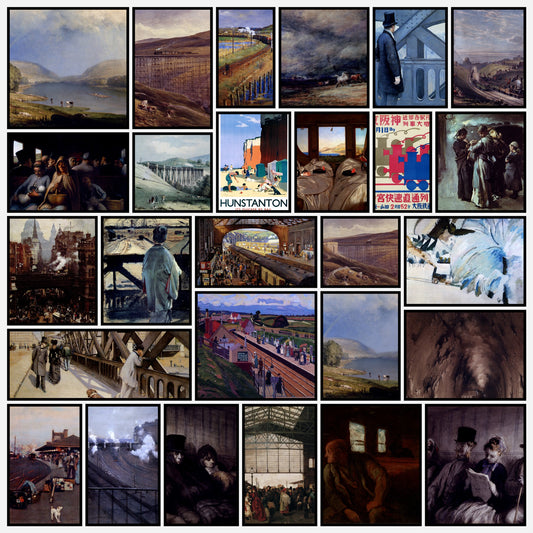
Trains in Art - 105 High Resolution Images
Vendor:Digital Download - 105 imagesRegular price £6.00Regular priceUnit price per


Latest Picture Trove Blog Posts
View all-

William Morris’s Strawberry Thief: The Story Behind a Classic Arts and Crafts Pattern
Few William Morris designs are as instantly recognisable as Strawberry Thief. With its richly patterned foliage, small red strawberries and watchful birds hidden among curling leaves, it has become one of the most loved designs of the Arts and Crafts movement.
William Morris’s Strawberry Thief: The Story Behind a Classic Arts and Crafts Pattern
Few William Morris designs are as instantly recognisable as Strawberry Thief. With its richly patterned foliage, small red strawberries and watchful birds hidden among curling leaves, it has become one of the most loved designs of the Arts and Crafts movement.
-

Glasgow and the Mackintosh Style
We recently took ourselves off to Scotland, and on our travels, we popped into the Mackintosh Tea Rooms in Glasgow for a bit of a nose around and a spot of lunch.
Glasgow and the Mackintosh Style
We recently took ourselves off to Scotland, and on our travels, we popped into the Mackintosh Tea Rooms in Glasgow for a bit of a nose around and a spot of lunch.
-

A Trip to Edinburgh & Glasgow, and Scottish Art
We have just returned from a well-deserved few days' break in Scotland, visiting both Edinburgh and Glasgow, taking in Scottish art and tea rooms!
A Trip to Edinburgh & Glasgow, and Scottish Art
We have just returned from a well-deserved few days' break in Scotland, visiting both Edinburgh and Glasgow, taking in Scottish art and tea rooms!


