

Gerard Seghers (1591-1651) was a prominent Flemish Baroque painter who made significant contributions to the artistic landscape of seventeenth-century Europe. Born in Antwerp, Seghers was deeply influenced by the dynamic and dramatic styles that characterised the Baroque period. His oeuvre is marked by a mastery of chiaroscuro, vibrant colour palettes, and expressive compositions, placing him among the foremost artists of his generation.
Seghers began his artistic training in Antwerp, a city renowned for its thriving art scene and as the home of illustrious painters such as Peter Paul Rubens and Anthony van Dyck. In his formative years, Seghers travelled to Italy, a journey that profoundly shaped his stylistic development. During his stay in Rome, he encountered the works of Caravaggio and his followers, known as the Caravaggisti. The intense naturalism and dramatic use of light and shadow in Caravaggio’s paintings left an indelible mark on Seghers, who returned to Flanders with a new artistic vision.
Upon his return to Antwerp, Seghers quickly established himself as a sought-after painter. His compositions, often depicting religious themes, were celebrated for their emotional depth and theatricality. Seghers’ ability to convey powerful narratives through expressive gestures and vivid contrasts drew admiration from patrons and fellow artists alike. Many of his altarpieces, created for churches across Flanders, demonstrate a sophisticated understanding of human emotion and spiritual devotion.
Seghers was also known for his talent as a portraitist and genre painter. His works frequently feature robust, lifelike figures rendered with meticulous attention to detail. In addition to religious scenes, he produced allegorical and mythological paintings, showcasing his versatility and command of different subjects. Seghers maintained a large workshop in Antwerp, where he trained numerous pupils and assistants, thereby exerting a lasting influence on the next generation of Flemish painters.
Throughout his career, Gerard Seghers enjoyed considerable success and recognition. He was appointed dean of the Antwerp Guild of Saint Luke, a prestigious position that attested to his standing within the artistic community. His paintings can be found in major museums and collections across Europe, testament to his enduring legacy. Seghers’ unique synthesis of Italian and Flemish artistic traditions ensured that his work remained highly regarded long after his death in 1651, securing his place in the annals of art history.
Images to download
-

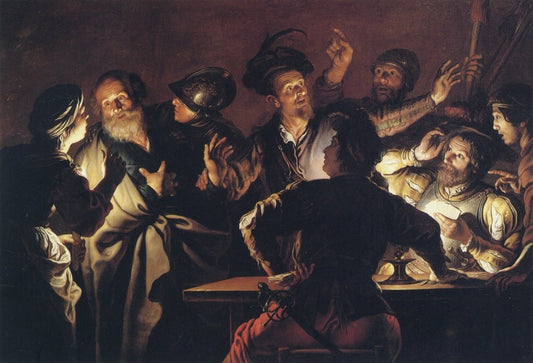
Seghers, Gerard (1591-1651) - The Denial of St. Peter c.1620-39
Vendor:Digital Download - 2 imagesRegular price £1.00Regular priceUnit price per

Latest Picture Trove Blog Posts
View all-

William Morris’s Strawberry Thief: The Story Behind a Classic Arts and Crafts Pattern
Few William Morris designs are as instantly recognisable as Strawberry Thief. With its richly patterned foliage, small red strawberries and watchful birds hidden among curling leaves, it has become one of the most loved designs of the Arts and Crafts movement.
William Morris’s Strawberry Thief: The Story Behind a Classic Arts and Crafts Pattern
Few William Morris designs are as instantly recognisable as Strawberry Thief. With its richly patterned foliage, small red strawberries and watchful birds hidden among curling leaves, it has become one of the most loved designs of the Arts and Crafts movement.
-

Glasgow and the Mackintosh Style
We recently took ourselves off to Scotland, and on our travels, we popped into the Mackintosh Tea Rooms in Glasgow for a bit of a nose around and a spot of lunch.
Glasgow and the Mackintosh Style
We recently took ourselves off to Scotland, and on our travels, we popped into the Mackintosh Tea Rooms in Glasgow for a bit of a nose around and a spot of lunch.
-

A Trip to Edinburgh & Glasgow, and Scottish Art
We have just returned from a well-deserved few days' break in Scotland, visiting both Edinburgh and Glasgow, taking in Scottish art and tea rooms!
A Trip to Edinburgh & Glasgow, and Scottish Art
We have just returned from a well-deserved few days' break in Scotland, visiting both Edinburgh and Glasgow, taking in Scottish art and tea rooms!


