

Morgan Russell (1886-1953) was an influential American painter, best known as a founding figure of the Synchromism art movement in the early twentieth century. Born in New York in 1886, Russell initially trained as an architect, before turning his attention to painting. He studied at the Art Students League of New York and later continued his artistic education in Paris, which was then the epicentre of avant-garde creativity. Paris proved to be a critical environment for Russell, exposing him to the works of contemporary European artists and enabling him to develop his own unique voice within modernism.
Russell’s most significant contribution to art was the creation of Synchromism, a movement he co-founded with fellow artist Stanton Macdonald-Wright. Synchromism was rooted in the idea that colour, like music, could be orchestrated to evoke emotion and create dynamic compositions. The artists sought to free painting from literal representation, instead focusing on the expressive potential of colour and form. Russell’s paintings from this period are characterised by their vibrant palettes, swirling, abstract shapes, and rhythmic structures, reflecting his belief in the harmony between colour and sensation.
Despite its innovation, Synchromism faced challenges in gaining recognition, particularly in the United States. Nonetheless, Russell exhibited his work in both Europe and America, participating in the famous 1913 Armory Show in New York, which introduced modernist art to a wider American audience. His canvases stood out for their bold use of colour, which often drew comparisons to the Orphism of Robert and Sonia Delaunay, though Russell maintained that Synchromism was an independent development.
Russell’s artistic journey was marked by periods of both productivity and hardship. Financial difficulties and health problems affected his career, and his later works showed a return to more figurative painting, though he never abandoned his interest in vibrant colour. Throughout his life, Russell remained committed to exploring the expressive power of painting, continually experimenting with new techniques and ideas.
Today, Morgan Russell is recognised as a significant, if sometimes overlooked, figure in early American modernism. His pioneering work in abstract painting has been reassessed by art historians, who acknowledge his role in advancing colour theory and abstraction. Major museums, including the Whitney Museum of American Art and the Smithsonian American Art Museum, now hold his works, ensuring his legacy endures as part of the narrative of twentieth-century art.
Images to download
-

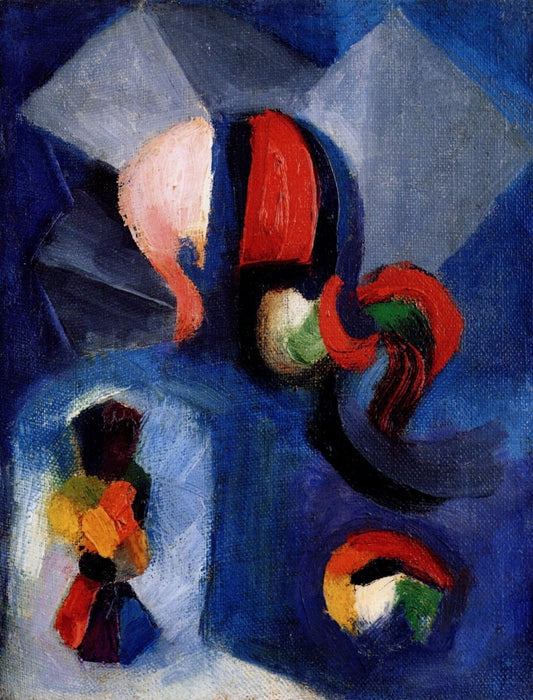
Russell, Morgan (1886-1953) - Synchromy c.1914-23
Vendor:Digital Download - 1 imageRegular price £0.80Regular priceUnit price per

Latest Picture Trove Blog Posts
View all-

William Morris’s Strawberry Thief: The Story Behind a Classic Arts and Crafts Pattern
Few William Morris designs are as instantly recognisable as Strawberry Thief. With its richly patterned foliage, small red strawberries and watchful birds hidden among curling leaves, it has become one of the most loved designs of the Arts and Crafts movement.
William Morris’s Strawberry Thief: The Story Behind a Classic Arts and Crafts Pattern
Few William Morris designs are as instantly recognisable as Strawberry Thief. With its richly patterned foliage, small red strawberries and watchful birds hidden among curling leaves, it has become one of the most loved designs of the Arts and Crafts movement.
-

Glasgow and the Mackintosh Style
We recently took ourselves off to Scotland, and on our travels, we popped into the Mackintosh Tea Rooms in Glasgow for a bit of a nose around and a spot of lunch.
Glasgow and the Mackintosh Style
We recently took ourselves off to Scotland, and on our travels, we popped into the Mackintosh Tea Rooms in Glasgow for a bit of a nose around and a spot of lunch.
-

A Trip to Edinburgh & Glasgow, and Scottish Art
We have just returned from a well-deserved few days' break in Scotland, visiting both Edinburgh and Glasgow, taking in Scottish art and tea rooms!
A Trip to Edinburgh & Glasgow, and Scottish Art
We have just returned from a well-deserved few days' break in Scotland, visiting both Edinburgh and Glasgow, taking in Scottish art and tea rooms!


