

Catherine Read (or Katherine, 1723-1778) was a Scottish artist. Born in the early 18th century, she is most known for her work as a portrait painter. She was for some years a fashionable artist in London, working in oils, crayons, and miniature. From 1760 she exhibited almost annually with either the Incorporated Society of Artists, the Free Society of Artists, or the Royal Academy, sending chiefly portraits of ladies and children of the aristocracy, which she painted with much grace and refinement.
Read was born in Dundee, Scotland on 3 February 1723, to Alexander and Elizabeth Read, and one of thirteen children of an affluent Forfarshire family. She received her education from Maurice Quentin De La Tour in Edinburgh. Her mother was the sister of Sir John Wedderburn, 5th Baronet of Blackness, who fought in the Jacobite rising of 1745, and whose daughters were cared for by Read after his execution.
When the war ended at the Battle of Culloden and with family friends fleeing to France, Read’s family was prompted to follow suit for their association and support of the Jacobite cause through her uncle. Through their connections with the gentry, they were given sanctuary in Paris that same year and introduced to the painter Robert Strange, who is speculated to be Read’s teacher and introduction into the French artistic sphere. There she studied other works of art and improved her skills with little hindrance or instruction; it would have been hard for her to have been accepted into an academy class as a woman, let alone a foreigner whose family had a price on their heads for aiding and supporting a cause against the King of Great Britain and Ireland, but from the late 1740s, she spent time in the studios of the pastellist Maurice Quentin de la Tour and Louis Blanchet.
This period was not to last, however, as she fled to Rome in 1750 along with a majority of the Jacobites that had sought refuge in Paris. While there, she became friends with members of the Roman Catholic Church, often commissioned to recreate master paintings in oil or pastel for those in high clerical positions. One of these faithful patrons, Cardinal Albani, allowed Read to copy some of the portraits he owned by Rosalba Carriera, which ultimately led the man to sit for her himself.
She remained in Rome until deciding to venture to England in 1753, with the blessing of Albani, who managed to help her keep face regardless of her family’s past alignment in the war. This era was filled with a healthy stream of patronage and commissions. She attracted a distinguished circle of clients, including Queen Charlotte. At the height of her career, her work was widely engraved, bringing her important artistic endorsement and commercial success. Read communicated with and submitted samples to the Society of Arts for their collection and approval of fixing pastels. However, her methods, when compared to those of Sebastien Jurine, were considered inferior as she used a different type of pastel than he.
In 1764, Read was on the road back to Paris for commissioned portraits of Madame Elisabeth through the Dauphin. Her work was shown by the Free Society (1761-1768) and the Society of Artists (1760-1772), of which she became an honorary member in 1769, along with the two other female pastel artists, Mary Benwell and Mary Black, in response to the Royal Academy accepting Angelica Kauffman and Mary Moser into their respective fold. Later, after a failed petition to the king, Read left to join the Royal Academy and was expelled from the Society as a consequence.
In 1771, she went to India to paint the portraits of the English officers living there. She was accompanied by her niece, Helena Beatson, a clever young artist, who there married, in 1777, (Sir) Charles Oakeley, baronet, later governor of Madras. Her death is recorded as 15 December 1778.
Images to download
-


Read, Katherine (1723-1778) - Sarah, Lady Pollington 1760s
Vendor:Digital Download - 1 imageRegular price £0.80Regular priceUnit price per -

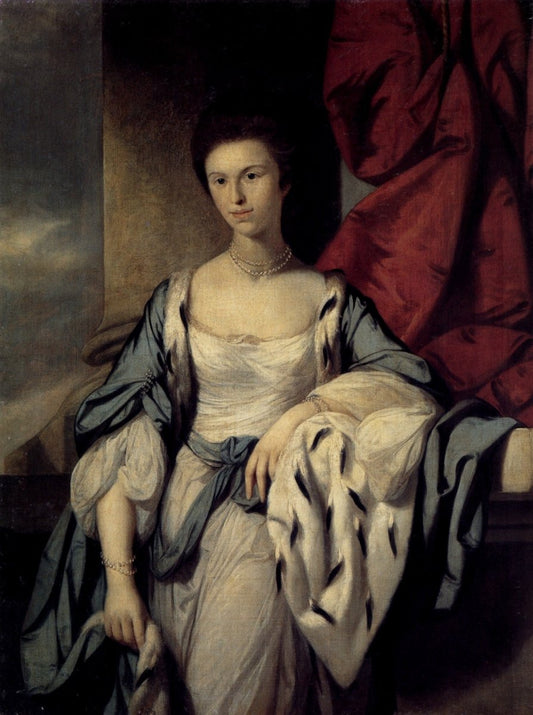
Read, Katherine (1723-1778) - Portrait of Maria Constantina, Countess of Suffolk c.1765
Vendor:Digital Download - 1 imageRegular price £0.80Regular priceUnit price per -


Read, Katherine (1723-1778) - Willielma Campbell, Lady Glenorchy 1762
Vendor:Digital Download - 1 imageRegular price £0.80Regular priceUnit price per -


Read, Katherine (1723-1778) - The Arundell Children with their Dog c.1772
Vendor:Digital Download - 1 imageRegular price £0.80Regular priceUnit price per -


Read, Katherine (1723-1778) - Miss Helena Beatson 1767
Vendor:Digital Download - 1 imageRegular price £0.80Regular priceUnit price per -


Read, Katherine (1723-1778) - Anna Vernon, Lady Berwick with son Thomas Noel-Hill c.1770
Vendor:Digital Download - 1 imageRegular price £0.80Regular priceUnit price per


Latest Picture Trove Blog Posts
View all-

William Morris’s Strawberry Thief: The Story Behind a Classic Arts and Crafts Pattern
Few William Morris designs are as instantly recognisable as Strawberry Thief. With its richly patterned foliage, small red strawberries and watchful birds hidden among curling leaves, it has become one of the most loved designs of the Arts and Crafts movement.
William Morris’s Strawberry Thief: The Story Behind a Classic Arts and Crafts Pattern
Few William Morris designs are as instantly recognisable as Strawberry Thief. With its richly patterned foliage, small red strawberries and watchful birds hidden among curling leaves, it has become one of the most loved designs of the Arts and Crafts movement.
-

Glasgow and the Mackintosh Style
We recently took ourselves off to Scotland, and on our travels, we popped into the Mackintosh Tea Rooms in Glasgow for a bit of a nose around and a spot of lunch.
Glasgow and the Mackintosh Style
We recently took ourselves off to Scotland, and on our travels, we popped into the Mackintosh Tea Rooms in Glasgow for a bit of a nose around and a spot of lunch.
-

A Trip to Edinburgh & Glasgow, and Scottish Art
We have just returned from a well-deserved few days' break in Scotland, visiting both Edinburgh and Glasgow, taking in Scottish art and tea rooms!
A Trip to Edinburgh & Glasgow, and Scottish Art
We have just returned from a well-deserved few days' break in Scotland, visiting both Edinburgh and Glasgow, taking in Scottish art and tea rooms!


