

Howard Pyle (1853-1911) was an influential American illustrator and writer, often regarded as the father of American illustration. Although his career was based in the United States, his impact was international, and his work has been admired in Britain and across Europe for its distinctive style and narrative depth. Pyle was born in Wilmington, Delaware in 1853 and developed an early interest in both art and storytelling, which would later become the hallmark of his career.
Pyle’s first significant commission was for Scribner’s Monthly in 1876, which launched his career as an illustrator. He quickly became known for his ability to bring stories to life with vivid, dramatic imagery and a keen sense of historical detail. His illustrations for works such as “The Merry Adventures of Robin Hood” (1883) and “Otto of the Silver Hand” (1888) remain classics, with the Robin Hood illustrations in particular helping to shape popular perceptions of English folklore. Pyle’s work often drew on British legends and history, and his style was marked by strong compositions, rich colours, and an almost cinematic sense of action.
In addition to his own illustrations, Pyle was a prolific writer, crafting original tales and retellings of classic stories. His narrative skill was matched by a deep understanding of the interplay between text and image, making his books especially engaging for readers. The success of his Robin Hood adaptation, with its accessible language and dynamic illustrations, introduced generations of young readers to the legendary English outlaw. Pyle’s vision of Robin Hood as a noble and heroic figure helped to cement the character’s place in both American and British cultural imagination.
Perhaps Pyle’s greatest legacy was as a teacher and mentor. In 1900, he founded the Howard Pyle School of Art in Wilmington, which quickly became a centre for artistic innovation. His teaching emphasised not just technical skill, but the importance of storytelling, composition, and emotional resonance in illustration. Many of his students, including N. C. Wyeth, Frank E. Schoonover, and Jessie Willcox Smith, went on to become significant illustrators in their own right, spreading Pyle’s influence throughout the world.
Pyle was also fascinated by British history and culture, and he travelled to England in 1910 to study the old masters and to seek new inspiration. Sadly, he died the following year in Florence, Italy, at the age of 58. Despite his relatively short life, Pyle’s impact on illustration and narrative art was profound. His approach blended meticulous research with imaginative storytelling, setting a standard for generations of illustrators.
In summary, Howard Pyle’s work bridged the gap between American and British traditions, and his illustrations for English legends like Robin Hood helped popularise these stories for new audiences. His commitment to both craft and narrative, along with his dedication to teaching, ensured that his influence would endure. Pyle’s legacy is evident not just in the beauty of his own illustrations, but in the continuing vitality of narrative illustration as an art form.
Images to download
-

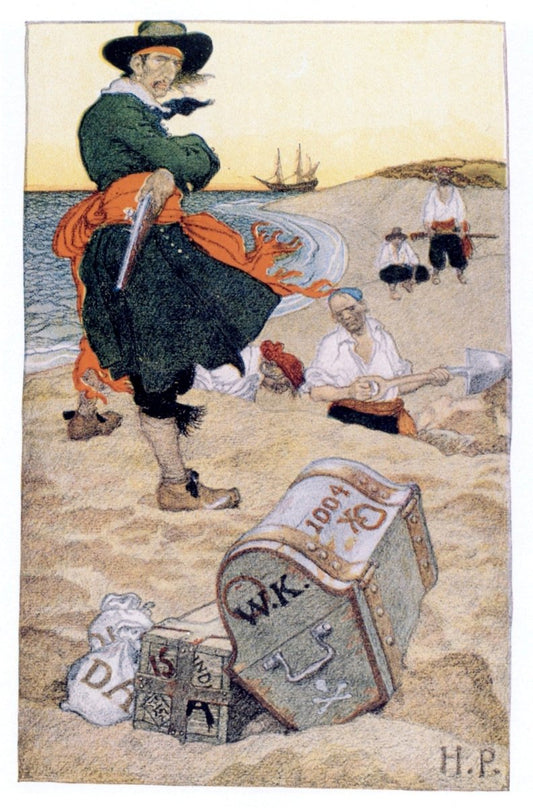
Pyle, Howard (1853-1911) - Treasure Chest 1921
Vendor:Digital Download - 1 imageRegular price £0.80Regular priceUnit price per

Latest Picture Trove Blog Posts
View all-

William Morris’s Strawberry Thief: The Story Behind a Classic Arts and Crafts Pattern
Few William Morris designs are as instantly recognisable as Strawberry Thief. With its richly patterned foliage, small red strawberries and watchful birds hidden among curling leaves, it has become one of the most loved designs of the Arts and Crafts movement.
William Morris’s Strawberry Thief: The Story Behind a Classic Arts and Crafts Pattern
Few William Morris designs are as instantly recognisable as Strawberry Thief. With its richly patterned foliage, small red strawberries and watchful birds hidden among curling leaves, it has become one of the most loved designs of the Arts and Crafts movement.
-

Glasgow and the Mackintosh Style
We recently took ourselves off to Scotland, and on our travels, we popped into the Mackintosh Tea Rooms in Glasgow for a bit of a nose around and a spot of lunch.
Glasgow and the Mackintosh Style
We recently took ourselves off to Scotland, and on our travels, we popped into the Mackintosh Tea Rooms in Glasgow for a bit of a nose around and a spot of lunch.
-

A Trip to Edinburgh & Glasgow, and Scottish Art
We have just returned from a well-deserved few days' break in Scotland, visiting both Edinburgh and Glasgow, taking in Scottish art and tea rooms!
A Trip to Edinburgh & Glasgow, and Scottish Art
We have just returned from a well-deserved few days' break in Scotland, visiting both Edinburgh and Glasgow, taking in Scottish art and tea rooms!


