

Kuzma Sergeevich Petrov-Vodkin (Кузьма́ Серге́евич Петро́в-Во́дкин) (1878-1939) was a Russian and Soviet painter, draughtsman, and writer, whose work marked a distinctive departure from both the academic traditions of the nineteenth century and the avant-garde experimentation of the early twentieth century. Born in Khvalynsk, a small town on the Volga, Petrov-Vodkin’s early life was shaped by the landscape and folklore of provincial Russia, influences that permeate much of his mature art.
Petrov-Vodkin initially trained as an icon painter before studying at the Moscow School of Painting, Sculpture and Architecture, and later in Munich. His artistic development coincided with a period of great upheaval and innovation in Russian art, as artists grappled with the legacy of realism and the allure of new movements such as Symbolism and Cubism. Petrov-Vodkin’s own style, however, remains difficult to categorise. He is perhaps best known for his use of vibrant, saturated colours and for developing a unique compositional method known as “spherical perspective”, which creates an effect of looking at a scene from multiple viewpoints simultaneously. This technique lends his paintings a sense of movement and spatial ambiguity, drawing the viewer into a world that is at once familiar and dreamlike.
Among his most celebrated works is “Bathing of a Red Horse” (1912), an iconic image of Russian modernism that blends classical poise with a mystical intensity. The painting’s luminous reds and blues, coupled with its enigmatic subject matter, exemplify Petrov-Vodkin’s approach: a fusion of the everyday and the otherworldly. Other significant works include “Petrograd Madonna” (1920), which reflects both the turmoil of the Russian Civil War and the enduring power of spiritual themes in his art.
In addition to his achievements as a painter, Petrov-Vodkin was an accomplished writer and theorist. His memoirs, such as “Khvalynsk” and “Space and Perspective”, offer valuable insights into his artistic philosophy and the intellectual ferment of his age. He also taught at the Academy of Arts in Petrograd, influencing a generation of Soviet artists.
Despite the shifting political landscape of early Soviet Russia, Petrov-Vodkin managed to retain a measure of creative independence. His later works, often more introspective and subdued, reflect his engagement with the challenges of his time. Today, Petrov-Vodkin is recognised as a singular figure whose art bridges tradition and innovation, and whose legacy continues to inspire.
Images to download
-

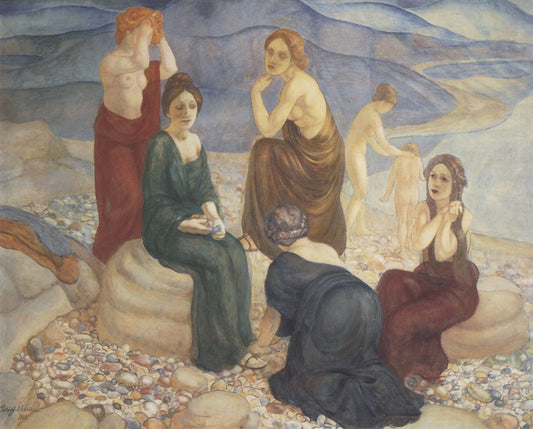
Petrov-Vodkin, Kosma (1878-1939) - Shore 1908
Vendor:Digital Download - 1 imageRegular price £0.80Regular priceUnit price per -

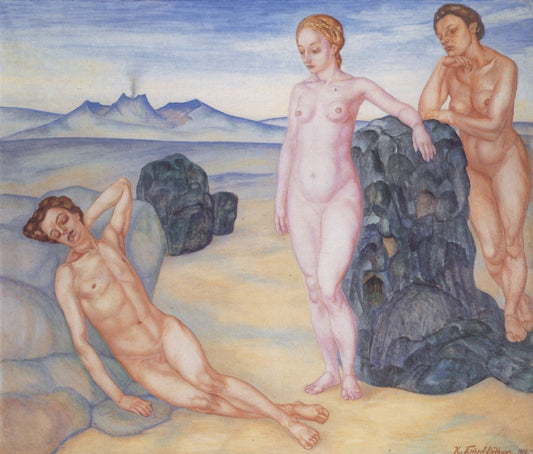
Petrov-Vodkin, Kosma (1878-1939) - Sleep 1911
Vendor:Digital Download - 1 imageRegular price £0.80Regular priceUnit price per -

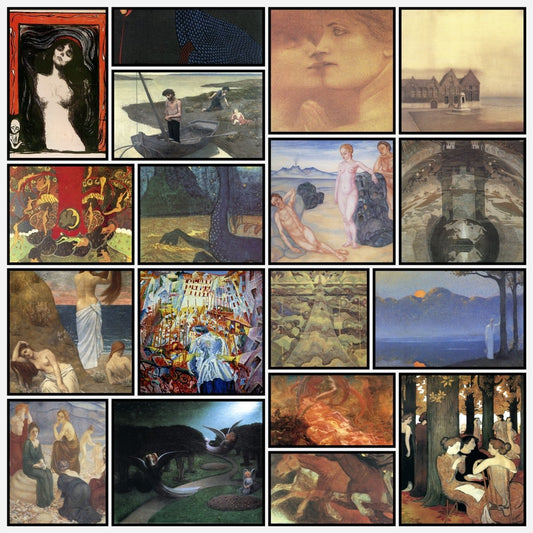
Symbolism Collection - 65 High Resolution Images
Vendor:Digital Download - 65 imagesRegular price £4.00Regular priceUnit price per


Latest Picture Trove Blog Posts
View all-

William Morris’s Strawberry Thief: The Story Behind a Classic Arts and Crafts Pattern
Few William Morris designs are as instantly recognisable as Strawberry Thief. With its richly patterned foliage, small red strawberries and watchful birds hidden among curling leaves, it has become one of the most loved designs of the Arts and Crafts movement.
William Morris’s Strawberry Thief: The Story Behind a Classic Arts and Crafts Pattern
Few William Morris designs are as instantly recognisable as Strawberry Thief. With its richly patterned foliage, small red strawberries and watchful birds hidden among curling leaves, it has become one of the most loved designs of the Arts and Crafts movement.
-

Glasgow and the Mackintosh Style
We recently took ourselves off to Scotland, and on our travels, we popped into the Mackintosh Tea Rooms in Glasgow for a bit of a nose around and a spot of lunch.
Glasgow and the Mackintosh Style
We recently took ourselves off to Scotland, and on our travels, we popped into the Mackintosh Tea Rooms in Glasgow for a bit of a nose around and a spot of lunch.
-

A Trip to Edinburgh & Glasgow, and Scottish Art
We have just returned from a well-deserved few days' break in Scotland, visiting both Edinburgh and Glasgow, taking in Scottish art and tea rooms!
A Trip to Edinburgh & Glasgow, and Scottish Art
We have just returned from a well-deserved few days' break in Scotland, visiting both Edinburgh and Glasgow, taking in Scottish art and tea rooms!


