

Samuel Palmer (1805-1881) was an English landscape painter, printmaker, and visionary artist whose work occupies a distinctive place in nineteenth-century British art. Born in London, Palmer demonstrated artistic talent from an early age, exhibiting at the Royal Academy by the age of fourteen. He became profoundly influential in the Romantic movement, drawing inspiration from the rural landscapes of England and imbuing them with a sense of spirituality and poetic mysticism.
Palmer’s formative years were marked by a deep engagement with the natural world and a fascination for the English countryside, particularly the Kentish village of Shoreham, where he moved in 1826. This period, often referred to as his “Shoreham Years”, proved to be the most creative and visionary phase of his career. During this time, Palmer produced a series of works characterised by lush pastoral imagery, glowing light, and a dreamlike quality that set his art apart from his contemporaries. He, together with George Richmond, was a key member of a group known as “The Ancients”, a circle of like-minded artists and writers who admired the work of William Blake and sought to capture the spiritual essence of nature.
Palmer’s technique was notable for his rich use of colour, intricate detail, and innovative compositions. His watercolours and drawings from the Shoreham period often depict idyllic scenes of harvest, moonlit landscapes, and rustic labourers, evoking a sense of harmony between humanity and the natural world. These works, such as “The Magic Apple Tree” and “A Cornfield by Moonlight with the Evening Star”, reveal Palmer’s belief in the divine presence within nature and his desire to transcend mere representation in favour of a more symbolic and emotional vision.
Despite the originality and beauty of his early works, Palmer struggled to gain widespread recognition during his lifetime. Following his marriage in 1837 and a trip to Italy, his style gradually shifted towards a more conventional approach, and he produced fewer of the visionary landscapes that had defined his earlier career. Nevertheless, Palmer continued to draw and paint throughout his life, leaving behind a substantial body of work that was only fully appreciated after his death.
Today, Samuel Palmer is celebrated as one of Britain’s most significant Romantic artists. His unique fusion of realism and imagination, his reverence for nature, and his spiritual vision have inspired generations of artists and continue to captivate audiences. Palmer’s legacy endures as a testament to the enduring power of art to reveal the hidden poetry of the world.
Images to download
-


Palmer, Samuel (1805-1881) - In a Shoreham Garden c.1829
Vendor:Digital Download - 1 imageRegular price £0.80Regular priceUnit price per -

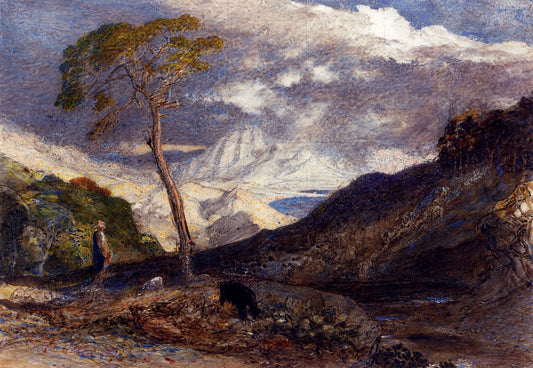
Palmer, Samuel (1805-1881) - The Goatherd c.1879
Vendor:Digital Download - 1 imageRegular price £0.80Regular priceUnit price per -


Palmer, Samuel (1805-1881) - Going Home at Curfew Time 1864
Vendor:Digital Download - 1 imageRegular price £0.80Regular priceUnit price per -


Palmer, Samuel (1805-1881) - View at Tivoli c.1839
Vendor:Digital Download - 1 imageRegular price £0.80Regular priceUnit price per -


Palmer, Samuel (1805-1881) - Ruth Returned from Gleaning c.1828
Vendor:Digital Download - 1 imageRegular price £0.80Regular priceUnit price per -


Palmer, Samuel (1805-1881) - Pear Tree in a Walled Garden c.1829
Vendor:Digital Download - 1 imageRegular price £0.80Regular priceUnit price per -


Palmer, Samuel (1805-1881) - The Waterfalls, Pistil Mawddach, North Wales 1835-6
Vendor:Digital Download - 1 imageRegular price £0.80Regular priceUnit price per -


Palmer, Samuel (1805-1881) - Landscape with Windmill 1851
Vendor:Digital Download - 1 imageRegular price £0.80Regular priceUnit price per


Latest Picture Trove Blog Posts
View all-

William Morris’s Strawberry Thief: The Story Behind a Classic Arts and Crafts Pattern
Few William Morris designs are as instantly recognisable as Strawberry Thief. With its richly patterned foliage, small red strawberries and watchful birds hidden among curling leaves, it has become one of the most loved designs of the Arts and Crafts movement.
William Morris’s Strawberry Thief: The Story Behind a Classic Arts and Crafts Pattern
Few William Morris designs are as instantly recognisable as Strawberry Thief. With its richly patterned foliage, small red strawberries and watchful birds hidden among curling leaves, it has become one of the most loved designs of the Arts and Crafts movement.
-

Glasgow and the Mackintosh Style
We recently took ourselves off to Scotland, and on our travels, we popped into the Mackintosh Tea Rooms in Glasgow for a bit of a nose around and a spot of lunch.
Glasgow and the Mackintosh Style
We recently took ourselves off to Scotland, and on our travels, we popped into the Mackintosh Tea Rooms in Glasgow for a bit of a nose around and a spot of lunch.
-

A Trip to Edinburgh & Glasgow, and Scottish Art
We have just returned from a well-deserved few days' break in Scotland, visiting both Edinburgh and Glasgow, taking in Scottish art and tea rooms!
A Trip to Edinburgh & Glasgow, and Scottish Art
We have just returned from a well-deserved few days' break in Scotland, visiting both Edinburgh and Glasgow, taking in Scottish art and tea rooms!


