

Harry Morley ARA (1881-1943) was a British painter, etcher and engraver known for his classical and mythological compositions.
Morley was born in Leicester where he studied at the Alderman Newton's School and then studied architecture at the Leicestershire School of Art. In 1901 he began studying in the architectural practice of Professor Beresford Pite and went on to study architecture at the Royal College of Art, where Pite taught. In 1905 Morley won travelling scholarships from both the RCA and the Royal Institute of British Architects. These awards allowed him to spend long periods of time in Italy and France and to concentrate on painting rather than architecture. Morley decided to continue his training at the Academie Julian in Paris throughout 1906. Following a visit to Sicily, he mounted an exhibition 'London and Continental' in his London studio.
In London 1911, Harry Morley married Lilias Helen Swain ARCA (1880-1973). A skilful calligrapher and embroiderer, Swain had studied design at the Royal College of Art under William Lethaby. Swain was teaching calligraphy and embroidery at the Royal College when she became engaged to Morley.
With fees from a commission to illustrate A Wanderer in Florence by E.V. Lucas (1912), Harry and Lilias Morley honeymooned in Florence. The couple travelled on to Venice and Paris, studied paintings in the galleries and sketched. Watercolours made by Morley in Venice were used two years later to illustrate Lucas's A Wanderer in Venice (1914). His watercolours of Paris were published in The Charm of Paris by Alfred H. Hyatt in 1913. In 1926, he was commissioned to illustrate a third book by Lucas, A Wanderer in Rome. The bird's-eye maps of Italian cities that appear on the end papers of all three books for Lucas were drawn by Morley and feature his wife's calligraphy.
Lilias all but gave up her artistic career to support Morley in his work. Whenever the opportunity arose, she undertook private commissions in calligraphy and embroidery design. She continued to draw and paint under the name Lester Romley. A quiet feminist from an early age, Lilias shared digs in Chelsea with fellow Royal College of Art student Sylvia Pankhurst, who like Lilias was from Manchester. Lilias designed and embroidered for the Pankhursts a demonstration banner (now lost).
By 1921 Morley had been elected a member of the Art Workers' Guild. He joined the Society of Painters in Tempera two years later. The ethos and camaraderie of artist groups appealed to him. He was an active member of both organisations. The Society of Painters in Tempera frequently held their meetings in Morley's studio. John D. Batten, the painter-activist Mary Sargant Florence, Francis Ernest Jackson, Maxwell Armfield and Joseph Southall were among the many that attended. The revival of British interest in tempera painting had begun as early as 1901 with the formation of the Society. By the 1920s the medium was better understood. However, it was only after the Royal Academy of Arts' groundbreaking Italian Art exhibition at Burlington House in 1930 that the academy accepted contemporary tempera paintings in its Summer Exhibition. A tempera of Morley's was one of the thirty-six tempera paintings shown that first year.
In 1925, commissions to illustrate E.V. Lucas' A Wanderer in Rome (1926) and Edward Hutton's Cities of Sicily (1926) allowed Morley and his wife to return to Italy. For several years they spent a few months each Spring travelling and working in Italy. In 1928 they stayed with the artist Job Nixon, sharing his studio in Anticoli Corrado. The following year, Robert Austin joined the Morleys in Anticoli. In search of interesting subjects the two men accompanied villagers of Ancticoli Corrado on an annual pilgrimage to the Sanctuary of the Madonna della Figura, Sora in the Lazio hills.
A weak heart and lifelong asthma excluded Morley from active duty during both wars. In 1940 Morley was staying at the Bishop's Palace, Wells working on his portrait The Very Reverend Bishop Underwood of Bath and Wells when his London home and studio were damaged by a bomb. Though Lilias and daughter Julia Morley were unharmed, pieces of the bomb were found in the back garden and the house and studio were uninhabitable. Morley and his family relocated to live with his newly married daughter Beryl and her husband Captain John Castle. They shared a small cottage in Wool, Dorset near Bovington Camp where Castle trained soldiers to drive tanks.
The Ministry of Information provided Morley with a permit to produce drawings of the Camp. Other commissions followed, including one to record the destruction at Southampton docks. Morley also completed a number of short commissions for the War Artists' Advisory Committee. These paintings are now housed in the Imperial War Museum. During his time at Wool, Morley suffered his first heart attack.
During his last years Morley undertook several posthumous portrait commissions of men who had lost their lives in the war. Though glad of the income, he regretted the sad circumstances under which he was working. The last of these portraits, The Late Lt.-Comm. M. D. Wanklyn VC DSO RN HMS S/M "Upholder" was painted for the Officers' Mess at HMS Dolphin in Gosport, and was exhibited at the Royal Academy in 1943. Weakened by a series of heart attacks and recurring bouts of asthma, Morley died at his London home on 18 September 1943. He was sixty-two years old.
Images to download
-

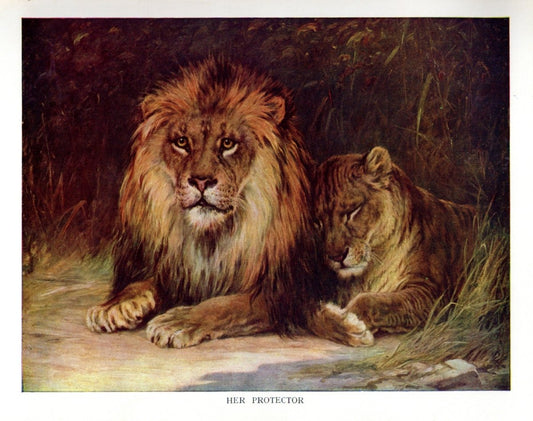
Morley, Harry (1881-1943) - Her Protector (Lions) 1921
Vendor:Digital Download - 1 imageRegular price £0.80Regular priceUnit price per

Latest Picture Trove Blog Posts
View all-

William Morris’s Strawberry Thief: The Story Behind a Classic Arts and Crafts Pattern
Few William Morris designs are as instantly recognisable as Strawberry Thief. With its richly patterned foliage, small red strawberries and watchful birds hidden among curling leaves, it has become one of the most loved designs of the Arts and Crafts movement.
William Morris’s Strawberry Thief: The Story Behind a Classic Arts and Crafts Pattern
Few William Morris designs are as instantly recognisable as Strawberry Thief. With its richly patterned foliage, small red strawberries and watchful birds hidden among curling leaves, it has become one of the most loved designs of the Arts and Crafts movement.
-

Glasgow and the Mackintosh Style
We recently took ourselves off to Scotland, and on our travels, we popped into the Mackintosh Tea Rooms in Glasgow for a bit of a nose around and a spot of lunch.
Glasgow and the Mackintosh Style
We recently took ourselves off to Scotland, and on our travels, we popped into the Mackintosh Tea Rooms in Glasgow for a bit of a nose around and a spot of lunch.
-

A Trip to Edinburgh & Glasgow, and Scottish Art
We have just returned from a well-deserved few days' break in Scotland, visiting both Edinburgh and Glasgow, taking in Scottish art and tea rooms!
A Trip to Edinburgh & Glasgow, and Scottish Art
We have just returned from a well-deserved few days' break in Scotland, visiting both Edinburgh and Glasgow, taking in Scottish art and tea rooms!


