

Bernard Meninsky (1891-1950) was a notable British artist, draughtsman, and teacher whose life and work made a significant contribution to twentieth-century British art. Born in Karotopin, Ukraine, Meninsky and his family emigrated to Liverpool when he was still a child. His prodigious artistic talent was recognised early on, and at the age of sixteen, he won a scholarship to the Liverpool School of Art. He later continued his studies at the prestigious Slade School of Fine Art in London, where he developed his distinctive approach to drawing and painting.
Meninsky’s art is best known for its sensitive portrayal of the human figure. His subjects often included mother and child groups, nudes, and portraits, all executed with a fluid line and a deep sense of empathy. His style combined elements of Post-Impressionism, Cubism, and Expressionism, yet retained a unique, personal voice. Meninsky’s use of subdued tones and expressive forms lent his works a contemplative and sometimes melancholy atmosphere.
In 1914, Meninsky joined the London Group, a collective of innovative artists, and played an active role in its activities, later serving as its secretary. The First World War interrupted his career, as he served in the British Army, an experience that had a lasting effect on his art, bringing a psychological intensity and gravitas to his post-war works.
After the war, Meninsky became a popular and influential teacher at the Westminster School of Art and other institutions, inspiring younger generations with his dedication and insight. He exhibited regularly at major venues, including the Royal Academy and the New English Art Club, and his work was acquired by several important collections, such as the Tate Gallery and the Victoria and Albert Museum.
Despite his professional achievements, Meninsky faced ongoing struggles with his mental health, which overshadowed much of his later life. He died in 1950, his death ruled as suicide. Nevertheless, his artistic legacy endures. Meninsky’s drawings, in particular, are celebrated for their technical mastery and emotional depth, and his influence can be traced in the work of many British artists who followed.
Bernard Meninsky is remembered today as a gifted and sensitive artist who contributed greatly to British art, both through his own work and his teaching. His legacy remains visible in public collections and continues to inspire admiration and scholarly interest.
Images to download
-

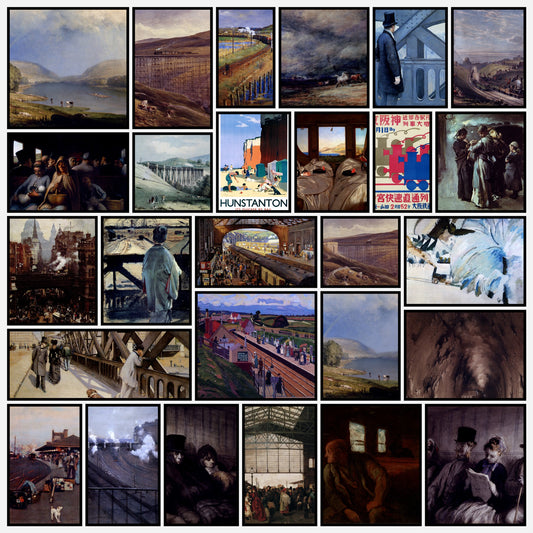
Trains in Art - 105 High Resolution Images
Vendor:Digital Download - 105 imagesRegular price £6.00Regular priceUnit price per -


Meninsky, Bernard (1891-1950) - Departure Platform, Victoria Station 1918
Vendor:Digital Download - 1 imageRegular price £0.80Regular priceUnit price per


Latest Picture Trove Blog Posts
View all-

William Morris’s Strawberry Thief: The Story Behind a Classic Arts and Crafts Pattern
Few William Morris designs are as instantly recognisable as Strawberry Thief. With its richly patterned foliage, small red strawberries and watchful birds hidden among curling leaves, it has become one of the most loved designs of the Arts and Crafts movement.
William Morris’s Strawberry Thief: The Story Behind a Classic Arts and Crafts Pattern
Few William Morris designs are as instantly recognisable as Strawberry Thief. With its richly patterned foliage, small red strawberries and watchful birds hidden among curling leaves, it has become one of the most loved designs of the Arts and Crafts movement.
-

Glasgow and the Mackintosh Style
We recently took ourselves off to Scotland, and on our travels, we popped into the Mackintosh Tea Rooms in Glasgow for a bit of a nose around and a spot of lunch.
Glasgow and the Mackintosh Style
We recently took ourselves off to Scotland, and on our travels, we popped into the Mackintosh Tea Rooms in Glasgow for a bit of a nose around and a spot of lunch.
-

A Trip to Edinburgh & Glasgow, and Scottish Art
We have just returned from a well-deserved few days' break in Scotland, visiting both Edinburgh and Glasgow, taking in Scottish art and tea rooms!
A Trip to Edinburgh & Glasgow, and Scottish Art
We have just returned from a well-deserved few days' break in Scotland, visiting both Edinburgh and Glasgow, taking in Scottish art and tea rooms!


