

Claude Lorrain, born Claude Gellée (c.1600-1682), in around 1600 in the small village of Chamagne in Lorraine, France, is celebrated as one of the foremost landscape painters of the seventeenth century. His influence on the development of landscape painting in Europe cannot be overstated, as his poetic visions of the countryside set a new standard for beauty and harmony in art.
Lorrain’s early life was humble. Orphaned at a young age, he was apprenticed to a pastry cook before turning to art. His journey as an artist began in earnest when he travelled to Rome in his teens, a city that would become his lifelong home and the backdrop for his most famous works. In Rome, Lorrain trained under the German painter Goffredo Wals and later with Agostino Tassi, from whom he learned the techniques of fresco painting and the intricacies of depicting architectural elements within landscapes.
It was in Rome, surrounded by the ruins of antiquity and the vibrant artistic community, that Lorrain’s style matured. He became renowned for his ability to capture the soft golden light of dawn or dusk, a characteristic feature of his landscapes. His paintings often depict idealised, Arcadian scenes populated by mythological or biblical figures, yet the figures themselves are secondary to the natural settings. Lorrain’s true genius lay in his rendering of atmosphere and light, which imbued his works with a sense of serenity and timelessness.
Among Lorrain’s most iconic works are “Seaport with the Embarkation of the Queen of Sheba” (1648) and “Landscape with the Marriage of Isaac and Rebecca” (1648-50), both masterpieces that exemplify his skill in balancing detailed foregrounds with vast, luminous vistas. He was meticulous in his craft, often making preparatory drawings and studies from nature. His sketchbooks, filled with observations of the Roman countryside, demonstrate his keen eye for natural effects and his dedication to capturing the subtleties of light.
Lorrain’s influence extended far beyond his lifetime. During the eighteenth and nineteenth centuries, his paintings were highly sought after by collectors, especially in Britain, where his works inspired artists such as J.M.W. Turner and John Constable. The so-called “Claude glass,” a tinted mirror used by artists and tourists to frame picturesque views, was named after him, reflecting the esteem in which his compositions were held.
Despite his success, Lorrain remained a modest figure, more interested in his art than in fame. He rarely left Rome after settling there, and his life was marked by steady, diligent work rather than scandal or intrigue. He died in 1682, leaving behind a legacy of paintings, drawings, and etchings that continue to enchant viewers with their harmonious blend of nature, light, and human drama.
Claude Lorrain’s contribution to art lies in his ability to elevate landscape painting from mere background to a subject worthy of admiration in its own right. His vision of nature—ordered, tranquil, and bathed in golden light—shaped the course of European art and set a benchmark for beauty that endures to this day.
Images to download
-


Lorrain, Claude (1600-1682) - Seaport with the Embarkation of the Queen of Sheba 1648
Vendor:Digital Download - 1 imageRegular price £0.80Regular priceUnit price per -

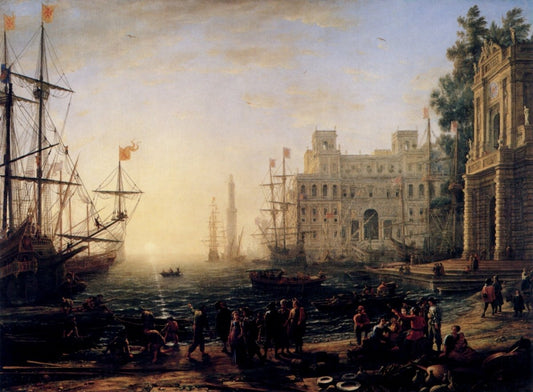
Lorrain, Claude (1600-1682) - Port with Villa Medici 1637
Vendor:Digital Download - 1 imageRegular price £0.80Regular priceUnit price per


Latest Picture Trove Blog Posts
View all-

William Morris’s Strawberry Thief: The Story Behind a Classic Arts and Crafts Pattern
Few William Morris designs are as instantly recognisable as Strawberry Thief. With its richly patterned foliage, small red strawberries and watchful birds hidden among curling leaves, it has become one of the most loved designs of the Arts and Crafts movement.
William Morris’s Strawberry Thief: The Story Behind a Classic Arts and Crafts Pattern
Few William Morris designs are as instantly recognisable as Strawberry Thief. With its richly patterned foliage, small red strawberries and watchful birds hidden among curling leaves, it has become one of the most loved designs of the Arts and Crafts movement.
-

Glasgow and the Mackintosh Style
We recently took ourselves off to Scotland, and on our travels, we popped into the Mackintosh Tea Rooms in Glasgow for a bit of a nose around and a spot of lunch.
Glasgow and the Mackintosh Style
We recently took ourselves off to Scotland, and on our travels, we popped into the Mackintosh Tea Rooms in Glasgow for a bit of a nose around and a spot of lunch.
-

A Trip to Edinburgh & Glasgow, and Scottish Art
We have just returned from a well-deserved few days' break in Scotland, visiting both Edinburgh and Glasgow, taking in Scottish art and tea rooms!
A Trip to Edinburgh & Glasgow, and Scottish Art
We have just returned from a well-deserved few days' break in Scotland, visiting both Edinburgh and Glasgow, taking in Scottish art and tea rooms!


