

Albert Lebourg (1849-1928), birth name Albert-Marie Lebourg, also called Albert-Charles Lebourg and Charles Albert Lebourg, was a French Impressionist and Post-Impressionist landscape painter of the Rouen School (l'École de Rouen). Member of the Société des Artistes Français, he actively worked in a luminous Impressionist style, creating more than 2,000 landscapes during his lifetime.
Initially studying at Évreux Lycée, Albert Lebourg, with interests in architecture, entered the École des Beaux-Arts of Rouen at a very young age. He studied art with Gustave Morin at l'Academie de peinture et de dessins, Rouen. Afterward, he was briefly a student of Jean-Paul Laurens. In 1876, Lebourg exhibited his works for the first time together with Claude Monet, Alfred Sisley, Pierre-Auguste Renoir, and other artists on the Boulevard Montmartre. Lebourg was referred to be appointed as a drawing professor at the Société des Beaux-Arts in Algiers after being noticed in Rouen by the art collector Laurent Laperlier. There he met Jean Seignemartin, who he inspired to bring more clarity and light into his paintings. In 1873 Lebourg married and remained in Algiers until the summer of 1877 when he resigned from his teaching position and returned to Paris with numerous paintings of the casbah, mosques and the Admiralty.
In the Fourth Impressionist Exhibition of 1879 Lebourg exhibited 30 works with Claude Monet, Camille Pissarro and Edgar Degas, presenting paintings and drawings executed in Algiers. In the Fifth Impressionist Exhibition or 1880 he exhibited 20 works depicting Rouen, Paris and Algiers. In 1883 he was admitted to the Salon (Paris) with his work entitled Matinée à Dieppe. In 1887 he exhibited at the acclaimed Les XX exhibition, with Walter Sickert, Camille Pissarro, Berthe Morisot and Georges-Pierre Seurat exhibit, with Seurat and Signac present at the opening. The major work shown is Seurat's A Sunday Afternoon on the Island of La Grande Jatte.
Lebourg remained occupied in all four seasons, painting animated scenes of the Seine in and near Rouen and Paris. He energetically painted in Auvergne, Normandy and Île-de-France, finally settling in Puteaux where he remained from 1888 to 1895, availing himself of the surroundings of Paris, painting what he would regard as his best works.
He became a member of the Société des Artistes Français beginning in 1893.
Lebourg moved to the Netherlands in 1895, where he would stay for two years. He exhibited to great acclaim at the Mancini Gallery in Paris and won the silver medal at the Exposition Universelle (1900). In 1903, a retrospective exhibition was organised, presenting 111 works at the Gallerie Rosenberg, the art gallery of Paul Rosenberg at 21 rue de la Boétie in Paris. While his fame was firmly established by 1910, he continued exhibiting annually at the Salon. In 1918, another retrospective was organised in Paris.
At the home of Impressionist art collector François Depeaux (1853-1920), Lebourg had the opportunity to converse many times with Camille Pissarro, Claude Monet, and Robert Antoine Pinchon (an artist who greatly admired him).
13 November 1909, the Musée des Beaux-Arts de Rouen opened a show with fifty-two paintings: thirteen by Lebourg, three by Monet, nine by Sisley, one by Renoir, three by Armand Guillaumin, five by Joseph Delattre, two by Charles Frechon and four by Robert Antoine Pinchon. And in 1918, in the same museum, Lebourg was represented along with Bonnard, Boudin, Camoin, Cross, Guillaumin, Luce, Matisse, Monet, Signac and Vuillard and Pinchon.
He suffered a stroke in September 1920 that paralysed the left side of his body. He nevertheless remarried in February 1921. A Catalogue Raisonné was organized that year that included 2,137 works and was released in 1923, which garnered united praise by the press.
He was named Chevalier of the Legion of Honour on 27 June 1903, and breveted Officer of the Legion of Honour 22 April 1924.
Albert Lebourg died in Rouen on 7 January 1928. Lebourg's works are exhibited at the Musée d’Orsay, Petit-Palais and Carnavalet in Paris, as well as museums in Bayonne, Clermont-Ferrand, Le Havre, Dunkerque, Lille, Strasbourg, Sceaux, and above all Rouen at the Musée des Beaux-Arts de Rouen (François Depeaux collection).
Images to download
-

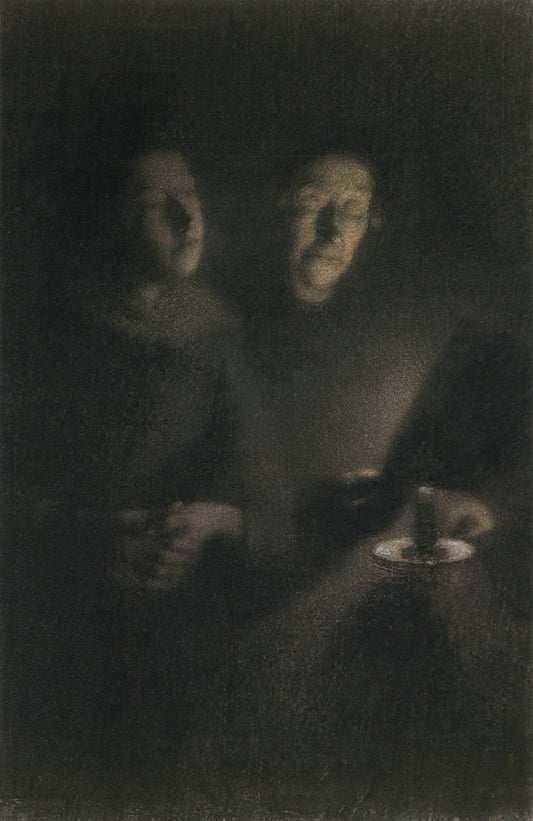
Lebourg, Albert (1849-1928) - Reading a letter by candlelight c.1879
Vendor:Digital Download - 1 imageRegular price £0.80Regular priceUnit price per -

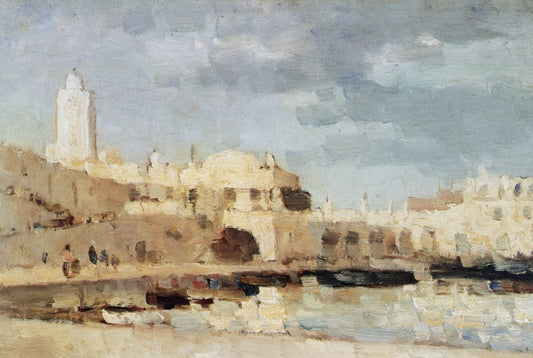
Lebourg, Albert (1849-1928) - Port of Algiers 1876
Vendor:Digital Download - 1 imageRegular price £0.80Regular priceUnit price per


Latest Picture Trove Blog Posts
View all-

William Morris’s Strawberry Thief: The Story Behind a Classic Arts and Crafts Pattern
Few William Morris designs are as instantly recognisable as Strawberry Thief. With its richly patterned foliage, small red strawberries and watchful birds hidden among curling leaves, it has become one of the most loved designs of the Arts and Crafts movement.
William Morris’s Strawberry Thief: The Story Behind a Classic Arts and Crafts Pattern
Few William Morris designs are as instantly recognisable as Strawberry Thief. With its richly patterned foliage, small red strawberries and watchful birds hidden among curling leaves, it has become one of the most loved designs of the Arts and Crafts movement.
-

Glasgow and the Mackintosh Style
We recently took ourselves off to Scotland, and on our travels, we popped into the Mackintosh Tea Rooms in Glasgow for a bit of a nose around and a spot of lunch.
Glasgow and the Mackintosh Style
We recently took ourselves off to Scotland, and on our travels, we popped into the Mackintosh Tea Rooms in Glasgow for a bit of a nose around and a spot of lunch.
-

A Trip to Edinburgh & Glasgow, and Scottish Art
We have just returned from a well-deserved few days' break in Scotland, visiting both Edinburgh and Glasgow, taking in Scottish art and tea rooms!
A Trip to Edinburgh & Glasgow, and Scottish Art
We have just returned from a well-deserved few days' break in Scotland, visiting both Edinburgh and Glasgow, taking in Scottish art and tea rooms!


