

Luca Giordano (1634-1705) was a remarkable Italian Baroque painter whose prodigious output and dazzling technique secured him a prominent place in the artistic landscape of seventeenth-century Europe. Born in Naples, Giordano was a precocious talent, training initially with his father before apprenticing under the influential painter Jusepe de Ribera. His early works reveal the dramatic chiaroscuro and intense naturalism characteristic of Ribera, but Giordano’s style quickly evolved as he encountered the vibrant colouring and dynamic compositions of Venetian masters such as Titian, Veronese, and Tintoretto.
Giordano’s artistic prowess lay in his astonishing speed and facility with the brush, earning him the nickname “Luca fa presto” (“Luca, work quickly”). This legendary swiftness enabled him to fulfil a vast array of commissions throughout Italy and beyond, including frescoes, altarpieces, and easel paintings. His versatility allowed him to adapt his style to suit the tastes of his patrons, moving effortlessly between grand religious narratives, mythological scenes, and portraits.
In Naples, Giordano’s talent was widely recognised, and his works adorned many of the city’s churches and palaces. His frescoes in the Certosa di San Martino and the Church of Santa Brigida are celebrated for their exuberance, rich colouring, and theatrical flair. He was also active in Florence, where he completed significant commissions for the Medici family, including the decoration of the Cappella Corsini in Santa Maria del Carmine.
Perhaps the most transformative period of Giordano’s career came during his decade-long sojourn in Spain (1692–1702). Invited by King Charles II, Giordano became court painter and undertook monumental decorative projects in the Escorial, the Royal Palace of Madrid, and the church of San Lorenzo. His Spanish works, characterised by their luminous palette and fluid brushwork, had a profound influence on local artists and contributed to a new direction in Spanish Baroque painting.
Giordano’s prolific output and adaptability sometimes led critics to question the consistency of his artistic quality, but his best works are widely praised for their vitality, inventiveness, and mastery of colour and composition. He returned to Naples in his final years, continuing to paint until his death in 1705. Today, Luca Giordano is celebrated as a virtuoso of the Baroque, whose art embodies the exuberance and grandeur of the age.
Images to download
-


Giordano, Luca (1634-1705) - Vulcan's forge 1657-60
Vendor:Digital Download - 1 imageRegular price £0.80Regular priceUnit price per -

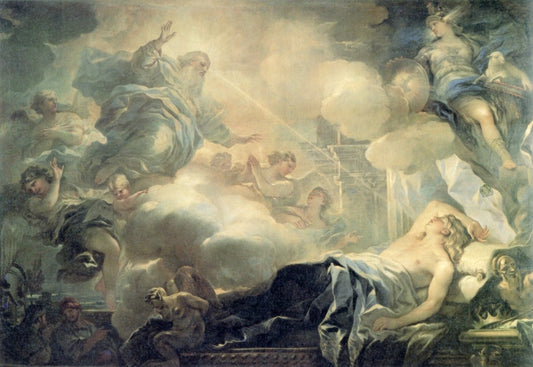
Giordano, Luca (1634-1705) - The Dream of Solomon c.1693
Vendor:Digital Download - 1 imageRegular price £0.80Regular priceUnit price per


Latest Picture Trove Blog Posts
View all-

William Morris’s Strawberry Thief: The Story Behind a Classic Arts and Crafts Pattern
Few William Morris designs are as instantly recognisable as Strawberry Thief. With its richly patterned foliage, small red strawberries and watchful birds hidden among curling leaves, it has become one of the most loved designs of the Arts and Crafts movement.
William Morris’s Strawberry Thief: The Story Behind a Classic Arts and Crafts Pattern
Few William Morris designs are as instantly recognisable as Strawberry Thief. With its richly patterned foliage, small red strawberries and watchful birds hidden among curling leaves, it has become one of the most loved designs of the Arts and Crafts movement.
-

Glasgow and the Mackintosh Style
We recently took ourselves off to Scotland, and on our travels, we popped into the Mackintosh Tea Rooms in Glasgow for a bit of a nose around and a spot of lunch.
Glasgow and the Mackintosh Style
We recently took ourselves off to Scotland, and on our travels, we popped into the Mackintosh Tea Rooms in Glasgow for a bit of a nose around and a spot of lunch.
-

A Trip to Edinburgh & Glasgow, and Scottish Art
We have just returned from a well-deserved few days' break in Scotland, visiting both Edinburgh and Glasgow, taking in Scottish art and tea rooms!
A Trip to Edinburgh & Glasgow, and Scottish Art
We have just returned from a well-deserved few days' break in Scotland, visiting both Edinburgh and Glasgow, taking in Scottish art and tea rooms!


