

Henry Fuseli RA or Johann Heinrich Füssli (1741-1825) was a Swiss painter, draughtsman, and writer on art who spent much of his life in Britain.
Many of his successful works depict supernatural experiences, such as The Nightmare. He produced painted works for John Boydell's Shakespeare Gallery and his own "Milton Gallery". He held the posts of Professor of Painting and Keeper at the Royal Academy. His style had a considerable influence on many younger British artists, including William Blake.
Fuseli was born on 7 February 1741, in Zürich, the second of 18 children. Among his brothers and sisters were Johann Kaspar and Anna. His father was Johann Caspar Füssli, a painter of portraits and landscapes, and author of Lives of the Helvetic Painters. He intended Henry for the church, and sent him to the Caroline college of Zürich, where he received a classical education.
After taking orders in 1761, Fuseli was forced to leave the country after having helped his friend Lavater to expose an unjust magistrate, whose powerful family sought revenge. He travelled through Germany, and then, in 1765, visited England, where he supported himself for some time by miscellaneous writing. Eventually, he became acquainted with Sir Joshua Reynolds, to whom he showed his drawings. Following Reynolds' advice, he decided to devote himself entirely to art. In 1770 he made an art pilgrimage to Italy, where he remained until 1778, changing his name from Füssli to the more Italian-sounding Fuseli.
In early 1779, he returned to Britain, visiting Zürich on the way. In London, he found a commission awaiting him from Alderman John Boydell, who was then setting up his Shakespeare Gallery. Fuseli painted a number of pieces for Boydell, and supervised the first English edition of Lavater's work on physiognomy. He also gave William Cowper some valuable assistance in preparing a translation of Homer. In 1788, Fuseli married Sophia Rawlins (originally one of his models), and he soon after became an associate of the Royal Academy. The early feminist Mary Wollstonecraft, whose portrait he had painted, planned a trip with him to Paris, and pursued him determinedly, but communication between the two was stopped by Rawlins. Fuseli later said "I hate clever women. They are only troublesome". In 1790, he became a full academician, presenting Thor Battering the Midgard Serpent as his diploma work. In 1799, Fuseli was appointed professor of painting to the Academy. Four years later, he was chosen as Keeper and resigned his professorship, but resumed it in 1810, continuing to hold both offices until his death. He was succeeded as Keeper by Henry Thomson.
As a painter, Fuseli favoured the supernatural. He pitched everything on an ideal scale, believing a certain amount of exaggeration necessary in the higher branches of historical painting. In this theory he was confirmed by the study of Michelangelo's works and the marble statues of the Monte Cavallo, which, when at Rome, he liked to contemplate in the evening, relieved against a murky sky or illuminated by lightning.
Fuseli painted more than 200 pictures, but he exhibited only a small number of them. His earliest painting was Joseph Interpreting the Dreams of the Baker and Butler, but the first to attract particular attention was The Nightmare, exhibited in 1782, for which he painted several versions. Themes seen in The Nightmare, such as horror, dark magic and sexuality, were echoed in his 1796 painting Night-Hag visiting the Lapland Witches.
His pupils included David Wilkie, Benjamin Haydon, William Etty, and Edwin Landseer. William Blake, who was 16 years his junior, recognised a debt to him, and for a time many English artists copied his mannerisms.
After a life of uninterrupted good health, he died on 17 April 1825, at the house of the Countess of Guildford on Putney Hill aged 84, and was buried in the crypt of St Paul's Cathedral. He was comparatively wealthy at the time of his death.
Images to download
-


Fuseli, Henry (1741-1825) - The Nightmare 1818
Vendor:Digital Download - 1 imageRegular price £0.80Regular priceUnit price per -

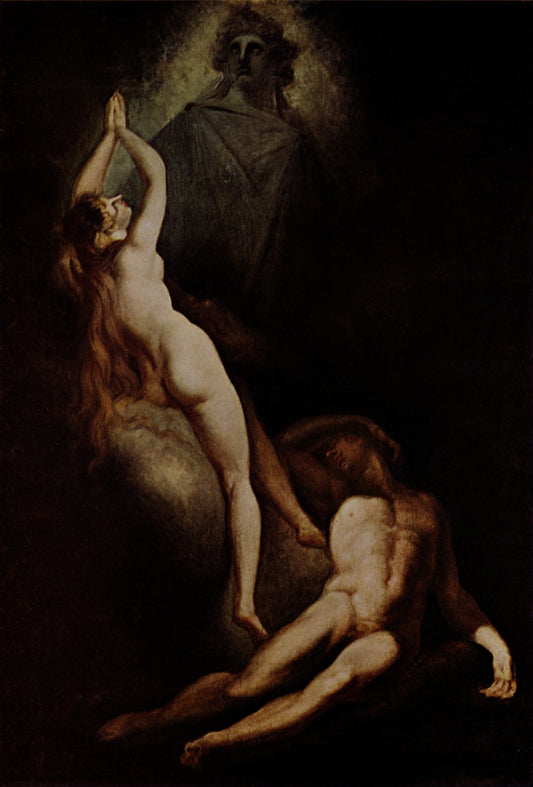
Fuseli, Henry (1741-1825) - The Creation of Eve 1793
Vendor:Digital Download - 1 imageRegular price £0.80Regular priceUnit price per -

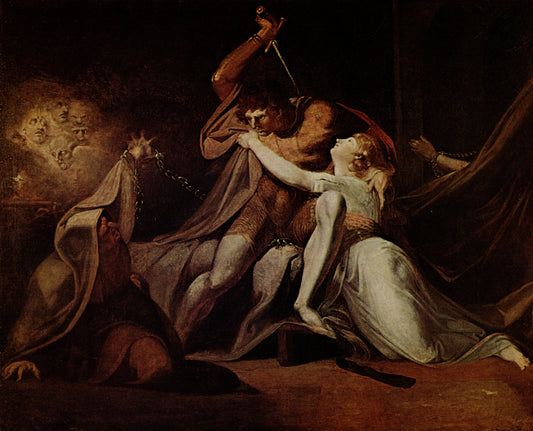
Fuseli, Henry (1741-1825) - Percival delivering Belisane from the Enchantment of Urma 1783
Vendor:Digital Download - 1 imageRegular price £0.80Regular priceUnit price per -

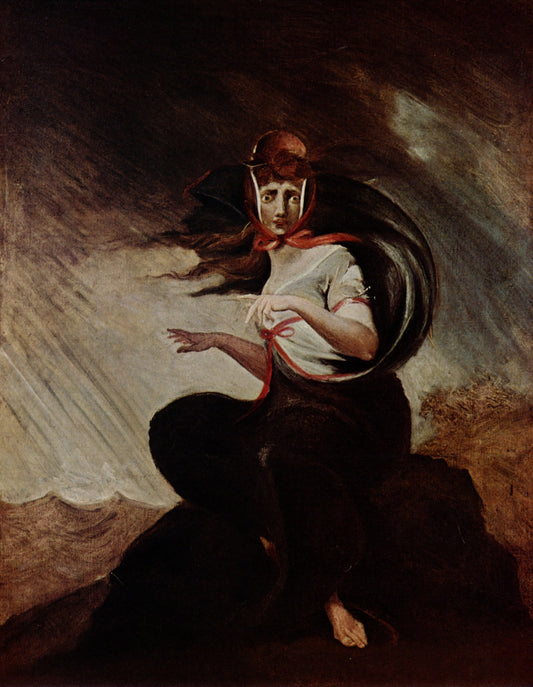
Fuseli, Henry (1741-1825) - Mad Kate 1806-7
Vendor:Digital Download - 1 imageRegular price £0.80Regular priceUnit price per -

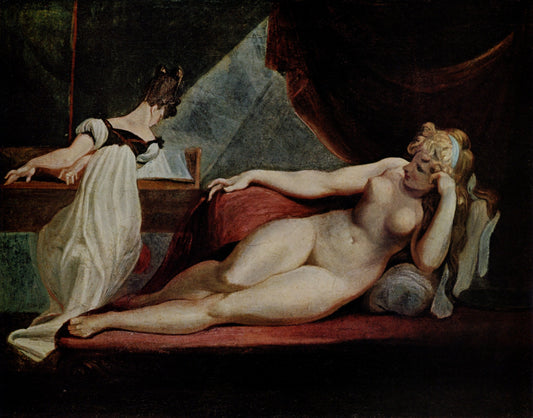
Fuseli, Henry (1741-1825) - A Nude Reclining and a Woman Playing the Piano 1799-1800
Vendor:Digital Download - 1 imageRegular price £0.80Regular priceUnit price per -


Fuseli, Henry (1741-1825) - Dante and Virgil on the Ice of Kocythos (Dante's Inferno) 1774
Vendor:Digital Download - 1 imageRegular price £0.80Regular priceUnit price per -


Fuseli, Henry (1741-1825) - The Nightmare 1781
Vendor:Digital Download - 1 imageRegular price £0.80Regular priceUnit price per -


Fuseli, Henry (1741-1825) - Lady Macbeth with the Daggers 1812
Vendor:Digital Download - 1 imageRegular price £0.80Regular priceUnit price per -


Fuseli, Henry (1741-1825) - Brunhilde Observing Gunther, whom She Has Tied to the Ceiling 1807
Vendor:Digital Download - 1 imageRegular price £0.80Regular priceUnit price per -


Fuseli, Henry (1741-1825) - Allegory of Vanity 1811
Vendor:Digital Download - 1 imageRegular price £0.80Regular priceUnit price per


Latest Picture Trove Blog Posts
View all-

William Morris’s Strawberry Thief: The Story Behind a Classic Arts and Crafts Pattern
Few William Morris designs are as instantly recognisable as Strawberry Thief. With its richly patterned foliage, small red strawberries and watchful birds hidden among curling leaves, it has become one of the most loved designs of the Arts and Crafts movement.
William Morris’s Strawberry Thief: The Story Behind a Classic Arts and Crafts Pattern
Few William Morris designs are as instantly recognisable as Strawberry Thief. With its richly patterned foliage, small red strawberries and watchful birds hidden among curling leaves, it has become one of the most loved designs of the Arts and Crafts movement.
-

Glasgow and the Mackintosh Style
We recently took ourselves off to Scotland, and on our travels, we popped into the Mackintosh Tea Rooms in Glasgow for a bit of a nose around and a spot of lunch.
Glasgow and the Mackintosh Style
We recently took ourselves off to Scotland, and on our travels, we popped into the Mackintosh Tea Rooms in Glasgow for a bit of a nose around and a spot of lunch.
-

A Trip to Edinburgh & Glasgow, and Scottish Art
We have just returned from a well-deserved few days' break in Scotland, visiting both Edinburgh and Glasgow, taking in Scottish art and tea rooms!
A Trip to Edinburgh & Glasgow, and Scottish Art
We have just returned from a well-deserved few days' break in Scotland, visiting both Edinburgh and Glasgow, taking in Scottish art and tea rooms!


