
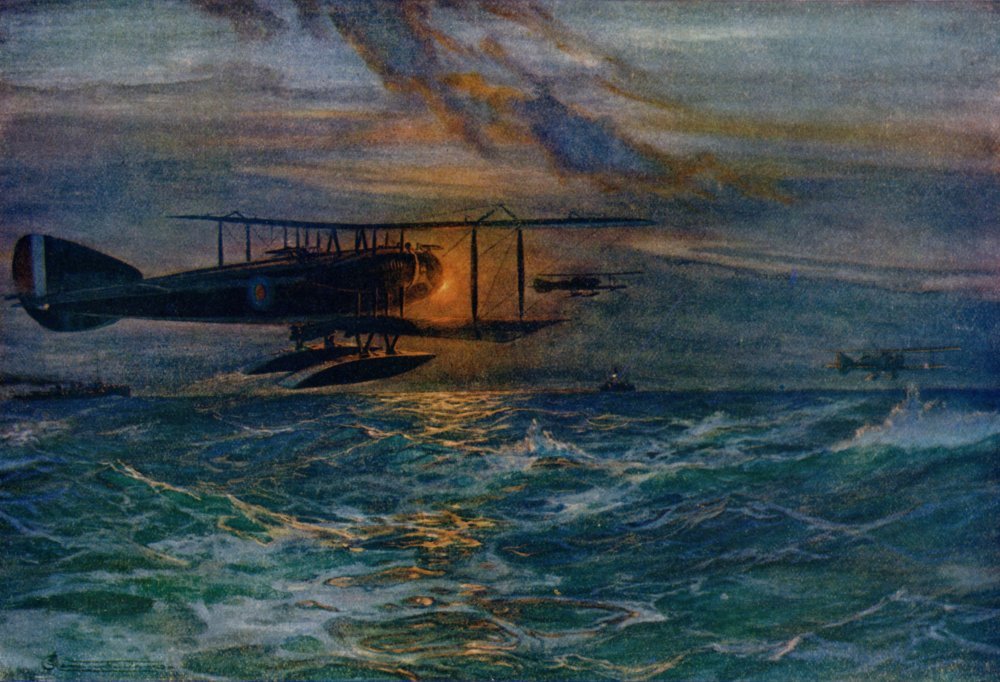
Clifford Roger Fleming-Williams (1880-1940) went to work at Windermere at the start of 1915 as a ground school instructor and general manager with responsibility for marketing. He also made drawings and designed a seaplane. He left in August 1916 to join the Royal Flying Corps.
Fleming-Williams was a pioneer of making drawings from the air so as to prove the use of aeroplanes for military observation. The equipment consisted of a glove for the left hand to protect from the cold, the right hand being protected by the lid of a drawing box fixed to the knee. A compass was strapped to the left wrist. Pencils were sharpened at both ends and attached by string to prevent them from falling.
Waterbird was commissioned by Edward Wakefield, who was an advocate of using hydro-aeroplanes to relay information by way of an observer and wireless, having learnt the value of scouting in the Boer War. Testing of Waterbird took place at Brooklands during May-July 1911, and then conversion to a hydro-aeroplane at Windermere with the first flight on 25 November 1911.
Fleming-Williams experimented with model hydro-aeroplanes and wrote an article setting out his deductions in The Aeroplane magazine, 29 December 1911. He achieved the first model hydro-aeroplane to lift off water.
In 1913, Fleming-Williams submitted an application for UK Patent No. 5,003 covering improvements relating to hydro-aeroplanes, so as to enable them to travel through rough water and by constructing the float such that it offered minimum head resistance. That is, by attaching hinged and sprung, automatically adjusting planes to the float bottom. It was granted in 1914. He also successfully applied for other aircraft-related UK Patents.
Following demobilisation from the RAF in 1919, he returned to Hill of Oaks, Windermere for about 1 year and established himself as an illustrator.
Images to download
-

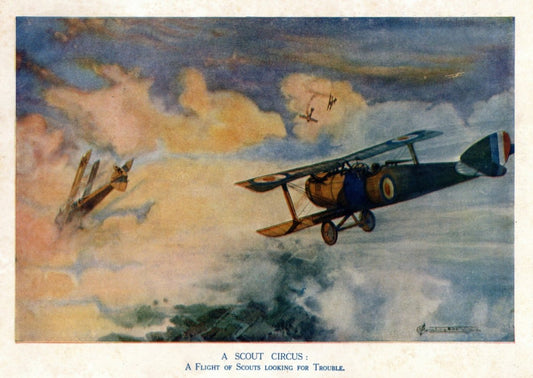
Fleming-Williams, Clifford (1880-1940) - A Scout Circus 1919
Vendor:Digital Download - 1 imageRegular price £0.00Regular priceUnit price per -

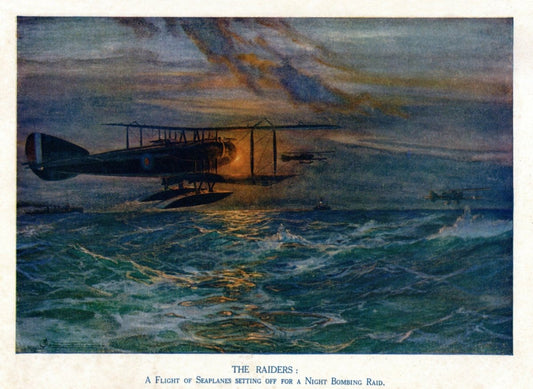
Fleming-Williams, Clifford (1880-1940) - The Raiders 1919
Vendor:Digital Download - 1 imageRegular price £0.80Regular priceUnit price per


Latest Picture Trove Blog Posts
View all-

William Morris’s Strawberry Thief: The Story Behind a Classic Arts and Crafts Pattern
Few William Morris designs are as instantly recognisable as Strawberry Thief. With its richly patterned foliage, small red strawberries and watchful birds hidden among curling leaves, it has become one of the most loved designs of the Arts and Crafts movement.
William Morris’s Strawberry Thief: The Story Behind a Classic Arts and Crafts Pattern
Few William Morris designs are as instantly recognisable as Strawberry Thief. With its richly patterned foliage, small red strawberries and watchful birds hidden among curling leaves, it has become one of the most loved designs of the Arts and Crafts movement.
-

Glasgow and the Mackintosh Style
We recently took ourselves off to Scotland, and on our travels, we popped into the Mackintosh Tea Rooms in Glasgow for a bit of a nose around and a spot of lunch.
Glasgow and the Mackintosh Style
We recently took ourselves off to Scotland, and on our travels, we popped into the Mackintosh Tea Rooms in Glasgow for a bit of a nose around and a spot of lunch.
-

A Trip to Edinburgh & Glasgow, and Scottish Art
We have just returned from a well-deserved few days' break in Scotland, visiting both Edinburgh and Glasgow, taking in Scottish art and tea rooms!
A Trip to Edinburgh & Glasgow, and Scottish Art
We have just returned from a well-deserved few days' break in Scotland, visiting both Edinburgh and Glasgow, taking in Scottish art and tea rooms!


