

Gentile da Fabriano (c.1370-1427) was an eminent Italian painter of the late Gothic period, celebrated for his refined technique and opulent use of colour and gold. Born in Fabriano, a town in the Marche region of central Italy, Gentile’s early life remains somewhat obscure, but by the turn of the fifteenth century, he had established himself as a leading figure in the International Gothic style.
Gentile’s artistic journey took him to various major artistic centres of Italy, including Venice, Florence, and Siena. His exposure to diverse regional styles and artistic traditions contributed to the distinctive elegance and sophistication that became hallmarks of his work. One of his earliest known commissions was for the Palazzo della Ragione in Venice, where he painted a cycle of frescoes, now lost, that garnered him considerable acclaim.
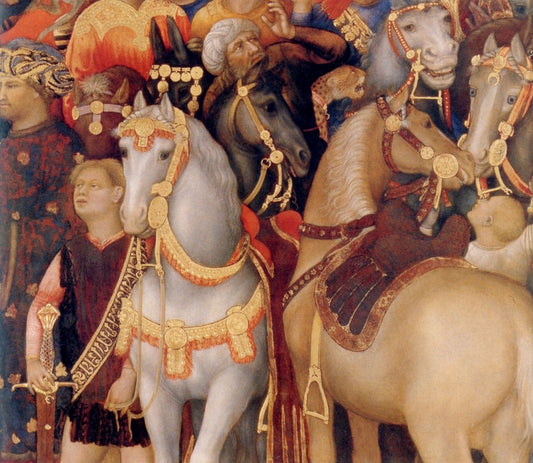
Gentile’s most celebrated masterpiece is the Adoration of the Magi, painted in 1423 for the Strozzi family chapel in Santa Trinita, Florence. This altarpiece exemplifies the splendour and intricacy associated with his oeuvre. The painting dazzles with its sumptuous colours, elaborate gilding, and meticulous attention to detail. The procession of the Magi is rendered with a sense of pageantry and exoticism, reflecting both the cosmopolitan outlook of his patrons and the artist’s own travels. Gentile’s rendering of textiles, jewels, and animals demonstrates his technical virtuosity and his fascination with the decorative arts.
Gentile da Fabriano’s influence extended beyond his own remarkable output. He played a significant role in the transmission of the International Gothic style throughout Italy, and his works were highly admired by contemporaries and later artists alike. His approach to naturalism, particularly in his sensitive portrayal of landscape and light, anticipated the innovations of the early Renaissance. He is known to have interacted with younger painters, including the celebrated Masaccio, who is said to have been influenced by Gentile’s lyrical style and delicate handling of narrative.
In the later years of his career, Gentile continued to receive prestigious commissions, including work for the Papal court in Rome. He died in 1427, leaving behind a legacy that bridged the Gothic and Renaissance worlds. Today, his surviving paintings, such as the Madonna and Child in the Uffizi Gallery and the Quaratesi Polyptych in the Galleria degli Uffizi, are treasured for their beauty, craftsmanship, and historical significance.
Gentile da Fabriano stands as a testament to the cosmopolitan spirit and artistic ingenuity of early fifteenth-century Italy. His work remains a touchstone for understanding the rich interplay between tradition and innovation at a pivotal moment in art history.
Images to download
-

Gentile da Fabriano 15 High Resolution Images
Vendor:Digital Download - 15 imagesRegular price £3.00Regular priceUnit price per

Latest Picture Trove Blog Posts
View all-

William Morris’s Strawberry Thief: The Story Behind a Classic Arts and Crafts Pattern
Few William Morris designs are as instantly recognisable as Strawberry Thief. With its richly patterned foliage, small red strawberries and watchful birds hidden among curling leaves, it has become one of the most loved designs of the Arts and Crafts movement.
William Morris’s Strawberry Thief: The Story Behind a Classic Arts and Crafts Pattern
Few William Morris designs are as instantly recognisable as Strawberry Thief. With its richly patterned foliage, small red strawberries and watchful birds hidden among curling leaves, it has become one of the most loved designs of the Arts and Crafts movement.
-

Glasgow and the Mackintosh Style
We recently took ourselves off to Scotland, and on our travels, we popped into the Mackintosh Tea Rooms in Glasgow for a bit of a nose around and a spot of lunch.
Glasgow and the Mackintosh Style
We recently took ourselves off to Scotland, and on our travels, we popped into the Mackintosh Tea Rooms in Glasgow for a bit of a nose around and a spot of lunch.
-

A Trip to Edinburgh & Glasgow, and Scottish Art
We have just returned from a well-deserved few days' break in Scotland, visiting both Edinburgh and Glasgow, taking in Scottish art and tea rooms!
A Trip to Edinburgh & Glasgow, and Scottish Art
We have just returned from a well-deserved few days' break in Scotland, visiting both Edinburgh and Glasgow, taking in Scottish art and tea rooms!


