

Adolf Erbslöh (1881-1947) was a German Expressionist painter; one of the founders of the Neue Künstlervereinigung München.
He was born to a merchant family originally from Barmen. His father, Gustav Adolf (1844-1900), was a junior partner in the export firm, Dieckerhoff, Raffloer & Co., and spent fifteen years at their New York office, returning to Barmen in 1887. Adolf received commercial training, although he displayed some talent for drawing. The year after his father's death, he abandoned his business career to attend the Academy of Fine Arts, Karlsruhe, where he studied with Ernst Schurth and Ludwig Schmid-Reutte. In 1905, he continued his studies at the Academy of Fine Arts, Munich, with Ludwig von Herterich.
In 1907, he married his second cousin, Adeline Schuchard (1880-1974), the daughter of Hugo Schuchard, who owned a large import-export business. The following year, he came up with the plan for the "Neue Künstlervereinigung München" (NKVM), which was chartered in 1909. He initially served as its Secretary. Their first informal showing was in Barmen, followed by a public exhibition at the Galerie Heinrich Thannhauser in Munich. Their first museum exhibition was in 1910, at what is now the Von der Heydt Museum in Wuppertal. That same year, he was elected the association's Chairman, upon the resignation of Wassily Kandinsky, who helped co-found a competing art group, "Der Blaue Reiter". In 1913, he participated in creating the Münchener Neue Secession, with some of his associates from the NKVM and former members of the Munich Secession. They held their first exhibition in 1914.
He was conscripted in 1915, serving in Flanders and France. The following year, he was chosen to be a war painter for the regimental staff in Verdun, but as there was no such official position for non-commissioned officers, he was employed as an assistant clerk. His drawings from the field show portraits of his war comrades, forests and houses that had been destroyed. The colours of his oil paintings from that time were generally dull and pale. He returned to Munich in 1919.
Shortly after, he and Adeline took a trip through Westphalia, where he composed an album of sketches. In the 1920s, he turned to the New Objectivity, an art movement that was a reaction against Expressionism. A major feature of the new style was a return to lighting and shading effects, which the Expressionists had disdained.
His last solo exhibition during his lifetime took place in 1931. A joint exhibition was planned for 1934, but had to be cancelled because most of the works by former NKVM members were declared to be "Degenerate". In 1937, four of his paintings were confiscated from public collections and destroyed. After that, he retired to his home near Icking and avoided any publicity. He remained in seclusion until his death in 1947.
Images to download
-

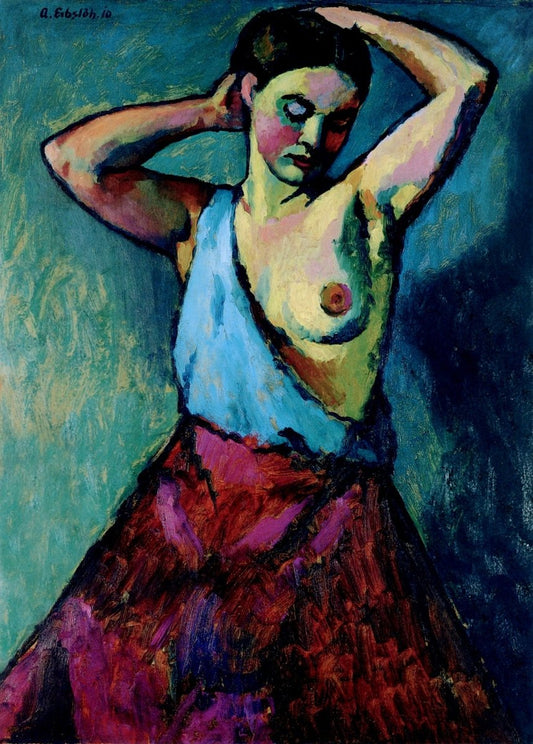
Erbslöh, Adolf (1881-1947) - The Red Skirt 1910
Vendor:Digital Download - 1 imageRegular price £0.80Regular priceUnit price per

Latest Picture Trove Blog Posts
View all-

William Morris’s Strawberry Thief: The Story Behind a Classic Arts and Crafts Pattern
Few William Morris designs are as instantly recognisable as Strawberry Thief. With its richly patterned foliage, small red strawberries and watchful birds hidden among curling leaves, it has become one of the most loved designs of the Arts and Crafts movement.
William Morris’s Strawberry Thief: The Story Behind a Classic Arts and Crafts Pattern
Few William Morris designs are as instantly recognisable as Strawberry Thief. With its richly patterned foliage, small red strawberries and watchful birds hidden among curling leaves, it has become one of the most loved designs of the Arts and Crafts movement.
-

Glasgow and the Mackintosh Style
We recently took ourselves off to Scotland, and on our travels, we popped into the Mackintosh Tea Rooms in Glasgow for a bit of a nose around and a spot of lunch.
Glasgow and the Mackintosh Style
We recently took ourselves off to Scotland, and on our travels, we popped into the Mackintosh Tea Rooms in Glasgow for a bit of a nose around and a spot of lunch.
-

A Trip to Edinburgh & Glasgow, and Scottish Art
We have just returned from a well-deserved few days' break in Scotland, visiting both Edinburgh and Glasgow, taking in Scottish art and tea rooms!
A Trip to Edinburgh & Glasgow, and Scottish Art
We have just returned from a well-deserved few days' break in Scotland, visiting both Edinburgh and Glasgow, taking in Scottish art and tea rooms!


