

Eber Elk (1892-1941) occupies a distinctive position in early twentieth-century European art, notable for his evocative landscapes and subtle explorations of the human condition. Born in Vienna, Elk was raised amidst the vibrancy of the Austro-Hungarian empire, an environment that would later inform both the subject matter and emotional tone of his works. His early education at the Academy of Fine Arts in Vienna exposed him to a range of influences, from the late Romantic painters to the emerging currents of Expressionism.
Elk’s oeuvre is characterised by a remarkable sensitivity to atmosphere and mood. His landscapes often depict the rolling hills and shadowed woodlands of the Austrian countryside, rendered with a muted palette and a keen attention to light. Rather than presenting idealised scenes, Elk imbued his depictions with a gentle melancholy, suggesting a world in transition. This sense of impermanence, perhaps reflective of his own experiences during the upheavals of the First World War, became a hallmark of his mature style.
The war years proved formative for Elk, both personally and artistically. Conscripted into the army in 1914, he served on the Eastern Front, an experience that left a lasting impression on his psyche. Surviving letters and diaries reveal an artist grappling with the horrors of conflict, and this emotional intensity found its way into his post-war paintings. Works from this period, such as “Fields After Battle” (1919), show a starkness of composition and a sombre use of colour, evoking both the trauma of war and the resilience of nature.
In the 1920s and 1930s, Elk’s work gained greater recognition, with exhibitions in Vienna, Berlin, and Paris. Critics often praised his ability to capture the “quiet drama” of everyday life, and his paintings were acquired by several important collections. Despite this success, Elk remained something of a recluse, preferring the solitude of his rural studio to the bustle of the city. His later works, painted during the rise of fascism in Europe, reflect a growing sense of unease - figures are more isolated, horizons more distant, as if anticipating the darkness to come.
Eber Elk died in 1941, leaving behind a body of work that continues to resonate for its emotional depth and universal themes. Today, he is celebrated as a sensitive chronicler of both landscape and soul.
Images to download
-

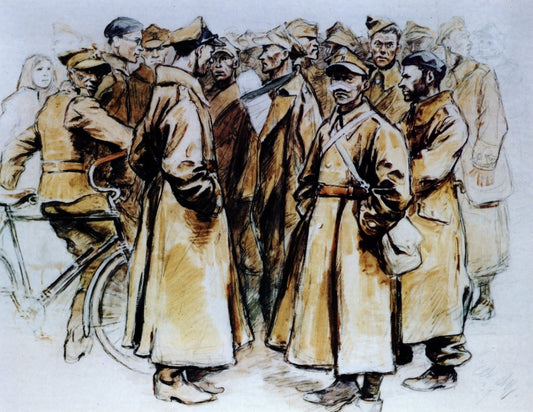
Eber, Elk (1892-1941) - Prisoners of War 1939
Vendor:Digital Download - 1 imageRegular price £0.80Regular priceUnit price per

Latest Picture Trove Blog Posts
View all-

William Morris’s Strawberry Thief: The Story Behind a Classic Arts and Crafts Pattern
Few William Morris designs are as instantly recognisable as Strawberry Thief. With its richly patterned foliage, small red strawberries and watchful birds hidden among curling leaves, it has become one of the most loved designs of the Arts and Crafts movement.
William Morris’s Strawberry Thief: The Story Behind a Classic Arts and Crafts Pattern
Few William Morris designs are as instantly recognisable as Strawberry Thief. With its richly patterned foliage, small red strawberries and watchful birds hidden among curling leaves, it has become one of the most loved designs of the Arts and Crafts movement.
-

Glasgow and the Mackintosh Style
We recently took ourselves off to Scotland, and on our travels, we popped into the Mackintosh Tea Rooms in Glasgow for a bit of a nose around and a spot of lunch.
Glasgow and the Mackintosh Style
We recently took ourselves off to Scotland, and on our travels, we popped into the Mackintosh Tea Rooms in Glasgow for a bit of a nose around and a spot of lunch.
-

A Trip to Edinburgh & Glasgow, and Scottish Art
We have just returned from a well-deserved few days' break in Scotland, visiting both Edinburgh and Glasgow, taking in Scottish art and tea rooms!
A Trip to Edinburgh & Glasgow, and Scottish Art
We have just returned from a well-deserved few days' break in Scotland, visiting both Edinburgh and Glasgow, taking in Scottish art and tea rooms!


