

Paul Gustave Louis Christophe Doré (1832-1883) was a French printmaker, illustrator, painter, comics artist, caricaturist, and sculptor. He is best known for his prolific output of wood-engravings illustrating classic literature, especially those for the Vulgate Bible and Dante's Divine Comedy. These achieved great international success, and he became renowned for printmaking, although his role was normally as the designer only; at the height of his career, some 40 block-cutters were employed to cut his drawings onto the wooden printing blocks, usually also signing the image.
He created over 10,000 illustrations, the most important of which were reproduced using an electrotype process with cylinder presses, enabling very large print runs to be published simultaneously in multiple countries.
Although Doré's work was popular with the general public during his life, it was met with mixed reviews from contemporary art critics. His work has been more widely celebrated in the centuries following his death. Among his admirers were writers H.P. Lovecraft and Théophile Gautier.
Doré was born in Strasbourg on 6 January 1832. At the age of 15, he began his career working as a caricaturist for the French paper Le Journal pour Rire. The illustrations of J.J. Grandville have been noted as an influence on his work. Wood-engraving was his primary method at this time. In the late 1840s and early 1850s, he made several text comics, like Les Travaux d'Hercule (1847), Trois artistes incompris et mécontents (1851), Les Dés-agréments d'un voyage d'agrément (1851) and L'Histoire de la Sainte Russie (1854). Doré subsequently went on to win commissions to depict scenes from books by Cervantes, Rabelais, Balzac, Milton, and Dante. He also illustrated "Gargantua et Pantagruel" in 1854.
In 1853, Doré was asked to illustrate the works of Lord Byron. This commission was followed by additional work for British publishers, including a new illustrated Bible. In 1856 he produced 12 folio-size illustrations of The Legend of the Wandering Jew, which propagated longstanding antisemitic views of the time, for a short poem which Pierre-Jean de Béranger had derived from a novel of Eugène Sue of 1845.
In the 1860s he illustrated a French edition of Cervantes's Don Quixote, and his depictions of the knight and his squire, Sancho Panza, became so famous that they influenced subsequent readers, artists, and stage and film directors' ideas of the physical "look" of the two characters. Doré also illustrated an oversized edition of Edgar Allan Poe's "The Raven", an endeavor that earned him 30,000 francs from publisher Harper & Brothers in 1883.
Doré's illustrations for the Bible (1866) were a great success, and in 1867 he had a major exhibition of his work in London. This exhibition led to the foundation of the Doré Gallery in Bond Street, London. In 1869, Blanchard Jerrold, the son of Douglas William Jerrold, suggested that they work together to produce a comprehensive portrait of London. Jerrold had obtained the idea from The Microcosm of London produced by Rudolph Ackermann, William Pyne, and Thomas Rowlandson (published in three volumes from 1808 to 1810). Doré signed a five-year contract with the publishers Grant & Co that involved his staying in London for three months a year, and he received the vast sum of £10,000 a year for the project. Doré was celebrated for his paintings in his day, but his wood-engravings, like those he did for Jerrold, are where he excelled as an artist with an individual vision.
The completed book London: A Pilgrimage, with 180 wood engravings, was published in 1872. It enjoyed commercial and popular success, but the work was disliked by some contemporary British critics, as it appeared to focus on the poverty that existed in parts of London. Doré was accused by The Art Journal of "inventing rather than copying." The Westminster Review claimed that "Doré gives us sketches in which the commonest, the vulgarest external features are set down." But they impressed Vincent van Gogh, who painted a version of the Prisoners' Round in 1890, the year of his death. The book was a financial success, however, and Doré received commissions from other British publishers.
Doré's later work included illustrations for new editions of Coleridge's Rime of the Ancient Mariner, Milton's Paradise Lost, Tennyson's Idylls of the King, The Works of Thomas Hood, and The Divine Comedy. Doré's work also appeared in the weekly newspaper The Illustrated London News.
The medical doctor Jean-Baptiste Fuzier, who was a specialist in yellow fever and other tropical diseases, bequeathed watercolour paintings by Doré to the museum of Grenoble in 1880. According to the Musée de Grenoble, Doré developed his expertise as a watercolourist during a trip to Scotland in 1873.
Doré never married and, following the death of his father in 1849, he continued to live with his mother, illustrating books until his death of a heart attack in Paris on January 23, 1883, following a short illness. At the time of his death, Doré was working on illustrations for an edition of Shakespeare's plays.
Images to download
-


Dante's Divine Comedy 1867 - Gustave Doré (1832-1888) - 136 images
Vendor:Digital Download - 136 imagesRegular price £5.00Regular priceUnit price per -

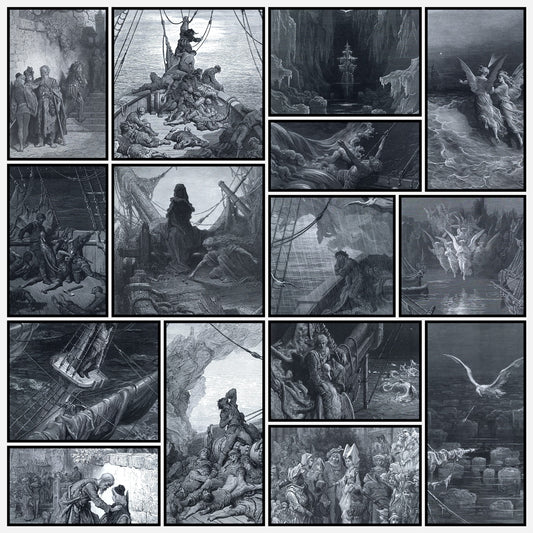
Rime of the Ancient Mariner, The 1878 - Gustave Doré (1832-1888) - 40 images
Vendor:Digital Download - 34 imagesRegular price £3.00Regular priceUnit price per -


Fairy Tales by Charles Perrault 1867 - Gustave Doré (1832-1888) - 34 images
Vendor:Digital Download - 34 imagesRegular price £3.00Regular priceUnit price per -

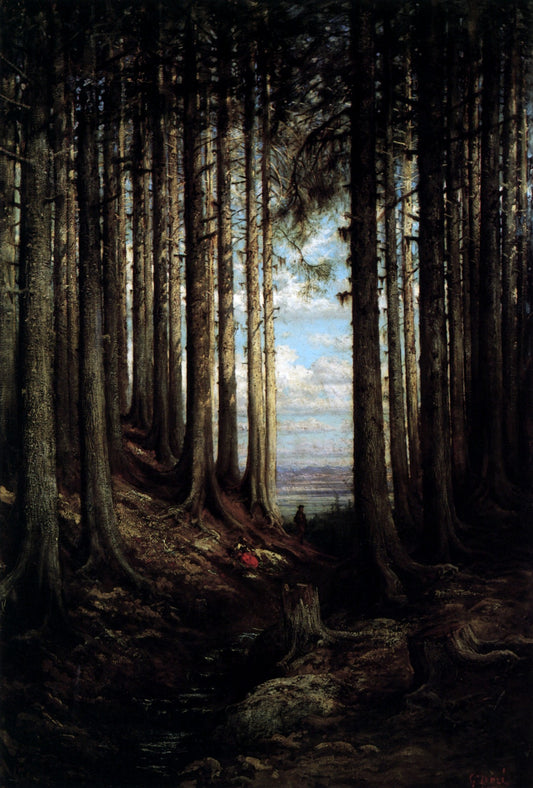
Doré, Gustave (1832-1888) - Forest or Alpine Scene 1865
Vendor:Digital Download - 1 imageRegular price £0.80Regular priceUnit price per -


Doré, Gustave (1832-1888) - The Exercise Yard at Newgate 1872
Vendor:Digital Download - 1 imageRegular price £0.80Regular priceUnit price per -

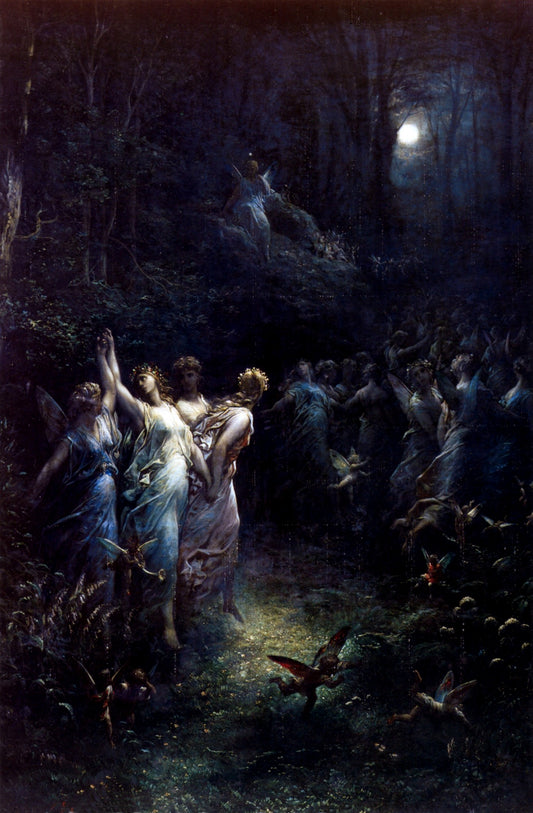
Doré, Gustave (1832-1888) - A Midsummer Night's Dream 1870
Vendor:Digital Download - 1 imageRegular price £0.80Regular priceUnit price per -

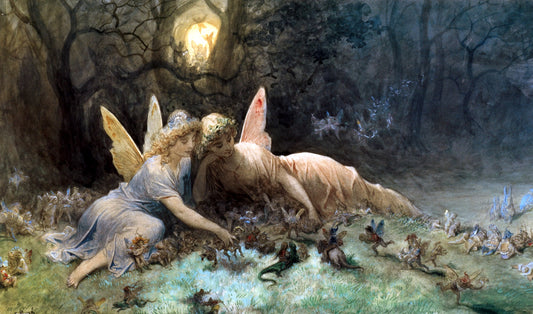
Doré, Gustave (1832-1888) - The Fairies, scene from Shakespeare 1873
Vendor:Digital Download - 1 imageRegular price £0.80Regular priceUnit price per


Latest Picture Trove Blog Posts
View all-

William Morris’s Strawberry Thief: The Story Behind a Classic Arts and Crafts Pattern
Few William Morris designs are as instantly recognisable as Strawberry Thief. With its richly patterned foliage, small red strawberries and watchful birds hidden among curling leaves, it has become one of the most loved designs of the Arts and Crafts movement.
William Morris’s Strawberry Thief: The Story Behind a Classic Arts and Crafts Pattern
Few William Morris designs are as instantly recognisable as Strawberry Thief. With its richly patterned foliage, small red strawberries and watchful birds hidden among curling leaves, it has become one of the most loved designs of the Arts and Crafts movement.
-

Glasgow and the Mackintosh Style
We recently took ourselves off to Scotland, and on our travels, we popped into the Mackintosh Tea Rooms in Glasgow for a bit of a nose around and a spot of lunch.
Glasgow and the Mackintosh Style
We recently took ourselves off to Scotland, and on our travels, we popped into the Mackintosh Tea Rooms in Glasgow for a bit of a nose around and a spot of lunch.
-

A Trip to Edinburgh & Glasgow, and Scottish Art
We have just returned from a well-deserved few days' break in Scotland, visiting both Edinburgh and Glasgow, taking in Scottish art and tea rooms!
A Trip to Edinburgh & Glasgow, and Scottish Art
We have just returned from a well-deserved few days' break in Scotland, visiting both Edinburgh and Glasgow, taking in Scottish art and tea rooms!


