

Marcellin Gilbert Desboutin (1823-1902) was a French painter, printmaker, and writer. Desboutin always signed himself Baron de Rochefort.
Desboutin was born in Cérilly, Allier on 26 August 1823. His parents were Barthélémy Desboutin, a bodyguard of Louis XVIII, and Baroness Anne-Sophie de Rochefort-Dalie Farges.
He studied at the Collège Stanislas de Paris and began studying law while writing dramatic works. In 1845, he joined the studio of sculptor Louis-Jules Etex at the École nationale supérieure des Beaux-Arts in Paris, and then he studied painting for two years under Thomas Couture. He then travelled in Britain, Belgium, the Netherlands and Italy. In 1857, he acquired a large property near Florence, the Ombrellino, where he led a lavish lifestyle and became friends with Edgar Degas.
The Franco-Prussian War of 1870-71 interrupted the performances at the Théâtre Français of Maurice de Saxe, a play he had written in collaboration with Jules Amigues. In 1873, at the age of 50, ruined by speculations, Desboutin moved to Paris, where he and Degas frequently met, often joined by Édouard Manet, at the Café Guerbois and the café Nouvelle Athènes. At Manet's home he met Émile Zola.
To make his living, he studied engraving and began a series of drypoint sketches while showing his paintings in exhibitions. He participated in the second exhibition of the Impressionists with six paintings, including Street Singer and The Cellist. He made many portraits of his friends including Edgar Degas, Auguste Renoir, Berthe Morisot, Pierre Puvis de Chavannes, Eugène Labiche, Nina de Villard, Erik Satie, Joséphin Péladan, Edmond and Jules de Goncourt.
In 1880, longing for the sun drove him to move to Nice, where he remained until 1888.
Back in Paris, he helped found the Second National Society of Fine Arts and celebrated his appointment in the order of the Legion of Honour on 8 June 1895 with two hundred guests presided over by Puvis de Chavannes, in one of his favorite restaurants of Montmartre, giving the toast, "Gentlemen, drink to Manet in painting, in Chabrier music, Villiers and Duranty in literature!"
He returned to Nice in 1896 and worked there until his death there in 1902.
As a writer, Desboutin, besides Maurice of Saxony, is the author of a translation of Byron's Don Juan and of a drama performed in the late 1880s, Madame Roland.
Desboutin himself posed for Manet, Renoir and Degas. He is depicted in Degas' famous 1876 painting L'Absinthe. Two of his sons, André Desboutin, known as Mycho (1870-1937) and Jean Desboutin, known as Tchiquine (1878-1951), were also artists, the latter a noted photographer. He frequently depicted them in his work.
Images to download
-

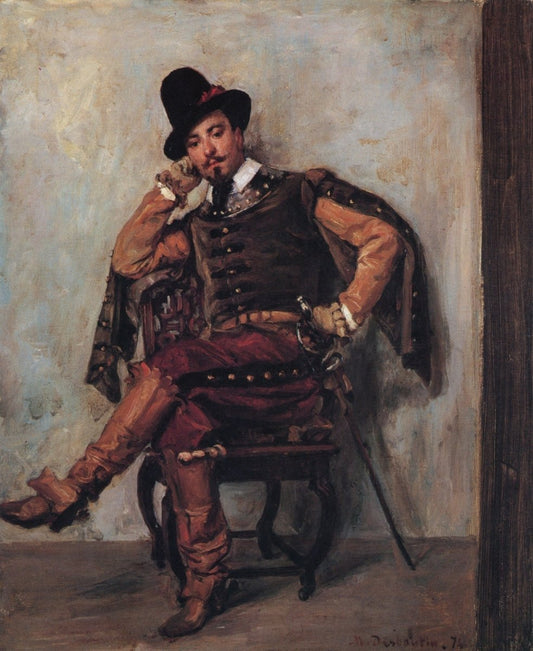
Desboutin, Marcellin (1823-1902) - Portrait of Jean-Baptiste Faure 1874
Vendor:Digital Download - 1 imageRegular price £0.80Regular priceUnit price per

Latest Picture Trove Blog Posts
View all-

William Morris’s Strawberry Thief: The Story Behind a Classic Arts and Crafts Pattern
Few William Morris designs are as instantly recognisable as Strawberry Thief. With its richly patterned foliage, small red strawberries and watchful birds hidden among curling leaves, it has become one of the most loved designs of the Arts and Crafts movement.
William Morris’s Strawberry Thief: The Story Behind a Classic Arts and Crafts Pattern
Few William Morris designs are as instantly recognisable as Strawberry Thief. With its richly patterned foliage, small red strawberries and watchful birds hidden among curling leaves, it has become one of the most loved designs of the Arts and Crafts movement.
-

Glasgow and the Mackintosh Style
We recently took ourselves off to Scotland, and on our travels, we popped into the Mackintosh Tea Rooms in Glasgow for a bit of a nose around and a spot of lunch.
Glasgow and the Mackintosh Style
We recently took ourselves off to Scotland, and on our travels, we popped into the Mackintosh Tea Rooms in Glasgow for a bit of a nose around and a spot of lunch.
-

A Trip to Edinburgh & Glasgow, and Scottish Art
We have just returned from a well-deserved few days' break in Scotland, visiting both Edinburgh and Glasgow, taking in Scottish art and tea rooms!
A Trip to Edinburgh & Glasgow, and Scottish Art
We have just returned from a well-deserved few days' break in Scotland, visiting both Edinburgh and Glasgow, taking in Scottish art and tea rooms!


