

David Dalby of York (1790-1840) was an English artist renowned for his evocative landscapes and skilled depictions of rural life. Working predominantly in the early nineteenth century, Dalby’s artistic career was closely tied to the city of York and the surrounding countryside, where he both lived and found much of his inspiration. His works are now appreciated for their distinctive character and their contribution to the development of regional landscape painting in Britain.
Dalby was born in 1790, and little is known about his early life or artistic training. What is clear, however, is that by the early 1810s he had established himself as a professional artist in York, a city that at the time was enjoying a growing reputation as a centre for the arts. Dalby’s career coincided with a period of increased interest in landscape painting and the picturesque, and his work reflects the influence of these wider artistic trends.
He is perhaps best known for his depictions of horses, hunts, and rural scenes, which display a keen observation of animal anatomy and movement. Like many artists of his generation, Dalby was influenced by the great sporting painters of the day, including George Stubbs and John Ferneley. However, Dalby’s works are distinguished by their particular attention to the Yorkshire landscape and the unique character of local life. His paintings often feature the rolling hills, lush pastures, and distinctive architecture of the region, rendered with a sensitivity that speaks to his deep familiarity with his subject matter.
Dalby exhibited his works locally and contributed to the cultural life of York, helping to foster a community of artists and collectors in the city. His paintings were sought after not only for their technical proficiency but also for their ability to capture the essence of rural Yorkshire at a time when the region was undergoing significant social and economic change. Dalby’s works are now held in various public and private collections, including the York Art Gallery, where they continue to be admired for their historical and artistic value.
David Dalby died in 1840, leaving behind a body of work that stands as a testament to his skill as a painter and his enduring connection to the landscapes and people of Yorkshire. Today, he is remembered as one of the leading regional artists of his era, whose art offers a window into the rural life of nineteenth-century England.
Images to download
-

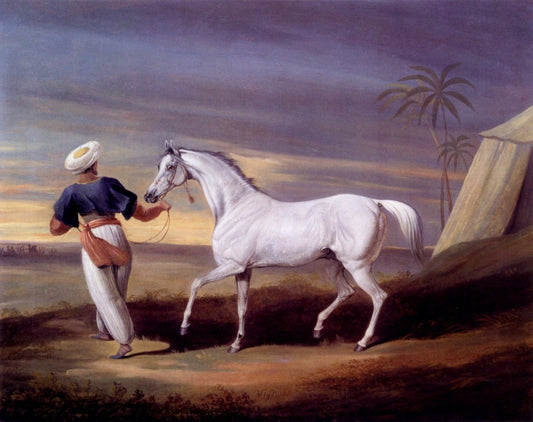
Dalby of York, David (1790-1840) - Signal, a Grey Arab with a Groom 1829
Vendor:Digital Download - 1 imageRegular price £0.80Regular priceUnit price per

Latest Picture Trove Blog Posts
View all-

William Morris’s Strawberry Thief: The Story Behind a Classic Arts and Crafts Pattern
Few William Morris designs are as instantly recognisable as Strawberry Thief. With its richly patterned foliage, small red strawberries and watchful birds hidden among curling leaves, it has become one of the most loved designs of the Arts and Crafts movement.
William Morris’s Strawberry Thief: The Story Behind a Classic Arts and Crafts Pattern
Few William Morris designs are as instantly recognisable as Strawberry Thief. With its richly patterned foliage, small red strawberries and watchful birds hidden among curling leaves, it has become one of the most loved designs of the Arts and Crafts movement.
-

Glasgow and the Mackintosh Style
We recently took ourselves off to Scotland, and on our travels, we popped into the Mackintosh Tea Rooms in Glasgow for a bit of a nose around and a spot of lunch.
Glasgow and the Mackintosh Style
We recently took ourselves off to Scotland, and on our travels, we popped into the Mackintosh Tea Rooms in Glasgow for a bit of a nose around and a spot of lunch.
-

A Trip to Edinburgh & Glasgow, and Scottish Art
We have just returned from a well-deserved few days' break in Scotland, visiting both Edinburgh and Glasgow, taking in Scottish art and tea rooms!
A Trip to Edinburgh & Glasgow, and Scottish Art
We have just returned from a well-deserved few days' break in Scotland, visiting both Edinburgh and Glasgow, taking in Scottish art and tea rooms!


