

Honoré Daumier (1808–1879) was a French artist renowned for his keen social and political commentary, primarily expressed through caricature, lithography, painting, and sculpture. Born in Marseille, Daumier moved to Paris as a child, where he developed an early interest in art. He began his career as a lithographer, contributing to satirical journals such as La Caricature and Le Charivari, which were crucial outlets for political dissent during the July Monarchy and subsequent regimes.
Daumier’s caricatures often targeted the political elite, including King Louis-Philippe, government officials, and the bourgeoisie. His sharp wit and bold visual language led to several run-ins with authorities. In 1832, he was imprisoned for six months after publishing a particularly unflattering depiction of the king, a testament to the power and influence of his work during a period of strict censorship.
Over his prolific career, Daumier produced more than 4,000 lithographs, 1,000 wood engravings, 500 paintings, and numerous sculptures. His lithographs, characterised by expressive linework and exaggerated features, provided biting satire and incisive social commentary. Through series such as “Les Gens de Justice”, Daumier lampooned lawyers and judges, exposing the foibles and hypocrisies of the legal profession. Other works, like “Les Bas-Bleus”, poked fun at the literary aspirations of middle-class women, while “Robert Macaire” satirised the archetype of the swindler.
In addition to his graphic work, Daumier was a gifted painter and sculptor. His paintings often depicted scenes of everyday life, such as railway travellers, laundresses, and street performers, reflecting the hardships and dignity of the working classes. These works, notable for their loose brushwork and sombre palette, influenced later artists, including the Impressionists. His sculptures, most notably the series of clay busts of politicians known as “Célébrités du Juste Milieu”, extended his satirical vision into three dimensions.
Despite his influence, Daumier struggled financially for much of his life and received limited recognition during his lifetime. Only in his later years did his work begin to gain appreciation from contemporaries such as Charles Baudelaire and Edgar Degas. Today, Daumier is celebrated as a master of visual satire and a forerunner of modern art, whose work provides invaluable insights into the politics, society, and culture of nineteenth-century France.
Images to download
-


Honoré-Victorin Daumier 64 High Resolution Images
Vendor:Digital Download - 64 imagesRegular price £4.00Regular priceUnit price per -

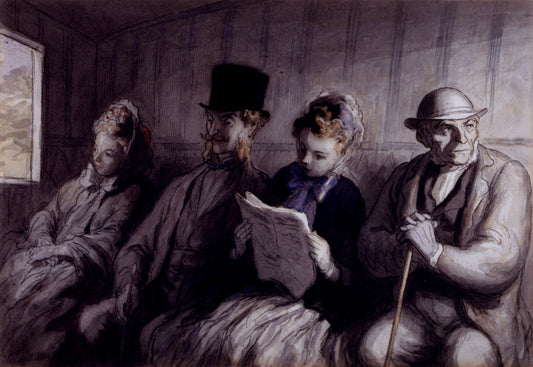
Daumier, Honoré-Victorin (1808-1879) - First-class Carriage 1864
Vendor:Digital Download - 1 imageRegular price £0.80Regular priceUnit price per -


Daumier, Honoré-Victorin (1808-1879) - Woman with a Child in her Arms c.1847 or 1870
Vendor:Digital Download - 1 imageRegular price £0.80Regular priceUnit price per -


Daumier, Honoré-Victorin (1808-1879) - The Third-class Railway Carriage 1862-64
Vendor:Digital Download - 1 imageRegular price £0.80Regular priceUnit price per -


Daumier, Honoré-Victorin (1808-1879) - The Print Collectors c.1860-64
Vendor:Digital Download - 1 imageRegular price £0.80Regular priceUnit price per -


Daumier, Honoré-Victorin (1808-1879) - The Print Collector (L'Amateur d'estampes) c.1857-63
Vendor:Digital Download - 1 imageRegular price £0.80Regular priceUnit price per -


Daumier, Honoré-Victorin (1808-1879) - The Connoisseur c.1860-65
Vendor:Digital Download - 1 imageRegular price £0.80Regular priceUnit price per -


Daumier, Honoré-Victorin (1808-1879) - The Bathers (Les Baigneurs) c.1865-68
Vendor:Digital Download - 1 imageRegular price £0.80Regular priceUnit price per -


Daumier, Honoré-Victorin (1808-1879) - Old Man with Frightened Expression c.1848-52
Vendor:Digital Download - 1 imageRegular price £0.80Regular priceUnit price per -


Daumier, Honoré-Victorin (1808-1879) - In the Street (Dans la Rue)
Vendor:Digital Download - 1 imageRegular price £0.80Regular priceUnit price per -


Daumier, Honoré-Victorin (1808-1879) - Don Quixote and Sancho Panza c.1866-68
Vendor:Digital Download - 1 imageRegular price £0.80Regular priceUnit price per -


Daumier, Honoré-Victorin (1808-1879) - Clown Playing a Drum c.1865-67
Vendor:Digital Download - 1 imageRegular price £0.80Regular priceUnit price per -


Daumier, Honoré-Victorin (1808-1879) - A Third Class Carriage c.1865
Vendor:Digital Download - 1 imageRegular price £0.80Regular priceUnit price per -


Daumier, Honoré-Victorin (1808-1879) - Medaille d'Argent 1878
Vendor:Digital Download - 1 imageRegular price £0.80Regular priceUnit price per -


Daumier, Honoré-Victorin (1808-1879) - The Print Collector c.1860
Vendor:Digital Download - 2 imagesRegular price £0.80Regular priceUnit price per -


Daumier, Honoré-Victorin (1808-1879) - The Connoisseurs 1860s
Vendor:Digital Download - 1 imageRegular price £0.80Regular priceUnit price per -


Daumier, Honoré-Victorin (1808-1879) - Pierrot playing a mandoline or guitar c1870-73
Vendor:Digital Download - 1 imageRegular price £0.80Regular priceUnit price per -


Daumier, Honoré-Victorin (1808-1879) - Crispin & Scapin 1860s
Vendor:Digital Download - 1 imageRegular price £0.80Regular priceUnit price per


Latest Picture Trove Blog Posts
View all-

William Morris’s Strawberry Thief: The Story Behind a Classic Arts and Crafts Pattern
Few William Morris designs are as instantly recognisable as Strawberry Thief. With its richly patterned foliage, small red strawberries and watchful birds hidden among curling leaves, it has become one of the most loved designs of the Arts and Crafts movement.
William Morris’s Strawberry Thief: The Story Behind a Classic Arts and Crafts Pattern
Few William Morris designs are as instantly recognisable as Strawberry Thief. With its richly patterned foliage, small red strawberries and watchful birds hidden among curling leaves, it has become one of the most loved designs of the Arts and Crafts movement.
-

Glasgow and the Mackintosh Style
We recently took ourselves off to Scotland, and on our travels, we popped into the Mackintosh Tea Rooms in Glasgow for a bit of a nose around and a spot of lunch.
Glasgow and the Mackintosh Style
We recently took ourselves off to Scotland, and on our travels, we popped into the Mackintosh Tea Rooms in Glasgow for a bit of a nose around and a spot of lunch.
-

A Trip to Edinburgh & Glasgow, and Scottish Art
We have just returned from a well-deserved few days' break in Scotland, visiting both Edinburgh and Glasgow, taking in Scottish art and tea rooms!
A Trip to Edinburgh & Glasgow, and Scottish Art
We have just returned from a well-deserved few days' break in Scotland, visiting both Edinburgh and Glasgow, taking in Scottish art and tea rooms!


