

Carlo Crivelli (c.1430-c.1495) was an Italian Renaissance painter known for his distinctive, highly decorative style and his devotion to religious themes. Born around 1430 in Venice, Crivelli was a contemporary of artists such as Andrea Mantegna and Giovanni Bellini, yet his work stands apart for its elaborate detail and use of luxurious materials. Although not as widely recognised as some of his peers, Crivelli’s paintings have gained increased appreciation for their unique qualities and enduring beauty.
Crivelli was likely trained in the Venetian tradition, but his career flourished primarily in the Marches, a region in central Italy. His early works show the influence of the Vivarini family, prominent Venetian painters, and also reflect the impact of early Netherlandish art, particularly in his careful attention to detail and surface texture. Crivelli’s paintings are instantly recognisable for their brilliant colours, gilded backgrounds, and the extensive use of punchwork and pastiglia (raised gilded plaster), creating a sumptuous, almost jewel-like effect.
The majority of Crivelli’s surviving works are altarpieces and devotional panels, created for churches and private patrons. These works often feature saints, Madonnas, and scenes from the life of Christ, rendered with an intense emotional expressiveness. Crivelli’s figures are elongated and elegantly posed, and his compositions are marked by a sense of order and clarity. Yet, what truly sets Crivelli apart is the opulence of his paintings: he frequently adorned his works with gold leaf, imitation gemstones, and intricate patterns, giving his religious subjects a transcendent, otherworldly quality.
Despite his adherence to certain Gothic traditions, such as the use of gold backgrounds, Crivelli was also innovative. He demonstrated a keen interest in spatial illusion, often incorporating trompe-l’œil effects, such as painted cracks in marble or illusionistic curtains and fruits that seem to project out of the picture plane. These details not only showcase his technical prowess but also engage the viewer, blurring the boundaries between the sacred and the everyday.
Crivelli’s career was not without its challenges. In 1457, he was imprisoned in Venice for adultery, a scandal that may have prompted his move to the Marches. There, he found a receptive audience for his art, securing important commissions in the towns of Ascoli Piceno and Camerino. Among his masterpieces are the “Annunciation with Saint Emidius” (1486), now in the National Gallery, London, and the “Madonna della Candeletta” (c.1490), both celebrated for their intricate detail and spiritual intensity.
Carlo Crivelli died around 1495, leaving behind a legacy as one of the most distinctive voices of the Italian Renaissance. Though his art was later eclipsed by the rise of a more classical style, modern scholars and viewers have come to value his sumptuous technique and visionary imagination. Today, Crivelli’s paintings are admired not only for their devotional power but also for their extraordinary craftsmanship and decorative splendour, securing his place as a singular figure in the history of Renaissance art.
Images to download
-

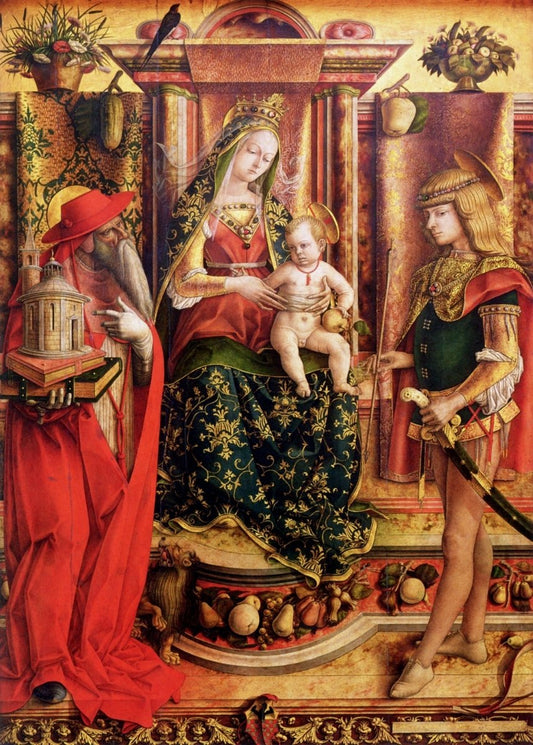
Crivelli, Carlo (c1435-1495) - The Madonna of the Swallow c.1490
Vendor:Digital Download - 1 imageRegular price £0.80Regular priceUnit price per -

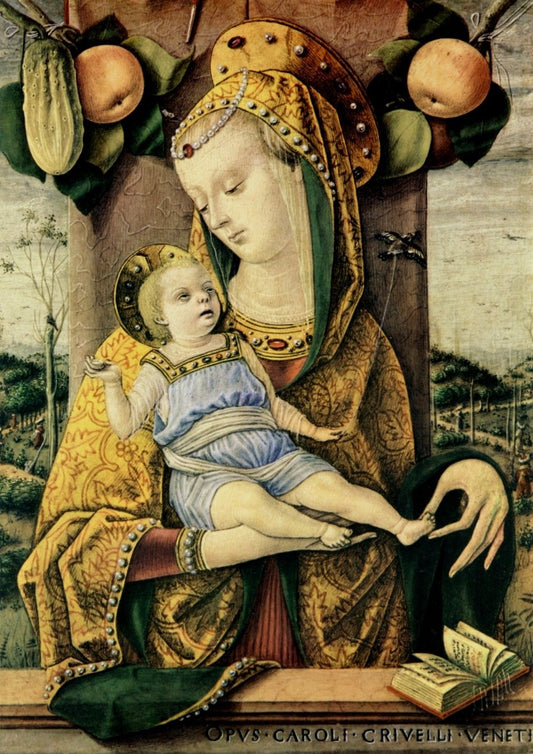
Crivelli, Carlo (c1435-1495) - Virgin and Child
Vendor:Digital Download - 1 imageRegular price £0.80Regular priceUnit price per -

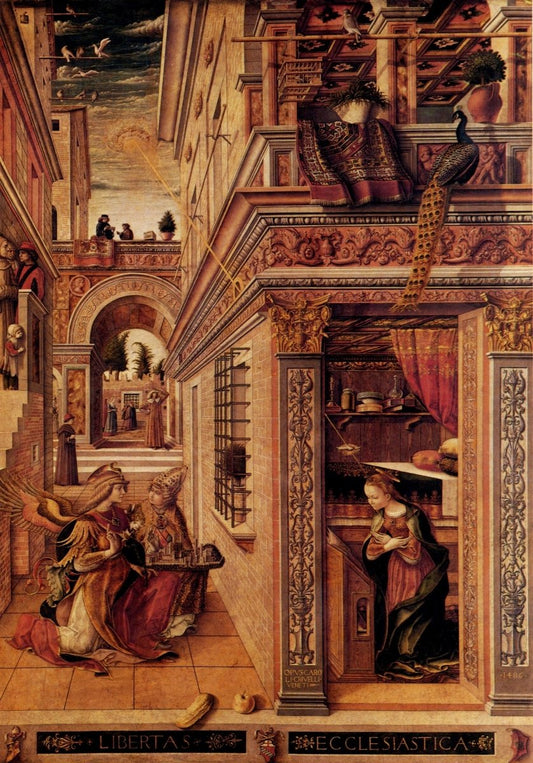
Crivelli, Carlo (c1430-1495) - The Annunciation with St. Emidius 1486
Vendor:Digital Download - 1 imageRegular price £0.80Regular priceUnit price per


Latest Picture Trove Blog Posts
View all-

William Morris’s Strawberry Thief: The Story Behind a Classic Arts and Crafts Pattern
Few William Morris designs are as instantly recognisable as Strawberry Thief. With its richly patterned foliage, small red strawberries and watchful birds hidden among curling leaves, it has become one of the most loved designs of the Arts and Crafts movement.
William Morris’s Strawberry Thief: The Story Behind a Classic Arts and Crafts Pattern
Few William Morris designs are as instantly recognisable as Strawberry Thief. With its richly patterned foliage, small red strawberries and watchful birds hidden among curling leaves, it has become one of the most loved designs of the Arts and Crafts movement.
-

Glasgow and the Mackintosh Style
We recently took ourselves off to Scotland, and on our travels, we popped into the Mackintosh Tea Rooms in Glasgow for a bit of a nose around and a spot of lunch.
Glasgow and the Mackintosh Style
We recently took ourselves off to Scotland, and on our travels, we popped into the Mackintosh Tea Rooms in Glasgow for a bit of a nose around and a spot of lunch.
-

A Trip to Edinburgh & Glasgow, and Scottish Art
We have just returned from a well-deserved few days' break in Scotland, visiting both Edinburgh and Glasgow, taking in Scottish art and tea rooms!
A Trip to Edinburgh & Glasgow, and Scottish Art
We have just returned from a well-deserved few days' break in Scotland, visiting both Edinburgh and Glasgow, taking in Scottish art and tea rooms!


