

David Cox (1783-1859) stands as one of the most significant figures in the history of British landscape painting, particularly renowned for his mastery of watercolour. Born in Birmingham, Cox’s upbringing in the Midlands profoundly influenced his artistic vision. Unlike many of his contemporaries who trained in London, Cox’s early exposure to the industrial yet picturesque surroundings of Birmingham offered a unique perspective, blending the pastoral with the modern.
Cox began his career as a scene painter for the theatre but soon transitioned to landscape painting, a genre that would become his lifelong passion. By the early nineteenth century, watercolour painting was gaining popularity in Britain, and Cox quickly established himself as a leading proponent of the medium. His works were celebrated for their freshness, spontaneity, and atmospheric effects, qualities that set him apart from more conventional artists of the time.
Cox’s technique was innovative. He often worked outdoors, directly observing nature, which was relatively uncommon in the early nineteenth century. This practice enabled him to capture fleeting effects of light and weather, imbuing his landscapes with a sense of immediacy and movement. His brushwork was bold and expressive; he used broad washes of colour, often allowing pigments to blend naturally on the page. This approach anticipated the looser, more expressive techniques that would later be associated with Impressionism.
Throughout his career, Cox maintained strong links with the Birmingham art community, returning to the city later in life to teach and mentor younger artists. His influence was substantial, not just through his own work but through his role as a teacher. Cox’s pupils included several artists who would themselves become prominent figures in British art, ensuring that his impact endured beyond his own lifetime.
Cox’s subject matter was diverse, although he is best known for his depictions of the British countryside, windswept moors, tranquil fields, and dramatic skies. He travelled widely across Britain, especially in Wales, whose rugged landscapes provided endless inspiration. His Welsh scenes, in particular, are celebrated for their dynamic compositions and evocative atmospheres.
Despite his considerable talent, Cox’s work was sometimes undervalued during his lifetime, particularly in comparison to contemporaries such as J.M.W. Turner and John Constable. However, later generations have recognised the significance of his contribution to British art. Today, his paintings are held in major collections, including the Tate and the Birmingham Museum and Art Gallery, and are admired for their technical brilliance.
Images to download
-

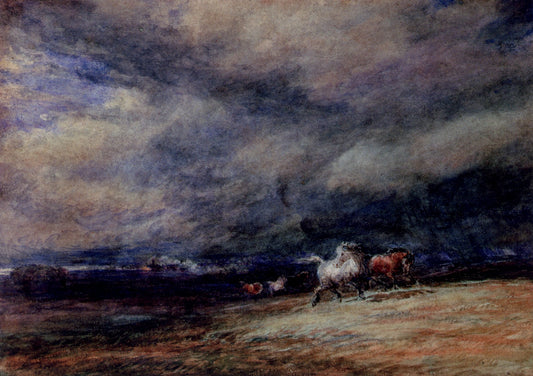
Cox, David (1783-1859) - The Night Train 1849
Vendor:Digital Download - 1 imageRegular price £0.80Regular priceUnit price per -


Cox, David (1783-1859) - The Challenge 1856
Vendor:Digital Download - 1 imageRegular price £0.80Regular priceUnit price per -


Cox, David (1783-1859) - The Mill (with Rainbow) 1853
Vendor:Digital Download - 1 imageRegular price £0.80Regular priceUnit price per -


Cox, David (1783-1859) - Rhyl Sands, Wales c.1854
Vendor:Digital Download - 1 imageRegular price £0.80Regular priceUnit price per -


Cox, David (1783-1859) - A Welsh Funeral, Bettws-y-Coed c.1845-50
Vendor:Digital Download - 1 imageRegular price £0.80Regular priceUnit price per -


Cox, David (1783-1859) - Figures and Cattle in a Wooded Landscape
Vendor:Digital Download - 1 imageRegular price £0.80Regular priceUnit price per -


Cox, David (1783-1859) - The Skirts of the Forest
Vendor:Digital Download - 1 imageRegular price £0.80Regular priceUnit price per -


Cox, David (1783-1859) - Pembroke Castle, Wales c.1810
Vendor:Digital Download - 1 imageRegular price £0.80Regular priceUnit price per -


Cox, David (1783-1859) - Harlech Castle, Wales
Vendor:Digital Download - 1 imageRegular price £0.80Regular priceUnit price per


Latest Picture Trove Blog Posts
View all-

William Morris’s Strawberry Thief: The Story Behind a Classic Arts and Crafts Pattern
Few William Morris designs are as instantly recognisable as Strawberry Thief. With its richly patterned foliage, small red strawberries and watchful birds hidden among curling leaves, it has become one of the most loved designs of the Arts and Crafts movement.
William Morris’s Strawberry Thief: The Story Behind a Classic Arts and Crafts Pattern
Few William Morris designs are as instantly recognisable as Strawberry Thief. With its richly patterned foliage, small red strawberries and watchful birds hidden among curling leaves, it has become one of the most loved designs of the Arts and Crafts movement.
-

Glasgow and the Mackintosh Style
We recently took ourselves off to Scotland, and on our travels, we popped into the Mackintosh Tea Rooms in Glasgow for a bit of a nose around and a spot of lunch.
Glasgow and the Mackintosh Style
We recently took ourselves off to Scotland, and on our travels, we popped into the Mackintosh Tea Rooms in Glasgow for a bit of a nose around and a spot of lunch.
-

A Trip to Edinburgh & Glasgow, and Scottish Art
We have just returned from a well-deserved few days' break in Scotland, visiting both Edinburgh and Glasgow, taking in Scottish art and tea rooms!
A Trip to Edinburgh & Glasgow, and Scottish Art
We have just returned from a well-deserved few days' break in Scotland, visiting both Edinburgh and Glasgow, taking in Scottish art and tea rooms!


