

Carlo Cignani (1628-1719) was an Italian painter. His innovative style referred to as his 'new manner', introduced a reflective, intimate mood of painting and presaged the later pictures of Guido Reni and Guercino, as well as those of Simone Cantarini. This gentle manner marked a break with the more energetic style of earlier Bolognese classicism of the Bolognese School of painting.
He was born to a family of noble ancestry, but limited resources, in Bologna. His father's first name was Pompeo, and his mother, Maddalena Quaini.
In Bologna, he studied first under Battista Cairo and later under Francesco Albani, to whom he remained closely allied, and was his most famous disciple. His first noted commission was a St Paul exorcising a demon for the church of the Gesu in Bologna. For a hall dedicated to the Farnese in the Palazzo Publico, he painted with Taruffi, depicting the Francis, king of France, curing Scrofula on his entry to Bologna and the Entry of Paul III Farnese to Bologna.
He was also strongly influenced by the genius of Correggio and by the masterworks by Melozzo da Forlì. For instance, his masterpiece, the Assumption of the Virgin, around the cupola of the church of the Madonna del Fuoco at Forlì, is inspired by Correggio's frescoes in the cupola of the Cathedral of Parma and by Melozzo's perspective from down to up. These frescoes occupied Cignani for some twenty years.
In 1681 Cignani returned to Bologna from Parma. He opened an Accademia del nudo for painting from models and had as one of his pupils Giuseppe Maria Crespi.
His elaborate finish and his audacious artificiality in the use of colour and in composition mark Albani's influence. Despite that, he imparted to his work more of an intellectual character than his mentors. As a man Cignani was eminently amiable, unassuming and generous.
He accepted no honors offered him by the duke of Parma, but lived and died an artist. In 1686 he moved to Forlì, where he died.
His son Felice Cignani (1660-1724) and nephew Paolo Cignani (1709-1764) were also painters. His most noted pupils were Marcantonio Franceschini and Federico Bencovich. Other pupils include Giacomo Boni, Andrea and Francesco Bondi; Giovanni Girolamo Bonesi; Girolamo Domini; Pietro Donzelli; Francesco Galli; Bonaventura Lamberti; Giovanni Battista Loreti; Matteo Zamboni; Camilla Lauteri; Stefano Maria Legnani; Giovanni Battista Loreti; Charles Lucy (1692 - after 1767), Francesco Mancini; Paolo Antonio Paderna., and Sante Vandi.
Images to download
-

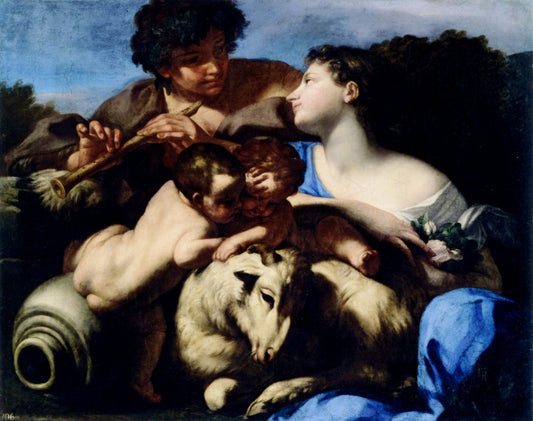
Cignani, Carlo (1628-1719) - Shepherd & Shepherdess 1660s-70s
Vendor:Digital Download - 1 imageRegular price £0.80Regular priceUnit price per

Latest Picture Trove Blog Posts
View all-

William Morris’s Strawberry Thief: The Story Behind a Classic Arts and Crafts Pattern
Few William Morris designs are as instantly recognisable as Strawberry Thief. With its richly patterned foliage, small red strawberries and watchful birds hidden among curling leaves, it has become one of the most loved designs of the Arts and Crafts movement.
William Morris’s Strawberry Thief: The Story Behind a Classic Arts and Crafts Pattern
Few William Morris designs are as instantly recognisable as Strawberry Thief. With its richly patterned foliage, small red strawberries and watchful birds hidden among curling leaves, it has become one of the most loved designs of the Arts and Crafts movement.
-

Glasgow and the Mackintosh Style
We recently took ourselves off to Scotland, and on our travels, we popped into the Mackintosh Tea Rooms in Glasgow for a bit of a nose around and a spot of lunch.
Glasgow and the Mackintosh Style
We recently took ourselves off to Scotland, and on our travels, we popped into the Mackintosh Tea Rooms in Glasgow for a bit of a nose around and a spot of lunch.
-

A Trip to Edinburgh & Glasgow, and Scottish Art
We have just returned from a well-deserved few days' break in Scotland, visiting both Edinburgh and Glasgow, taking in Scottish art and tea rooms!
A Trip to Edinburgh & Glasgow, and Scottish Art
We have just returned from a well-deserved few days' break in Scotland, visiting both Edinburgh and Glasgow, taking in Scottish art and tea rooms!


